Campbell’s Cuts Dividend 36% and Launches $500 Million Cost-Savings Push
Campbell’s is resetting its quarterly payout to $0.25 a share and targeting $500 million in savings by fiscal 2030 after a year of weaker sales and margins.
Our editorial standards
MarketReview publishes clear, independently produced financial information using reliable sources and transparent editorial standards.
Read our Editorial Policy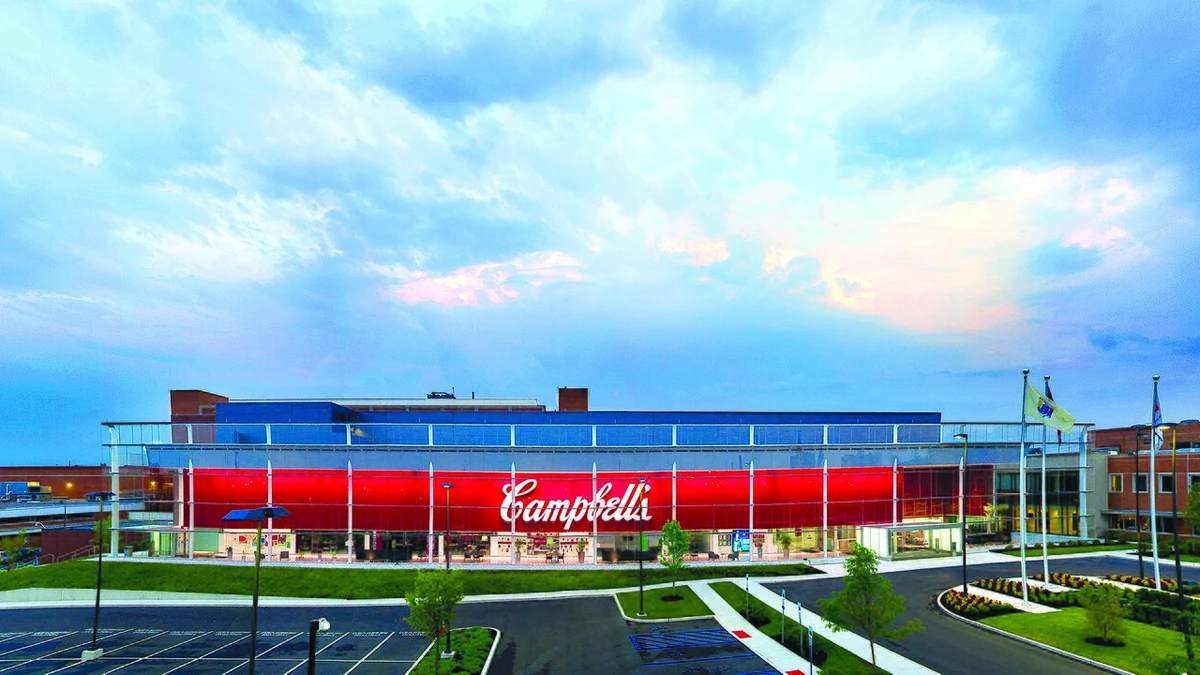
Campbell’s is cutting its quarterly dividend by 36% and launching a new $500 million cost-savings program as the food company moves to reduce debt and respond to weaker sales and margin pressure. The board approved a quarterly dividend of $0.25 a share, down from $0.39, taking the annualized payout to $1.00 from $1.56.
The reset came alongside Campbell’s fiscal fourth-quarter and full-year 2026 results, which showed lower sales and adjusted profit. For the year ended Aug. 2, net sales fell 5% to $9.744 billion, while organic net sales declined 2%. Adjusted EBIT dropped 21% to $1.181 billion and adjusted earnings per share fell 27% to $2.17.
Campbell’s also set a tougher fiscal 2027 outlook. Management expects reported and organic net sales to decline 4% to 2%, adjusted EBIT to fall 12% to 7%, and adjusted earnings per share of $1.65 to $1.80. The company said its assumptions reflect a volatile external environment and another year of elevated inflation.
Dividend reset puts debt reduction ahead of the prior payout
Campbell’s said in its September 3 earnings release that the lower dividend is intended to accelerate the reduction of debt on its balance sheet. The $0.25 quarterly payment is payable Nov. 2 to shareholders of record at the close of business Oct. 1. The board’s action represents a direct change to the cash return shareholders had been receiving rather than a temporary suspension.
The decision follows a fiscal year in which cash generation remained substantial but declined from the prior period. Cash flow from operations was $1.0 billion in fiscal 2026, compared with $1.1 billion a year earlier. Capital expenditures fell to $361 million from $426 million, while Campbell’s returned $496 million to shareholders, primarily through cash dividends.
Operating results also weakened. Full-year EBIT declined to $852 million from $1.124 billion, and net earnings attributable to Campbell’s fell to $403 million from $602 million. On a diluted basis, reported earnings per share were $1.31, down from $2.01. The adjusted figures excluded costs and gains that management does not consider representative of ongoing operations, including restructuring-related items and impairment charges.
The fourth quarter showed the same pressure more sharply. Net sales declined 8% to $2.137 billion, although organic sales were down only 1% because the year-ago period contained an extra week. Adjusted EBIT fell 25% to $242 million and adjusted earnings per share dropped 37% to $0.39. Adjusted gross margin narrowed 190 basis points to 28.6%, with Campbell’s citing cost inflation and other supply-chain costs, including tariffs, partly offset by productivity improvements.
$500 million savings program starts in fiscal 2027
Cost reduction is now becoming a larger part of Campbell’s response. The company said it generated about $25 million of savings in the fourth quarter, bringing cumulative savings under its prior $375 million program to roughly $225 million. Beginning in fiscal 2027, Campbell’s will replace that framework with a broader enterprise-wide program targeting $500 million of total savings by fiscal 2030.
The new target is not an additional $500 million layered entirely on top of the old plan. Campbell’s said it will include initiatives that remain under the prior program, an overhead-savings initiative announced during the third quarter of fiscal 2026, and a new enterprise spending optimization plan covering how the company manages direct and indirect spending. That distinction is important when comparing the new target with the $225 million already achieved.
Several measures are already under way. Campbell’s said plant closures and recently completed workforce reductions are among the actions being implemented. The program is intended to protect margins and create room for higher investment levels, which puts the savings effort at the center of both cost control and the company’s plans for its brands.
Fiscal 2026 illustrates why management is emphasizing that work. Adjusted EBIT fell faster than sales, with inflation and supply-chain costs weighing on profitability. Campbell’s also recorded $202 million of costs associated with cost-saving and optimization initiatives during the year, compared with $125 million in fiscal 2025. Those expenses are separate from the savings target itself and were among the items excluded from adjusted results.
Snacks weakness weighs on the fiscal 2027 starting point
The performance gap between Campbell’s two divisions was especially visible in the fourth quarter. Meals & Beverages generated $1.187 billion of sales, down 4% on a reported basis, while organic sales rose 3%. Campbell’s said that organic increase included an estimated two-point benefit related to the prior-year SAP enterprise-resource planning implementation at Sovos Brands. U.S. soup sales were down 8%, primarily because the comparison included the extra week in the prior year.
Snacks was weaker. Fourth-quarter sales fell 12% to $950 million and organic sales declined 6%, driven mainly by lower volume and mix. Segment operating earnings dropped 34% to $101 million. Campbell’s said the organic sales decline reflected weakness in its salty-snacks portfolio as well as sales tied to third-party partner brands and contract manufacturing.
For the full fiscal year, Meals & Beverages sales fell 4% to $5.928 billion and Snacks sales declined 6% to $3.816 billion. Operating earnings fell 14% in Meals & Beverages and 28% in Snacks. Campbell’s also recognized a combined $117 million impairment in the fourth quarter on the Cape Cod and Kettle Brand trademarks, consisting of $60 million for Kettle Brand and $57 million for Cape Cod.
The fiscal 2027 guidance indicates that management does not expect the cost program to eliminate the near-term earnings pressure. Campbell’s is forecasting adjusted EBIT to decline 12% to 7% and adjusted EPS of $1.65 to $1.80 even as it begins the broader savings effort. The recently completed La Regina acquisition is expected to provide a modest benefit to sales but to be neutral to adjusted EPS.
Management said the outlook incorporates its current understanding of government policy and tariffs and does not assume new tariffs or changes to existing tariff rates. That leaves the dividend reset and cost program as two of the clearest actions Campbell’s has already taken as fiscal 2027 begins: one redirects cash toward debt reduction, while the other is intended to lower the company’s cost base over the next four fiscal years.
More from Investing



Latest News
View all news- U.S. Median Weekly Pay Rises 1.5%, Trailing 3.5% Consumer Inflation
- U.S. Mortgage Applications Drop 5.3% Even as 30-Year Rate Falls to 7.41%
- U.S. Energy Department Offers Up to 315,000 Barrels From Heating Oil Reserve
- U.S. Crude Inventories Fall 3.1 Million Barrels in Latest EIA Report
- OCC Issues Final Rule to Implement GENIUS Act Stablecoin Regulations