

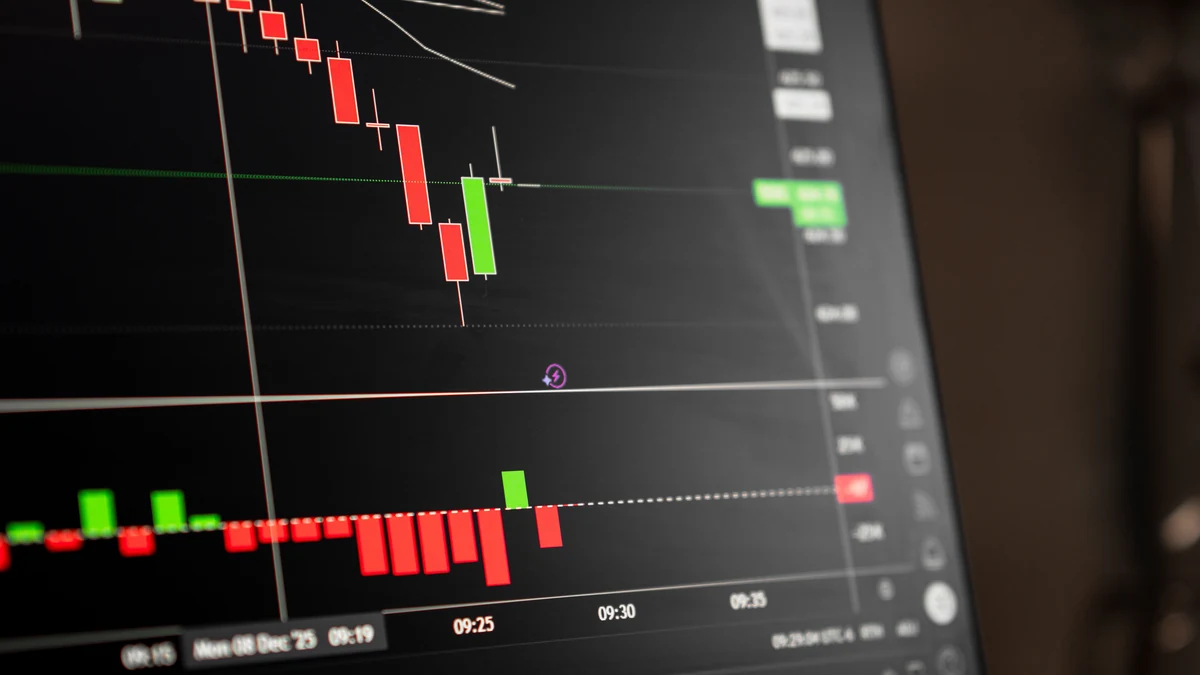
CFDs sit in a part of the market that can look simpler than it is. A trader chooses an underlying market, goes long or short, posts only a fraction of the position value as margin, and settles the resulting gain or loss in cash. The trade never requires ownership of the underlying share, index, commodity, currency pair or other reference asset, which makes CFDs flexible instruments for short-term financial trading but also changes the risks that matter.
The central issue is leverage. A relatively small deposit can create exposure to a much larger notional position, so an ordinary move in the underlying market can produce a much larger percentage gain or loss on the cash committed to the trade. Costs, forced position closures and the financial strength and execution practices of the CFD provider also matter, because a CFD is a contract with the provider rather than an exchange-traded ownership interest.
What a contract for difference actually gives you
A contract for difference, or CFD, is a derivative whose value is linked to the movement of another market. The underlying reference might be a share, stock index, commodity, currency pair or another financial instrument. The trader and the CFD provider agree to exchange the difference between the opening value and closing value of the position, adjusted for the size of the trade and any applicable costs. The trader does not acquire legal ownership of the underlying asset or the rights that normally come with ownership.
That distinction is more important than the name suggests. If you buy shares directly, you own the shares and your return comes from what happens to that ownership position, including price changes and, where applicable, dividends or other shareholder rights. A CFD instead creates a contractual economic exposure to price movement. Its quote is normally related to the underlying market, but the contract terms, execution method, financing charges and corporate-action adjustments are set by the provider.
CFDs therefore belong in the broader derivatives market rather than in the same category as direct investing. They are generally used to take directional positions, including short positions, without first borrowing the underlying asset. They can also provide access to markets that might otherwise require separate brokerage arrangements, although ease of access should not be confused with low risk. Official investor guidance from Australia’s Moneysmart describes CFDs as leveraged derivatives, notes that the investor does not own the underlying asset, and highlights commissions, spreads, overnight financing, margin calls, slippage and counterparty risk as material features of the product.[1]
How CFD profit and loss are calculated
The basic arithmetic is straightforward: the change in the underlying price is multiplied by the size of the position. If a trader buys 1,000 CFDs linked one-for-one to a share at $20 and closes the position at $21, the gross price gain is $1,000 before costs. If the price falls to $19 instead, the gross price loss is $1,000. A short CFD reverses the direction of the trade, so a fall in the reference price produces a gain and a rise produces a loss.
The percentage return on the trader’s deposited cash can be much larger because the full notional value of the position is not normally paid upfront. Suppose the same 1,000-share-equivalent position has a notional value of $20,000 and requires a 10% initial margin. The trader posts $2,000 rather than $20,000. A 5% move in the underlying asset changes the position value by $1,000, which is half of the initial $2,000 margin before trading costs. The underlying asset moved only 5%, but the effect on the cash committed to the position was 50%.
This is why it is misleading to describe margin as a way to make an expensive trade affordable. Margin changes the amount of capital required to establish exposure, but it does not shrink the economic size of the exposure itself. Position sizing should therefore start with the amount that can be lost at a plausible adverse price move, not with the maximum position a broker’s margin requirement happens to permit.
Margin, close-outs and available equity
Initial margin gets the position open, but the account must continue to satisfy the provider’s maintenance and close-out requirements. As losses reduce account equity, the available cushion above required margin narrows. Depending on the jurisdiction and the provider’s rules, the trader may be asked to add funds, reduce positions or have positions closed automatically when account equity falls to a prescribed level.
Forced closure is a risk-management mechanism, not a guaranteed exit price. Fast markets can gap through quoted levels, and an order intended to close a position at one price can be executed at another. Retail negative-balance protection in some regulated jurisdictions limits the amount a client can ultimately owe on a CFD account, but it does not prevent the account balance from being depleted by trading losses. It also should not be assumed to apply to every customer, provider or jurisdiction.
The costs are broader than the headline spread
CFD advertisements often emphasize tight spreads or commission-free dealing, but the total cost of a position can include several components. The bid-ask spread creates an immediate hurdle because a position is opened on one side of the market and closed on the other. Some providers charge a separate commission, particularly on share CFDs, while others earn more of their revenue through the spread.
Positions carried overnight may incur financing charges based on the notional exposure rather than the small amount of margin posted. That matters because financing can become meaningful when a leveraged position is held for days or weeks. A trade that is slightly profitable on price movement can still lose money after repeated overnight charges, and a losing trade becomes more expensive to carry while the trader waits for the market to reverse.
Other costs depend on the provider and product. Currency conversion can matter when the CFD is denominated in a currency different from the account currency, and providers may make cash adjustments for dividends or other corporate actions according to their contract terms. The practical comparison between brokers therefore requires more than checking the visible spread. The relevant question is the total expected cost for the instrument, position size and holding period you actually intend to use.
Leverage changes the risk before it changes the return
Leverage is the defining feature of most retail CFD trading because it magnifies exposure relative to deposited capital. It is sometimes presented as a benefit because it allows a trader to control a larger position with less cash, but that description leaves out the most important consequence: the trade reaches an unacceptable loss with a smaller move in the underlying market.
A trader using 5:1 leverage has a very different loss profile from one using 20:1 leverage even if both correctly predict the market’s direction over a longer period. The highly leveraged position has less room to survive ordinary price noise, a temporary reversal or a gap. It may be closed before the anticipated move develops, and adding more capital after a loss can turn a planned trade into an open-ended attempt to avoid realizing it.
Higher leverage also makes trading costs larger relative to the cash committed. A spread that looks small compared with the notional position can represent a meaningful percentage of the margin deposit. Frequent dealing compounds this effect because each new entry and exit starts with another spread or commission hurdle. For this reason, the attractiveness of a small minimum deposit should be evaluated alongside the effective position size it enables rather than treated as evidence that the product is suitable for a small account.
Risk control in Contracts for Difference trading therefore begins with exposure, not with the broker’s maximum leverage. The account size, stop distance, expected volatility, potential slippage and loss that would be tolerable if the stop executes badly all belong in the position-sizing decision. Leverage is useful only when it is subordinated to that decision; using the maximum available leverage because it is available reverses the process.
Market risk is only one part of CFD risk
A correct view on the underlying market does not guarantee the expected result. Because the provider is the contractual counterparty, the trader is also exposed to the provider’s pricing, order execution, technology and financial resilience. Regulation can constrain these risks, but it does not make them disappear.
Price formation deserves particular attention. A CFD provider may base quotes on an underlying exchange or another reference market, but the provider’s terms determine how the CFD itself is priced and executed. During volatile periods, the underlying market can move faster than the trading interface updates. Slippage can then cause a market order or stop order to execute away from the displayed level, while gaps can leave no tradable prices between the level before the move and the level after it.
The quality of stock market information and other reference-market data still matters even though the trader does not own the underlying instrument. A CFD price should have an intelligible relationship to the market it references, and unusual differences between the two require explanation. Traders should understand whether the provider acts as principal, how prices are derived, whether client orders are hedged externally, and how the firm handles outages, rejected orders and disputed fills.
Counterparty risk is more basic. If a provider fails, the status of client money, the insolvency process and any compensation arrangements depend on the legal entity and jurisdiction involved. A familiar brand name is not enough because a group can operate through multiple regulated entities in different countries. The entity named in the client agreement is the one that matters.
CFDs compared with shares, futures and forex
CFDs can provide economic exposure that resembles other instruments, but the legal and trading structure differs. Directly owning shares gives the investor an asset. A share CFD gives price exposure under a contract with the provider. That can make short positions and fractional-looking exposure operationally easier, but the trader gives up ownership and accepts provider-specific financing and counterparty terms.
Exchange-traded futures contracts are standardized contracts traded on an exchange with a clearing structure between market participants. CFDs are typically over-the-counter arrangements with the provider. Futures may therefore offer different liquidity, pricing and counterparty characteristics, while CFDs can offer smaller sizing and a wider menu of retail-friendly position sizes. The better instrument depends on the market, trade size, holding period, local regulation and the trader’s ability to manage each product’s mechanics.
The structure of online forex trading creates another area of confusion because retail rolling spot FX can resemble CFD trading economically. In some jurisdictions, regulators treat rolling spot foreign exchange within the same retail product-intervention framework as CFDs, while legal definitions and rules differ elsewhere. A trader choosing a forex broker should therefore identify the actual product being offered and the legal entity providing it rather than assuming that all online currency trades have the same regulatory status.
The same principle applies to other underlying markets, including commodities, stock indexes and bonds. A CFD can reference the price of an asset without transferring that asset to the trader. The convenience of having many markets inside one trading account can be useful, but the common platform does not make the underlying risks identical. A single-stock CFD carries equity-specific risk, an index CFD reflects a diversified basket, and a commodity CFD can react sharply to supply shocks or futures-market structure.
Regulation changes what a retail CFD account can look like
CFD regulation is jurisdiction-specific, and some of the largest retail markets have imposed product restrictions because of the speed and scale of client losses. In the United Kingdom, FCA rules for retail CFDs limit leverage to between 30:1 and 2:1 depending on the underlying asset, require account-level margin close-out when funds fall to 50% of the required margin, provide negative-balance protection, prohibit trading inducements and require standardized risk warnings. The FCA also warns that clients who are encouraged to opt up to professional status can lose retail protections.[2]
Australia has a similar retail product-intervention framework. Leverage limits vary by asset class, margin close-out protection applies, negative-balance protection limits retail client losses to the funds committed to the account, and certain inducements are prohibited. These protections reduce some of the most severe product risks, but Australian regulators still classify CFDs as complex, high-risk products and continue to report substantial retail losses.
The U.S. position is different. Ordinary off-exchange CFDs are not a mainstream authorized retail product in the same way they are in the U.K. or Australia, and the precise legal treatment depends on the underlying asset and transaction structure. The CFTC has brought enforcement actions where platforms offered commodity-based CFDs to U.S. retail customers outside the required regulated market structure; in one such case, the agency described CFDs as agreements to exchange the change in value of an underlying asset and alleged unlawful retail commodity transactions.[3] U.S. residents should not infer that access to an offshore website means the product is legally available to them.
Regulation should be checked at the entity level rather than at the website level. A provider may operate one regulated company for customers in one jurisdiction and a different offshore company for customers elsewhere. The protections attached to the account follow the contracting entity and the client classification, which is why an offer of higher leverage in exchange for moving to another entity or becoming a professional client requires particular scrutiny.
The broker’s business model matters, but simple labels do not settle it
The older image of a “bucket shop” is sometimes used to describe any broker that takes the opposite side of a retail client’s trade. That comparison captures one useful idea from the history of speculative markets: a trader should know whether the position is an exchange-traded asset or a private contractual claim. It becomes misleading, however, if it assumes that every modern CFD provider operates identically or that a provider that internalizes client flow is automatically fraudulent.
A CFD provider may hedge some client exposure in the underlying or wholesale derivatives market, offset long and short client positions internally, or retain some net market exposure within risk limits. The details vary by firm. What matters to the client is not whether every individual order is mirrored externally, but whether the provider is appropriately regulated, financially sound, transparent about execution, manages conflicts, handles client money properly where required and honors its contractual obligations.
Conflicts still deserve attention because the economics of the relationship can differ from an agency broker that simply routes a trade to an exchange. A provider can earn revenue from spreads, commissions, financing and client activity, and in some models it can also be economically exposed to client losses or gains. That is one reason regulators focus on inducements, high-pressure sales practices, excessive trading and the suitability or appropriateness of complex leveraged products.
What CFDs are genuinely useful for
CFDs have practical features that explain their popularity. They can make it operationally simple to take long or short exposure, use relatively small position increments, and access several markets through one account. For a trader who understands leverage, has a defined time horizon and needs a specific exposure, those characteristics can be useful.
The strongest case is usually tactical rather than investment-oriented. A short-term trader may value efficient short exposure or the ability to size a position precisely without buying an exchange-traded contract of a fixed size. Someone who intends to hold an asset for years, collect ownership benefits or build a low-turnover portfolio has a weaker reason to use a leveraged OTC contract that can accumulate financing costs and depends on a provider relationship.
Small account access is also a mixed benefit. Being able to open a position with a modest amount of cash does not mean the economic risk is modest. A trader with $500 who opens $5,000 of market exposure has not created a $500 trade; the trader has created a $5,000 exposure supported by $500 of equity. The distinction should remain visible in every position-sizing decision.
What to examine before opening a CFD account
Start with the legal entity you would actually contract with and verify its regulatory status using the relevant regulator’s register. The name in the footer or app store is less important than the company named in the client agreement. If the provider operates through several entities, determine which one would hold the account, which rules apply, where client money is held and what complaint or compensation arrangements exist if something goes wrong.
Next, read the margin and liquidation rules as carefully as the marketing material. The maximum leverage tells you the largest exposure the provider will allow, but the margin close-out methodology tells you when the provider can begin closing positions. Understand whether close-outs are calculated per position or at the account level, how pending orders affect available margin, and whether protections such as guaranteed stops or negative-balance protection are contractual, regulatory or optional.
Costs should be modeled for a realistic trade rather than compared in isolation. Estimate the spread or commission on entry and exit, then add financing for the intended holding period and any likely currency conversion or product-specific charges. A provider with a slightly wider spread can be cheaper for one style of trading if its financing is lower, while the opposite can be true for intraday traders who rarely hold positions overnight.
Execution terms deserve the same attention. Read how the provider handles price gaps, stop orders, rejected trades, market closures and platform outages, and compare the CFD quote with the underlying reference market during normal and volatile conditions. A demo account can help you learn the interface, but simulated execution cannot prove how the provider will perform with real orders during stressed markets.
Finally, decide the maximum loss before choosing the position size. The trade should remain survivable if the market moves quickly and the exit is worse than expected. If the position requires near-perfect execution, constant additional deposits or the maximum leverage available simply to stay open, the risk has already become larger than the account structure can comfortably support.
CFDs are simple to enter, not simple to manage
The appeal of Contracts for difference is easy to see: one account can provide long and short exposure to many markets without requiring ownership of the underlying assets. Modern platforms make that exposure fast to establish and easy to resize, which is a genuine convenience compared with older, more fragmented forms of market access.
The trade-off is that leverage, financing, execution and counterparty terms sit between the trader’s market view and the final result. A profitable idea can be undermined by excessive position size, a forced close-out or high carrying costs, while a badly chosen provider adds risks that have nothing to do with whether the underlying market goes up or down. For that reason, a CFD should be evaluated as a leveraged contract first and as a convenient trading interface second.
FAQs
- Do CFDs expire?
Many cash CFDs are designed to remain open until the trader closes them or the provider closes them under its margin rules, but some CFDs reference futures or other instruments with expiry or rollover conventions. The contract specification for the exact product should be checked before trading.
- Do CFD traders receive dividends?
CFD traders do not become shareholders and therefore do not receive shareholder dividends as owners. Providers commonly make cash adjustments when the underlying share goes ex-dividend, with the direction and amount depending on whether the CFD position is long or short and on the provider’s terms.
- Can CFDs be used for hedging?
They can be used to offset some market exposure because a trader can take a long or short position without owning the reference asset. A hedge is not automatically precise, however, because position sizing, pricing differences, financing costs, slippage and the terms of the CFD can prevent the hedge from matching the underlying exposure exactly.
- What happens if a CFD provider fails?
The outcome depends on the legal entity, jurisdiction, client-money rules and any applicable compensation arrangements. Regulation may require safeguards around client money, but those safeguards do not eliminate firm-failure risk, so traders should verify the exact entity holding the account and the protections that apply to it.
Sources
- Australian Securities and Investments Commission (Moneysmart): Contracts for difference (CFDs)
- Financial Conduct Authority: Contract for differences
- Commodity Futures Trading Commission: CFTC Charges Trading Platform with Illegal Transactions Margined in Bitcoin, Failing to Implement Procedures to Prevent Money-Laundering, and Failing to Register with the CFTC