Starcloud Raises $250 Million at $2.3 Billion Valuation for Orbital AI Data Centers
The Series A extension, led by Manhattan West with new backing from NVIDIA and Cisco Investments, lifts Starcloud’s total capital raised to $450 million.
Our editorial standards
MarketReview publishes clear, independently produced financial information using reliable sources and transparent editorial standards.
Read our Editorial Policy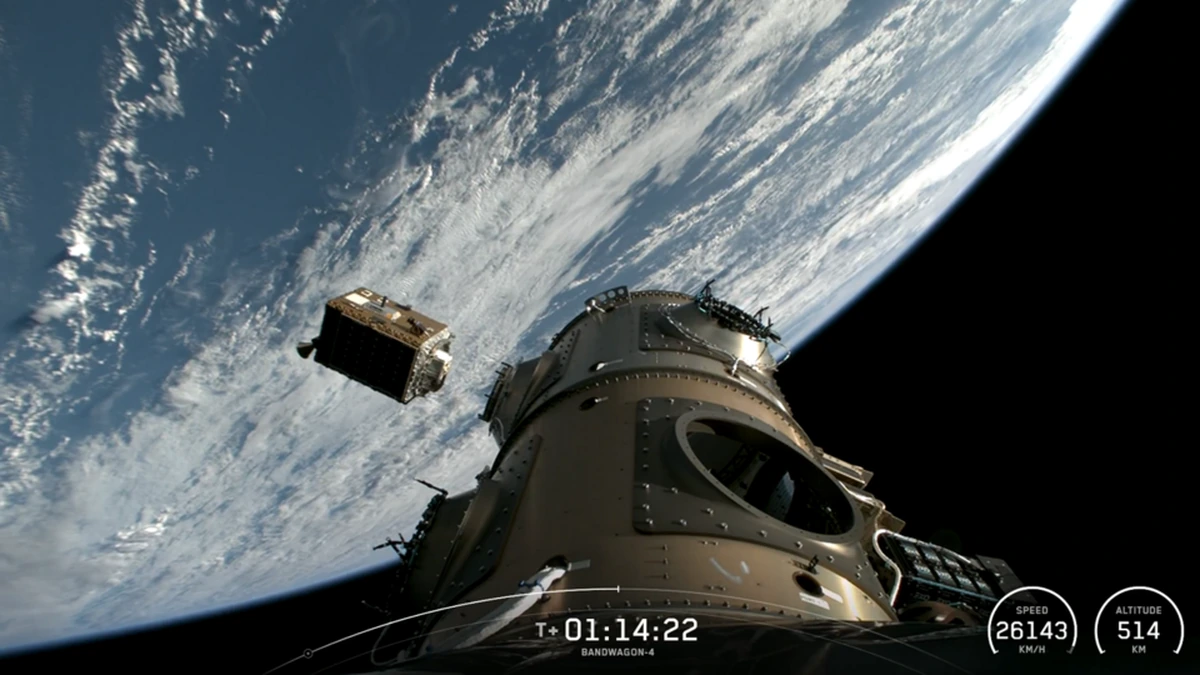
Starcloud has raised a $250 million Series A extension at a $2.3 billion post-money valuation, giving the Redmond, Washington-based startup more capital to pursue its plan for AI data centers in orbit. Manhattan West led the financing, with existing backers Benchmark, EQT, Soma, NFX and 776 participating alongside new investors including NVIDIA, Cisco Investments, Cedar Capital, Goanna Capital and Standard Capital.
The latest raise brings Starcloud’s total capital raised since its 2024 founding to $450 million. It also follows a $170 million Series A announced in March at a $1.1 billion valuation, meaning the headline valuation attached to the company has more than doubled in less than five months. Starcloud said the new money will support manufacturing capacity, engineering work with NVIDIA and procurement of future launch allocation.
Those uses of capital point to the central financial challenge in Starcloud’s model. Building orbital computing infrastructure requires more than buying GPUs: the company must manufacture spacecraft, secure launch capacity, harden computing hardware for space and connect satellites at enough bandwidth to make the system useful. The funding gives Starcloud a larger balance sheet for that buildout, but the gap between a demonstrated satellite and the company’s proposed long-term network remains large.
NVIDIA and Cisco join a funding round built around orbital compute
Starcloud’s pitch to investors is supported by a working technical demonstration. Its Starcloud-1 mission launched in November 2025 carrying an NVIDIA H100 GPU, which the company describes as the first H100 placed in orbit. Starcloud says the satellite later trained an AI model in space and ran a version of Google’s Gemini in orbit, giving the startup flight data from data-center-class hardware rather than relying only on simulations or ground tests.
NVIDIA has separately named Starcloud among the companies using its accelerated computing platforms for orbital and ground-based space applications. In NVIDIA’s March space-computing announcement, the chipmaker said its Space-1 Vera Rubin Module is designed to bring data-center-class AI performance into size, weight and power-constrained space environments. NVIDIA said the Rubin GPU on the module can deliver up to 25 times more AI compute than an H100 for space-based inferencing, although the product was listed for availability at a later date.
NVIDIA’s participation in the new financing therefore has both financial and engineering significance for Starcloud. The startup said its satellites are expected to be an early flight platform for space-rated hardware based on the Space-1 Vera Rubin Module. Cisco’s investment adds another major infrastructure company to the cap table, and its networking expertise is relevant because an orbital data center depends on moving data between spacecraft and between space and Earth as much as it depends on raw computing power.
Starcloud has already taken steps on that connectivity layer. In May, it announced a contract with SpaceX’s Starlink for more than 50 Mini Laser terminals across more than 25 satellites, with the first hardware expected on orbit within a year of that announcement. Starcloud said the optical links are intended to reduce dependence on bandwidth-constrained ground stations and connect individual satellites into a distributed computing network.
Manufacturing capacity and launch access move to the foreground
The latest financing is also aimed at moving Starcloud from one-off demonstrations toward repeatable production. The company said development of production lines for its next-generation Starcloud-3 spacecraft is underway at a new 100,000-square-foot manufacturing facility in Woodinville, Washington. That is a different operating problem from building a single experimental satellite because a scaled network requires consistent spacecraft production, component supply and launch scheduling.
Nearer term, Starcloud is preparing Starcloud-2 as its first commercial mission. The company says the spacecraft will include a GPU cluster, persistent storage, round-the-clock access and proprietary power and thermal systems in a small-satellite form factor, with full operation in sun-synchronous orbit planned for 2027. The intended uses include processing data generated by spacecraft before it is sent to Earth, as well as storage and cloud-computing services that operate independently of terrestrial data centers.
Launch procurement is one of the explicit destinations for the new capital, a detail that matters because every expansion step depends on available rocket capacity and economics. TechCrunch reported Friday that Starcloud is focused on two Starcloud-2 satellites for 2027 rideshare missions and is evaluating additional launch arrangements for future spacecraft. The company has also tied its larger-scale plans to the prospect of lower launch costs, so improvements in rocket availability and reusability remain important assumptions behind the economics of orbital computing.
That cost structure is central to Starcloud’s argument for putting AI infrastructure in space. The company says sun-synchronous orbit can provide near-continuous solar exposure, while radiative cooling can reduce the need for the water and mechanical cooling systems used by terrestrial facilities. Those claims describe Starcloud’s expected economics rather than established industry-wide results, and they still have to be tested at much larger scale than the company’s first mission.
The $2.3 billion valuation prices in a much larger network than Starcloud operates today
Starcloud says it is working toward a constellation of 88,000 satellites and 20 gigawatts of orbital compute capacity. The Federal Communications Commission has cited the company’s 88,000-orbital-data-center plan in its broader discussion of new types of satellite applications. Even at the proposal stage, that scale illustrates why the company is raising large amounts of private capital before it has anything close to a mature network in orbit.
The contrast is important for investors evaluating the $2.3 billion valuation. Starcloud has demonstrated that a high-end GPU can operate in orbit and has attracted strategic backing from two major infrastructure companies, but the commercial system will require far more manufacturing, launch, thermal-management and networking capacity than the initial mission. The new financing improves Starcloud’s ability to pay for those steps, yet it does not remove the technical or logistical risks involved in building large orbital computing clusters.
For now, the most concrete milestones are closer than the 88,000-satellite vision. Starcloud is building out its Woodinville production facility, advancing work with NVIDIA and targeting commercial Starcloud-2 operations in 2027. Progress on those items will show whether the company can turn its early orbital-computing demonstrations into repeatable infrastructure at the scale implied by its new valuation.
More from Investing


Latest News
View all news- NHTSA Opens Probe Into Nearly 1 Million GM Trucks and SUVs Over Engine Failures
- Bitcoin Surges Toward $80,000 as U.S. Crypto Stocks Rally
- Apollo Global Confirms Data Breach After Hackers Access Personal Information
- U.S. Stablecoin Customer-ID Proposal Reaches Public-Comment Deadline
- German Manufacturing PMI Hits 51-Month High as Services Remain in Contraction