

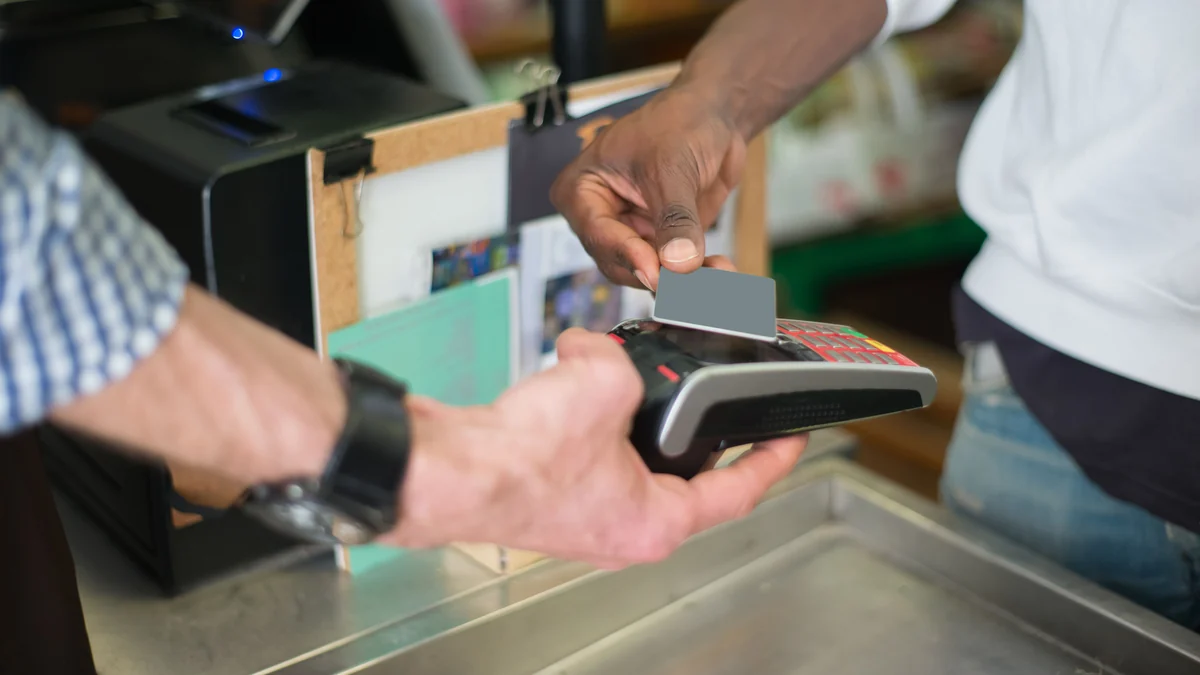
A credit-card purchase looks almost instantaneous to the person paying, but several different events sit behind that brief tap, insert, swipe or online checkout. The merchant asks for approval, the card network routes information, the card issuer decides whether to authorize the purchase, and the financial institutions involved later clear and settle what they owe one another. The cardholder sees one purchase, while the payment system sees a chain of messages and financial obligations.
Understanding that chain is useful because a credit card is not simply a digital substitute for cash. When a cardholder uses a credit card as payment, the issuer generally pays into the card-payment system on the cardholder’s behalf and records an amount that the cardholder will later owe under the card agreement. The payment function and the borrowing function are therefore connected, even when the cardholder plans to pay the statement in full and never incur interest.
What happens when you pay by credit card
Most general-purpose card transactions involve more parties than the buyer and seller. In the common four-party model, the cardholder presents a card issued by a bank or other issuer, the merchant receives the payment through an acquiring bank or payment provider, and a card network carries information between the acquiring and issuing sides. The Federal Reserve describes the network as coordinating both the transmission of information and the monetary transfers between issuers and acquirers, which is why a merchant does not need a separate payment relationship with every bank that might issue a customer’s card.[1]
The familiar network names on major credit cards are only one part of the transaction. The actual credit relationship is usually with the issuer named in the card agreement. The merchant, meanwhile, typically works with an acquirer, payment processor or payment facilitator that gives it access to the relevant network rather than negotiating separately with each issuing bank.
Authorization happens first
At checkout, the merchant sends an authorization request containing the transaction amount and information needed to identify the account and evaluate the purchase. The request travels through the merchant’s payment provider and card network to the issuer, which checks factors such as account status, available credit and fraud or risk indicators. An approval tells the merchant that the issuer is willing to authorize the transaction under the network’s rules, while a decline means the purchase cannot proceed through that card in its present form.
Authorization is fast because it is primarily an exchange of information and a commitment within the payment system, not the final movement of all funds. Modern payment systems separate authentication, authorization, clearing and settlement into distinct stages, and Visa describes clearing as the exchange of detailed transaction information and settlement as the later transfer of funds between the issuing and acquiring sides.[2] A consumer may therefore leave a store with the goods seconds after approval even though the purchase is still shown as pending on the card account.
Clearing and settlement follow
After authorization, the merchant submits completed transactions for processing. Clearing reconciles the transaction information and determines the amounts the participants owe one another, while settlement handles the transfer of those net amounts through the institutions and settlement arrangements used by the network. The merchant’s account may be credited before every underlying interbank obligation has reached its final state, because the merchant’s provider can make funds available according to its own settlement schedule.
This is one reason the old idea that every credit-card purchase is simply transferred directly from the cardholder’s bank to the merchant’s bank is misleading. The cardholder may not even bank with the institution that issued the card, and the merchant’s relationship is generally with its own acquiring side rather than the consumer’s issuer. Credit-card networks make widely distributed card acceptance possible by connecting those separate relationships under common technical and commercial rules.
Why card networks make acceptance scalable
Without a shared network, a merchant would face the impractical task of arranging acceptance with a large number of individual issuers. A network creates a common route through which participating issuers and merchant acquirers can exchange authorization messages, transaction records and settlement obligations. That network effect is a large part of what makes a general-purpose credit card useful outside the bank that issued it.
The principle is easy to see in familiar brands such as Visa, MasterCard and American Express. The exact organizational structure differs among networks and has changed over time, so it is not accurate to describe every brand as operating through precisely the same four-party arrangement in every market. What matters to the consumer is that the network, issuer and acquiring side work together so a merchant that supports the relevant card product can request authorization without having a direct banking relationship with that particular cardholder.
Acceptance is still not universal. A merchant may choose not to support a network, may accept only certain card products, or may face restrictions based on geography, transaction type or its payment provider. Online merchants can also reject cards issued in particular countries or require additional authentication, while an in-person terminal can be configured to support some combinations of chip, contactless and magnetic-stripe transactions but not others.
Who pays whom in a card transaction
The purchase amount shown to a cardholder is not necessarily the amount the merchant ultimately receives from its payment provider. In a typical four-party model, the merchant pays a merchant discount or other acquiring charges, the acquirer may pay interchange to the issuer, and the network charges participating institutions its own fees. The commercial arrangements vary by network, card type, merchant category, country and contract, so there is no single processing percentage that describes every credit-card purchase.
These fees also help explain why the economics of card payments differ from the economics of simply moving money between two deposit accounts. Traditional bank transactions and card transactions can both involve interbank settlement, but a card purchase also brings authorization, network routing, fraud controls, dispute procedures and a credit relationship with the issuer. The merchant is paying for access to a payment system and related services, not merely asking two banks to transfer the face value of a purchase.
Cardholder rewards are related to this broader economics, but it would be too simple to say that a particular merchant fee directly funds a particular customer’s points or cash back. Issuers earn and incur money in several ways, including interchange-related revenue, interest, annual fees, rewards expense, fraud losses and servicing costs. A rewards card can still be profitable for an issuer when a cardholder pays in full, but the overall economics depend on the account portfolio rather than a one-for-one transfer from a merchant fee to the cardholder’s reward.
Why a purchase can stay pending
An approved transaction often appears in the cardholder’s account as pending before it becomes a posted charge. The pending entry generally reflects an authorization that has reduced available credit, while the final posted amount is recorded after the merchant presents the completed transaction through clearing. In ordinary retail purchases the two amounts are often the same, but certain businesses deliberately authorize an estimate first and finalize the amount later.
Hotels, car-rental companies, restaurants and fuel stations are common examples. A hotel may authorize more than the room rate to cover incidentals, a restaurant may authorize the pre-tip amount and submit the final total afterward, and a fuel dispenser may place a temporary authorization before the actual purchase amount is known. These holds can temporarily reduce available credit even though the final posted charge will be smaller or different.
A pending transaction can also disappear rather than post if the merchant never completes it or the authorization expires, although timing depends on the issuer and merchant. Consumers should not assume that disappearance means a purchase was permanently canceled, because a merchant can sometimes submit a valid transaction later under the applicable rules. For budgeting purposes, available credit is therefore a more useful short-term measure than looking only at posted transactions.
How the payment becomes cardholder debt
Once a purchase posts, the cardholder owes the issuer according to the account agreement. That is the central difference between paying with a credit card and paying with a debit card linked directly to a deposit account: the credit-card transaction creates or increases a revolving credit balance, while a debit transaction generally draws on money in the account or on an attached overdraft facility. The payment experience can look similar at the terminal even though the financial consequence for the consumer is different.
Every billing cycle, the issuer totals posted transactions, payments, credits, fees and finance charges to produce a statement. The statement balance represents what the account owed at the cycle closing date, while the current balance can be higher or lower because of activity that occurred after that date. Confusing those two figures is common, especially for people who use a card frequently and therefore rarely see a current balance of zero.
The grace period connects payments and borrowing
Many credit cards provide a grace period on purchases, but it is not an automatic feature of every card or every type of balance. The Consumer Financial Protection Bureau defines the grace period as the time between the end of a billing cycle and the payment due date and notes that, when a card provides one and the cardholder is not carrying a balance, paying the balance in full by the due date can avoid interest on new purchases.[3]
This is why a cardholder who pays the statement balance in full does not normally need to bring the current balance to zero every time a payment is made. Purchases made after the statement closing date belong to the next billing cycle and can remain in the current balance even after the previous statement has been paid. The exact treatment depends on the card agreement, and cash advances or certain other transactions usually do not receive the same grace-period treatment as ordinary purchases.
If the cardholder does not pay enough to retain the grace period, the card moves more clearly from a payment tool into a borrowing tool. Interest can accrue on the unpaid balance and, depending on the account terms and grace-period status, on new purchases as well. That distinction is central to how credit cards are used because the economics of paying in full are very different from the economics of revolving a balance at a credit-card APR.
Card-present, contactless, online and mobile payments
The same account can reach the card network through several different technologies. A chip transaction at a terminal, a contactless tap, an online card-number entry and a card stored in a mobile wallet may all ultimately produce authorization, clearing and settlement messages, but the way the cardholder’s credentials are presented and protected is different. Modern systems increasingly use dynamic data, tokens and risk-based authentication so that the merchant does not always need the underlying card number in the same form.
Contactless payments do not mean that a purchase bypasses authorization simply because the physical interaction is brief. The terminal reads the card or device credential and passes the transaction into the merchant’s normal processing flow, with network and issuer controls determining whether it is approved. Mobile wallets often add tokenization or device authentication, but the underlying funding source can still be the same credit-card account the consumer would have used by presenting the physical card.
Online payments have different fraud and authentication challenges because the merchant does not physically see the card. Card networks and issuers use tools such as security codes, device data, one-time authentication and 3-D Secure protocols to assess whether the person attempting the payment is likely to be the legitimate cardholder. These controls can add friction to some transactions, but they also allow issuers to approve many legitimate online purchases without requiring the consumer to contact the bank.
Why credit-card payments are declined
A decline does not necessarily mean the cardholder lacks enough total credit. The issuer may block a transaction because of suspected fraud, an expired or replaced card, account restrictions, a mismatch in supplied information or a transaction that falls outside the issuer’s risk rules. A merchant or payment provider can also reject a payment before it reaches the issuer if the card type, network or transaction format is unsupported.
Available credit nevertheless remains a basic constraint. An authorization that would push the account beyond its usable limit may be declined, and existing pending authorizations can reduce the amount available for another purchase. That is particularly noticeable during travel, when hotel and rental-car holds can consume a large part of a modest credit line before the final charges are posted.
It is also less useful than it once was to give universal advice that cardholders should notify every issuer before international travel. Many issuers now rely on automated fraud systems and no longer use travel notices at all, while others still offer a notification feature. The better approach is to check the specific issuer’s current policy, make sure contact information is up to date and carry another usable payment method in case an otherwise legitimate transaction is declined.
Refunds, disputes and reversals
A merchant refund is not the same thing as canceling a pending authorization. When a posted purchase is refunded, the merchant sends a credit through the payment system and the cardholder’s account is adjusted when that credit posts. The timing depends on the merchant, acquirer, network and issuer, which is why a store can confirm a refund before it becomes visible on the card account.
Billing disputes involve a different process. U.S. law gives consumers specific rights for certain credit-card billing errors, and current CFPB guidance says consumers should contact the card company promptly and send a written billing-error notice within the required period to preserve statutory rights. The details matter because a dispute over an unauthorized charge, a duplicate charge and a disagreement over the quality of goods are not necessarily handled under exactly the same rules.
From the merchant’s side, a dispute can eventually produce a chargeback or other reversal under network procedures. The card network does not simply decide every disagreement in the cardholder’s favor, and merchants can respond with evidence when the rules permit it. The existence of a structured dispute system is still an important part of using a credit card for payment because it creates mechanisms that cash transactions generally do not provide.
What card acceptance means for merchants and consumers
For merchants, accepting cards can make checkout faster, support remote sales and reduce the need to handle cash, but acceptance also comes with processing costs, fraud exposure, operational requirements and potential disputes. A merchant can decide that the commercial benefit of accepting a particular network or premium card does not justify the cost, which is one reason card acceptance varies even where credit cards are common.
For consumers, broad acceptance makes a general-purpose card portable across merchants and often across countries, but the network logo does not guarantee that every transaction will work everywhere. Local regulations, merchant choices, network coverage, foreign-exchange terms, issuer risk controls and the card’s own conditions can all affect whether a purchase is accepted and what it costs. Carrying a backup payment method remains sensible when a failed transaction would create a serious problem.
The convenience of the payment system can also obscure the fact that the cardholder is creating a financial obligation each time the issuer approves a purchase. If the statement is paid in full under the account’s grace-period rules, the card can function primarily as a payment instrument with short-term credit in the background. If balances are carried, the same payment infrastructure becomes the front end of a revolving loan, and interest cost becomes more important than the speed or convenience of checkout.
Using a credit card primarily as a payment tool
For someone who wants a credit card mainly for payments, the cleanest approach is to make spending decisions before the card is involved. Purchases should fit the household’s cash-flow plan, statements should be reviewed for unexpected charges, and the amount needed to pay the statement balance should not come as a surprise at the end of the cycle. Rewards and purchase protections can then be evaluated as features of a payment method rather than as incentives to spend more.
That approach also makes the distinction between payment and borrowing visible. A cardholder who expects to carry a balance should evaluate the APR and repayment plan before making the purchase, not after the statement arrives. Once credit cards are used as revolving accounts, financing cost and repayment discipline matter more than transaction convenience.
A credit card succeeds as a means of payment because a large network of institutions makes a complex transaction feel simple at the point of sale. The simplicity is useful, but it should not hide the mechanics that matter to the cardholder: authorization is not settlement, a pending charge is not always final, the issuer rather than the merchant usually extends the credit, and paying the statement under the card’s terms determines whether a convenient purchase remains a payment-service benefit or becomes interest-bearing debt.
Sources
- Board of Governors of the Federal Reserve System: Interchange Fees and Payment Card Networks: Economics, Industry Developments, and Policy Issues
- Visa: 3D Secure: your guide to safer transactions
- Consumer Financial Protection Bureau: What is a grace period for a credit card?