Senate Pushes Crypto CLARITY Act Cloture Vote to September 15
The Senate's next procedural vote on H.R. 3633 is now set for September 15, when a cloture motion on the motion to proceed will ripen at 2:15 p.m.
Our editorial standards
MarketReview publishes clear, independently produced financial information using reliable sources and transparent editorial standards.
Read our Editorial Policy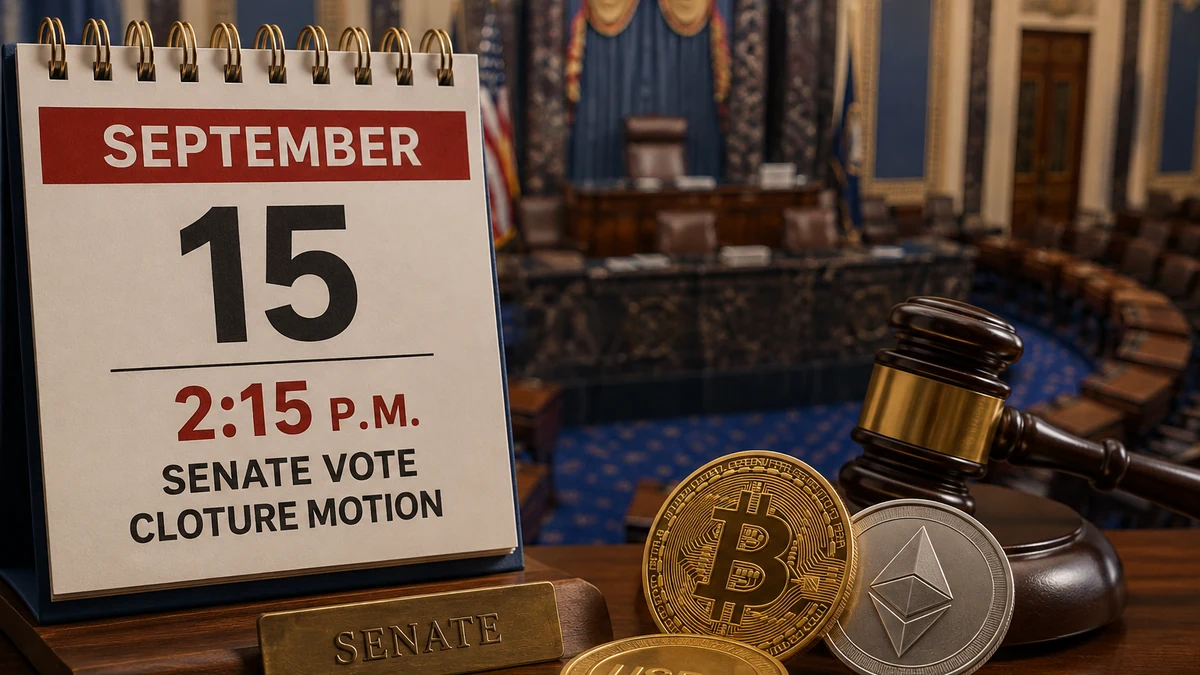
The U.S. Senate has formally pushed the next procedural test for a major cryptocurrency market-structure bill into September, setting a cloture motion on the Digital Asset Market Clarity Act to ripen on Tuesday, September 15 at 2:15 p.m.
The Senate Daily Press said the chamber will return for regular business on September 14 after its August recess. Before leaving Washington, Senate Majority Leader John Thune filed cloture on the motion to proceed to H.R. 3633, the Digital Asset Market Clarity Act. That means the September action is a vote on whether the Senate should move forward with consideration of the bill, not a final vote on whether the legislation becomes law.
The distinction matters because the delay itself is the completed event. The Senate did not finish its work on the market-structure package before the recess, and the official schedule now puts the next procedural step more than a month away. The September 15 vote will determine whether the chamber can proceed to debate the legislation under the Senate’s cloture rules.
September 15 is a procedural vote, not final passage
Cloture is the Senate procedure used to limit debate. For legislation, invoking cloture generally requires three-fifths of senators duly chosen and sworn, which is normally 60 votes in the 100-member chamber. In this case, Thune filed cloture on the motion to proceed to H.R. 3633. If cloture is invoked, the Senate can move toward taking up the bill. It would still need to work through the remaining floor process before any final passage vote.
The Senate Daily Press recorded Thune’s filing before the chamber adjourned for the August recess. Its August 10 schedule then specified that the cloture motion on H.R. 3633 will ripen at 2:15 p.m. on September 15. The Senate is scheduled to return for business at 3 p.m. on September 14, with a separate judicial nomination vote set for that evening.
That calendar makes the status unusually clear for investors following U.S. crypto legislation. There is now an official date for the next step, but there is not yet a completed Senate vote on the CLARITY Act itself. Nor has Congress sent the measure to the president. Any description of the September 15 event as a final up-or-down vote on the bill would overstate what the Senate has scheduled.
The procedural threshold also explains why the cloture vote is meaningful without making it a prediction market for the bill’s ultimate fate. Sixty votes are generally needed to invoke cloture on legislation, so the September vote will test whether enough senators support moving ahead with consideration. What happens after that would depend on the Senate’s handling of debate, amendments and subsequent votes.
The CLARITY Act would reshape federal crypto oversight
H.R. 3633 has been moving through Congress for more than a year. The House of Representatives passed the CLARITY Act on July 17, 2025 by a vote of 294 to 134, according to the official House Clerk record. All 216 Republicans who voted supported it, while Democrats split 78 in favor and 134 against.
The legislation is intended to create a federal market-structure framework for digital assets and clarify the roles of the Securities and Exchange Commission and Commodity Futures Trading Commission. The Senate’s current work is not simply a replay of the House-passed bill. Senate committees spent months developing their own provisions before lawmakers released an updated version in July 2026 that merged work from the Banking and Agriculture committees.
The Senate Banking Committee advanced H.R. 3633 by a 15-9 vote in May. Separately, the Senate Agriculture Committee had developed legislation focused on digital commodity intermediaries, including a proposed CFTC spot-market regime, customer-asset protections, registration requirements and coordination between the CFTC and SEC. Senator Cynthia Lummis said on July 22 that the updated CLARITY Act text reflected the merged work products of the two committees.
At a high level, the bill seeks to answer questions that have shaped U.S. crypto regulation for years: when a digital asset falls within securities law, when a token is treated as a digital commodity, which federal regulator supervises trading activity, and what registration and customer-protection rules apply to intermediaries. Those questions affect exchanges, brokers, dealers, token issuers and other firms that operate in the U.S. digital-asset market.
The Senate version has continued to draw negotiations over issues beyond the basic SEC-CFTC division. Reuters reported that lawmakers have remained divided over anti-money-laundering provisions, ethics restrictions involving government officials and rules governing rewards paid on customer holdings of dollar-backed stablecoins. Banking groups have also raised concerns about potential deposit competition, while crypto companies have argued against restrictions they say would disadvantage digital-asset products.
Those disputes are relevant because the text considered by the Senate can still change. The House has already passed its version, but both chambers ultimately must approve the same legislative text before a bill can be sent to the president. The September cloture step therefore advances the Senate process without resolving the substantive negotiations still surrounding the measure.
The August recess creates a defined pause in the bill’s path
The immediate consequence of the Senate schedule is a five-week gap between the chamber leaving Washington and its return to regular business. The Senate Daily Press lists only pro forma sessions through early September, with no business expected at those sessions, before the Senate reconvenes on September 14.
For crypto companies and investors, that makes the timing more concrete than the broader debate over whether Congress will eventually enact a market-structure law. The next scheduled action is not open-ended. The cloture motion on the motion to proceed is set to ripen on September 15 at 2:15 p.m., providing a specific procedural checkpoint for H.R. 3633.
The delay also separates the CLARITY Act from the stablecoin legislation Congress completed in 2025. The GENIUS Act established a federal framework for payment stablecoins, while the CLARITY Act addresses the broader structure of digital-asset markets. The latter remains unfinished legislation, despite its House passage and subsequent Senate committee work.
That is why the September date should be read narrowly. It confirms when the Senate plans to confront the next procedural hurdle. It does not establish how senators will vote, whether amendments will be adopted, when a final passage vote might occur, or what the final statutory text would look like if the legislation advances.
The next concrete event is therefore September 15 at 2:15 p.m., when the cloture motion on the motion to proceed to H.R. 3633 is scheduled to ripen. Until then, the confirmed development is the Senate’s decision to carry the CLARITY Act’s next floor test past the August recess and into September.
More from Cryptocurrency

Latest News
View all news- Standard Chartered Redeems €500 Million of Fixed-Rate Reset Notes
- Resources Connection Names Jessica Block Interim CFO, Trisha Jenks Chief Accounting Officer
- Registration Takes Effect for Nine Leverage Shares 3X Thematic ETFs
- France Launches Bpifrance Zero-Interest Loan Program for Fishing and Marine Aquaculture
- FinCEN’s Southwest-Border Cash-Reporting Compliance Deadline Takes Effect