
SAIC Raises Fiscal 2027 Revenue and Earnings Guidance After 6% Quarterly Growth
SAIC lifted fiscal 2027 revenue and adjusted earnings guidance after second-quarter revenue rose 6.3% and organic growth reached 5.3%.
Our editorial standards
MarketReview publishes clear, independently produced financial information using reliable sources and transparent editorial standards.
Read our Editorial Policy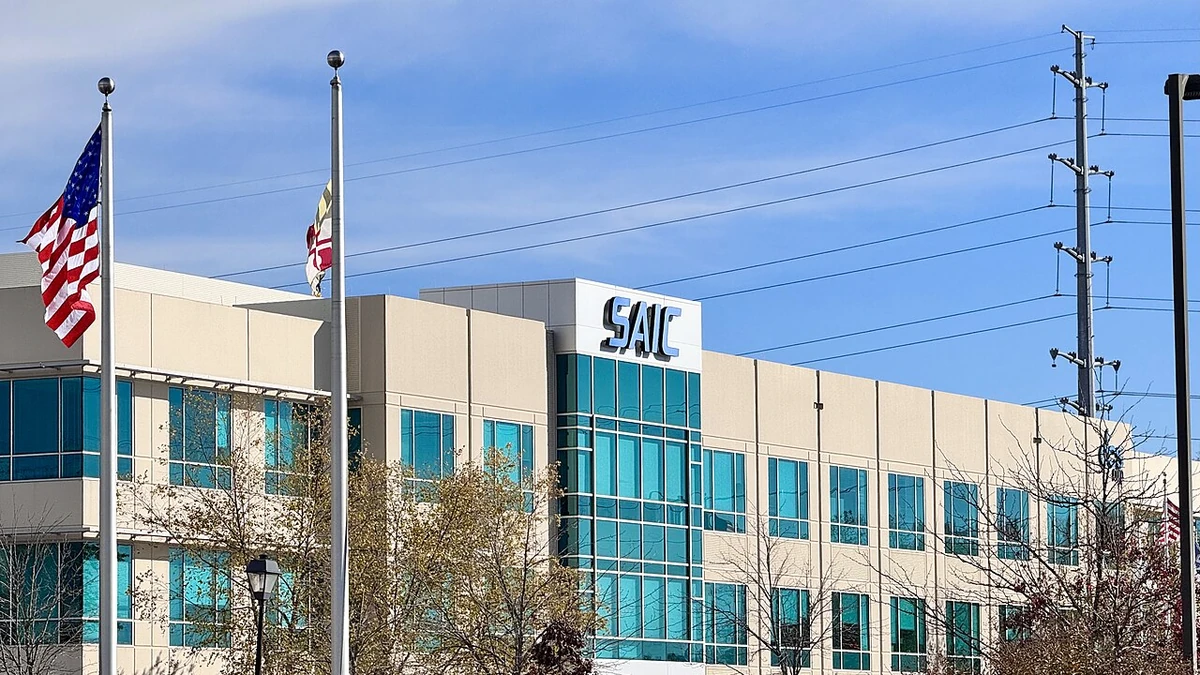
Science Applications International Corp. raised its outlook for fiscal 2027 on Monday after reporting stronger second-quarter growth, giving investors fresh evidence that the government technology contractor is gaining traction despite a softer bookings quarter.
In its second-quarter earnings release, SAIC said revenue for the quarter ended July 31 rose to $1.88 billion, up about 6.3% from a year earlier, while organic growth reached 5.3%. The company also reported net income of $102 million, adjusted EBITDA of $193 million, and diluted earnings per share of $2.38. Adjusted diluted earnings per share came in at $3.01.
The headline change for investors was the guidance increase. SAIC lifted its fiscal 2027 revenue range to $7.2 billion to $7.3 billion from a prior range of $7.0 billion to $7.2 billion. It also increased adjusted EBITDA guidance to $750 million to $755 million from $720 million to $730 million, raised its adjusted EBITDA margin outlook to 10.3% to 10.5% from 10.1% to 10.3%, and lifted adjusted diluted earnings per share guidance to $10.65 to $10.75 from $9.90 to $10.10. Free cash flow guidance was reiterated at more than $600 million.
The result gives SAIC a cleaner growth narrative than it had earlier in the year, when the company was still working through the effects of procurement delays and unfavorable award decisions that had pressured its near-term outlook. Monday’s update suggests execution on existing contracts, contributions from recent work, and incremental help from acquisitions are now supporting a better revenue and margin profile than management had expected just a few months ago.
Guidance moved higher as revenue and margins stayed firm
According to SAIC’s earnings release, second-quarter revenue increased by $111 million from the comparable period last year. The company said the improvement was driven primarily by ramp-up in volume on existing and new contracts, along with $20 million in revenue from the acquisition of SilverEdge Government Solutions. Contract completions partially offset that growth, but the overall direction was strong enough for management to raise its full-year expectations.
Adjusted EBITDA for the quarter totaled $193 million, equal to 10.3% of revenue. That was slightly below the 10.5% adjusted EBITDA margin posted in the prior-year quarter, but still kept the company in double-digit margin territory. Operating income as a share of revenue improved to 8.1% from 7.9% a year earlier. SAIC said profitability benefited from better performance across its contract portfolio and from costs tied to the settlement of federal tax audits that affected the prior-year comparison. At the same time, higher selling, general and administrative expenses limited some of the margin upside.
Not every comparison moved upward. Net income fell 20% from the year-earlier period, and diluted earnings per share declined from $2.71 to $2.38. Adjusted diluted earnings per share also slipped from $3.63 to $3.01. Those declines mean the quarter was not a simple across-the-board beat story. Revenue growth and stable margins were enough to support a stronger full-year outlook, but the earnings comparison was still running against a tougher base.
Even so, management’s public tone was confident. Chief Executive Officer Jim Reagan said the company delivered solid organic growth and double-digit margins while continuing to execute with discipline, and said the increased guidance reflected strong year-to-date performance. For the market, that matters because the revised outlook now implies better full-year performance both at the top line and in profitability than SAIC had previously projected.
Bookings were lighter, but backlog and award activity remained significant
One area investors may scrutinize more closely is demand conversion. SAIC reported net bookings of about $1.2 billion in the quarter, producing a quarterly book-to-bill ratio of 0.6 and a trailing twelve-month book-to-bill ratio of 0.8. Those figures are not especially strong and suggest awards recognized during the period did not fully keep pace with revenue recorded in the same timeframe.
Still, the company entered the second half of the year with estimated backlog of roughly $22.1 billion, of which about $3.8 billion was funded. That backlog base remains substantial for a company of SAIC’s size and provides some support for the improved guidance. The quarter also included several notable awards that help explain management’s confidence in the business pipeline.
Among contracts booked during the quarter, SAIC highlighted a roughly $400 million recompete supporting a U.S. intelligence agency, a contract of about $330 million supporting systems engineering and modeling work for all branches of the Armed Services, and a roughly $130 million U.S. Navy contract tied to airborne electronic warfare systems. After the quarter ended, SAIC also said it won a recompete task order worth about $740 million with the Department of Homeland Security to support Customs and Border Protection systems. It also secured a position on the estimated $14 billion COMET multiple-award vehicle, though that position does not count toward backlog until task orders are awarded.
That mix shows why the quarter’s lower book-to-bill figure does not necessarily tell the whole story. Large defense, intelligence and civilian technology contracts often convert unevenly across reporting periods, especially when awards include IDIQ structures or when timing shifts around task orders. Investors will still want to see bookings improve, but the overall award backdrop was not weak in operational terms.
Cash generation and capital deployment stayed in focus
Beyond revenue and guidance, SAIC’s cash generation remained a point of strength. Cash flows provided by operating activities rose 20% year over year to $146 million, while free cash flow totaled $131 million. The company said the improvement in operating cash flow reflected lower cash outflows tied to its master accounts receivable purchase agreement facility, lower cash incentive-based compensation payments, and other working capital changes, partly offset by the timing of customer collections.
Capital deployment remained active as well. During the quarter, SAIC used $106 million of capital, including $90 million for share repurchases and $16 million for cash dividends. After the quarter ended, the company said it amended its MARPA facility on Aug. 14 to increase the aggregate limit from $300 million to $400 million. It also noted that its board had declared a quarterly cash dividend of $0.37 per share, payable on Oct. 23 to shareholders of record on Oct. 9.
For investors, Monday’s report presents a mixed but generally favorable picture. SAIC did not post universal year-over-year earnings growth, and bookings were softer than many would prefer. But the company delivered healthy revenue growth, maintained double-digit adjusted EBITDA margins, generated cash, and raised full-year guidance across several important measures. In a government services business where visibility and execution matter as much as headline growth, that combination is meaningful.
The bigger question now is whether SAIC can sustain that momentum through the rest of fiscal 2027. The updated outlook still implies organic growth in a range of negative 2% to flat for the full year, even after the guidance increase, which shows that management is not assuming a uniformly strong environment across the portfolio. Yet Monday’s report makes clear that the company has improved its near-term trajectory. If revenue conversion continues, major awards begin feeding into future periods, and margins hold near current levels, SAIC will have reinforced the case that it is navigating a difficult federal contracting backdrop more effectively than earlier expectations suggested.
More News


Latest News
View all news- Union Pacific Third-Quarter Profit Rises 16% to $2.1 Billion as Freight Volumes Grow
- Nasdaq Q3 Revenue Jumps 13% as Annual Recurring Revenue Reaches $3.4 Billion
- Census Bureau Releases New Business Conditions Data Covering U.S. Employers
- Blackstone Reports Third-Quarter Earnings With Assets Under Management Near $1.4 Trillion
- BEA Expands State-Level R&D Economic Statistics With New 2024 Estimates
