South Korea Broadens Espionage Law to Foreign States as Seoul Targets Chip and AI Technology Leaks
The revised Criminal Act adds an espionage offense for conduct carried out for a foreign country or equivalent organization, while Seoul is separately expanding enforcement against semiconductor and AI technology leaks.
Our editorial standards
MarketReview publishes clear, independently produced financial information using reliable sources and transparent editorial standards.
Read our Editorial Policy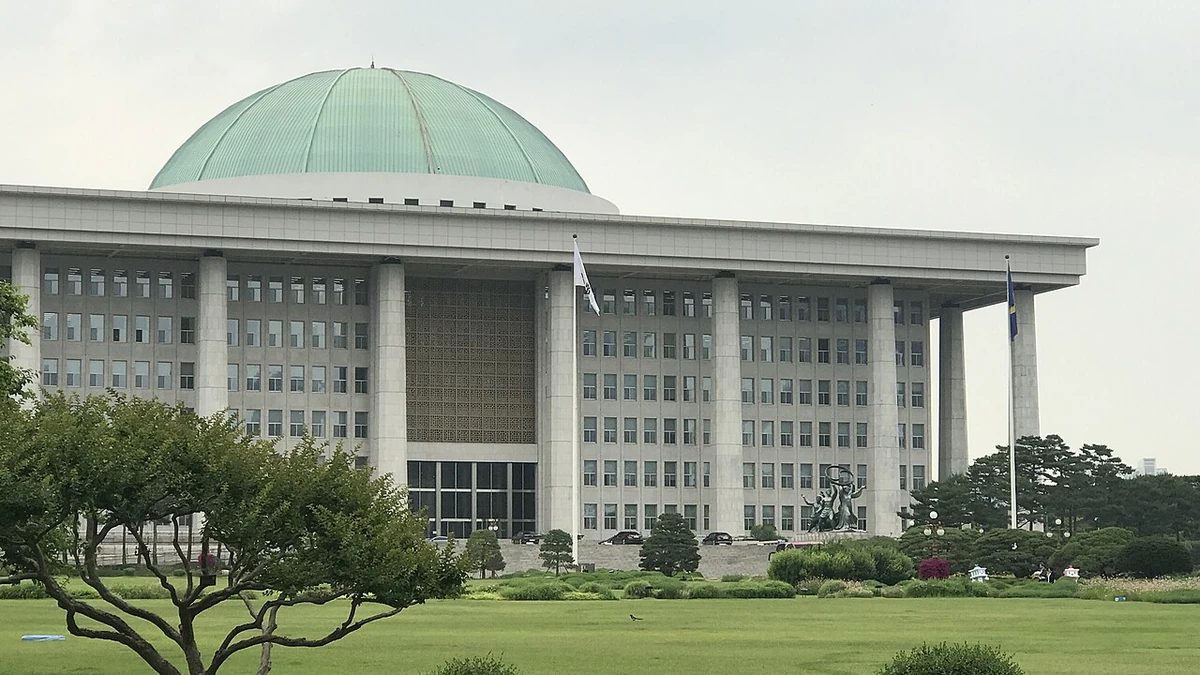
South Korea’s expanded espionage law took effect Sunday, extending a criminal offense that had long centered on an “enemy state” to conduct carried out for a foreign country or an equivalent organization. The change gives prosecutors a new route for cases involving national secrets and comes as the government is separately adding investigators and specialist teams to pursue leaks of advanced technologies, including semiconductors and artificial intelligence.
The two tracks are related by Seoul’s broader concern about economic and national security, but they are not the same law. A theft of a chip design, AI model information or other corporate trade secret does not automatically become espionage under the revised Criminal Act. The new offense requires the statutory elements for foreign-directed espionage, including a national-secret component, while technology-leak cases can also be investigated and prosecuted under separate industrial-technology and trade-secret rules.
The revised Criminal Act is effective from September 13 under Law No. 21450, which was promulgated on March 12. New Article 98-2 covers a person who, for a foreign country or an equivalent organization and under its direction, instigation or other communication, detects, collects, discloses, transmits or brokers national secrets, or assists such conduct. The offense carries at least three years in prison.
A broader espionage offense, but not a blanket technology-theft law
Before the amendment, Article 98 was framed around espionage for an enemy state. Legislative records for the measure said the older approach was too narrow for an environment in which national secrets could be transferred abroad even when the recipient was not formally an enemy. Parliament approved the committee alternative on February 26, the law was promulgated two weeks later, and most of the espionage changes were given a six-month lead time before taking effect.
The enacted language also shows where the expansion stops. Article 98-2 refers to a “foreign country or equivalent organization” and to “national secrets.” It does not expressly say that every foreign company qualifies, nor does it list “national core technology” as a standalone object of the espionage offense. Whether particular facts meet the Criminal Act’s requirements will therefore depend on the nature of the information, the foreign nexus and the evidence of direction, instigation or communication.
Lawmakers are already considering whether to go further. A bill filed August 31 by Rep. Ko Dong-jin and nine other lawmakers would add foreign companies to Article 98-2, expressly include national core technologies and increase the minimum prison term for the foreign-espionage offense from three years to 10 years. The proposal was referred to the National Assembly’s Legislation and Judiciary Committee on September 1. It has not replaced the law that took effect Sunday.
Semiconductor and AI enforcement is expanding on a separate track
South Korea’s Ministry of Intellectual Property has meanwhile expanded the investigative structure used for technology-leak cases. In a June 29 enforcement plan, the ministry said a specialist organization focused on advanced-technology leakage would begin operating the next day. Its technology-police force was increased from 27 investigators to 61, with a dedicated track for cases involving areas such as semiconductors and AI.
Recent enforcement figures point to a heavier caseload as well. The ministry said 161 suspects in technology-infringement cases were referred to prosecutors in the first half of 2026, up 33% from 121 a year earlier. In trade-secret leakage and theft cases received by the agency, the number of suspects rose to 42 from 15, an increase of 180%. Those figures cover a broader set of intellectual-property and trade-secret investigations and should not be read as a count of espionage cases or as proof that all of the conduct involved foreign actors.
Semiconductors make the economic stakes especially large for South Korea. Government trade data show semiconductor exports reached $281.2 billion in the first eight months of 2026, accounting for 40.6% of the country’s exports over that period. The National Intelligence Service’s current list of national core technologies contains 79 technologies across multiple sectors, including 11 semiconductor technologies covering areas such as advanced DRAM, 3D NAND, foundry processes, image sensors and advanced packaging.
AI is part of the government’s enforcement priority even though the legal classification of a specific AI asset can depend on the information involved and the statute being applied. The intellectual-property ministry said it is placing investigators with technical backgrounds in electrical, chemical and mechanical fields and is seeking authority to handle cases beyond ordinary trade secrets, including violations involving national core and advanced strategic technologies. That effort is distinct from Article 98-2, whose text is built around national secrets and the foreign-country or equivalent-organization nexus.
Future cases will test how far Article 98-2 reaches
For prosecutors, the new provision creates a Criminal Act offense that did not previously exist in this form for foreign-country espionage. It does not erase the other legal routes available when protected industrial technology or trade secrets are taken overseas. In a future chip or AI case, the applicable charges may turn on what information was obtained, how it was legally classified, who ultimately received it and what evidence exists about communications with a foreign state or qualifying organization.
That distinction matters because a commercial connection abroad, by itself, is not the wording of the new espionage offense. The law requires more specific elements, and its application will be shaped by charging decisions and court interpretation as cases are brought under Article 98-2. The separate August 31 proposal to add foreign companies and national core technologies underscores that lawmakers themselves see questions remaining about the reach of the provision now in force.
The immediate milestone is nevertheless clear: Article 98-2 is now operative after its six-month implementation period. The next legislative question is whether the National Assembly will advance the newer bill that would broaden the text again and sharply raise the minimum sentence. Until then, South Korea’s current framework pairs the new foreign-espionage offense with a separately expanding technology-protection apparatus aimed at the leakage and theft of strategically important know-how.
More News

Latest News
View all news- First Trust’s Palantir Target-Income ETF Registration Takes Effect
- Saudi Stocks Post Sharpest Drop Since April as Energy-Supply Risks Escalate
- Health Catalyst CEO Ben Albert Steps Down From Board as Leadership Handover Takes Effect
- New Hampshire Raises Housing Finance Authority Bond Caps to $1 Billion
- Trump Says Iran Probably Behind Saudi Pipeline Attack as Energy-Route Risk Deepens