
Bunge’s $7.7 Billion Credit-Facility Extensions Take Effect
The one-year maturity extensions push Bunge’s $4.2 billion revolving credit agreement to 2031 and its $3.5 billion facility to 2029; a separate $1.1 billion line was extended to 2027.
Our editorial standards
MarketReview publishes clear, independently produced financial information using reliable sources and transparent editorial standards.
Read our Editorial Policy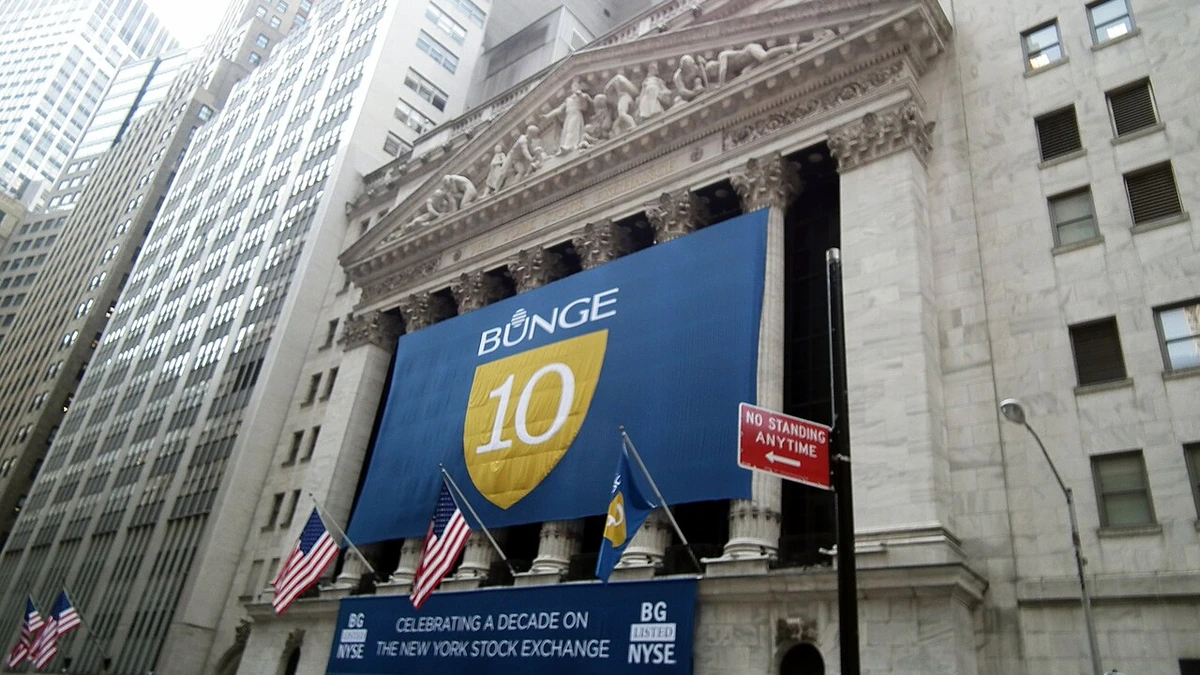
Bunge Global SA’s one-year maturity extensions for two unsecured revolving credit facilities totaling $7.7 billion take effect on October 3, 2026, extending the company’s access to committed bank financing without creating a new borrowing on the effective date.
The larger facility is a $4.2 billion five-year revolving credit agreement used by Bunge Limited Finance Corp., a wholly owned financing subsidiary. Its termination date moves from October 3, 2030 to October 3, 2031. A separate $3.5 billion three-year revolving facility used by Bunge Finance Europe B.V. now matures on October 3, 2029 instead of October 3, 2028.
Bunge and the relevant lenders agreed to the extensions on September 17. The company disclosed the changes in a Form 8-K filed with the Securities and Exchange Commission. Both facilities are unsecured and remain guaranteed by Bunge Global SA.
The extensions move two major maturities out by one year
The effective-date change is principally about the life of the credit commitments. It does not mean Bunge is borrowing $7.7 billion today. Revolving credit agreements give a company access to committed borrowing capacity that can be drawn, repaid and reused subject to the agreements’ terms. Extending the maturity gives Bunge a longer period before those commitments are scheduled to expire.
Both facilities were put in place on October 3, 2025. The $4.2 billion agreement replaced a $3.2 billion revolving credit agreement that had been scheduled to run until March 2029. The new agreement originally carried a 2030 maturity and allows Bunge Limited Finance Corp. to request additional one-year extensions, subject to lender approval. Borrowings can be used for general corporate purposes and bear interest under formulas tied to SOFR or Euribor, depending on the borrowing.
The $3.5 billion European facility also dates from October 3, 2025 and replaced an earlier $3.5 billion agreement. Its original maturity was October 3, 2028. The agreement likewise allows requests for additional one-year extensions, with each lender retaining discretion over whether to agree. Borrowings under the facility are tied to SOFR plus an adjustment and a ratings-based margin.
The extension therefore leaves the size of the two commitments unchanged while pushing their scheduled maturities farther into the future. The $4.2 billion line now runs roughly five years from the new effective date, while the $3.5 billion line extends through 2029.
Bunge entered the extension period with substantial committed liquidity
Bunge’s latest quarterly filing shows why the revolving lines matter within a broader financing structure. At June 30, 2026, the company reported four revolving credit facilities with total committed capacity of $9.665 billion. It had $830 million outstanding under the $3.5 billion facility and no borrowings outstanding under the $4.2 billion line, the $1.1 billion 364-day line or an $865 million revolving credit agreement. That left $8.835 billion of unused committed revolving capacity at the end of the quarter.
The figures appear in Bunge’s second-quarter Form 10-Q. Bunge also reported $15.214 billion of total debt at June 30, up from $14.051 billion at the end of 2025. The company attributed the increase primarily to higher short-term borrowings and to $1.2 billion of senior notes issued in March, partly offset by repayment of $575 million of senior notes in April.
Some of the higher short-term borrowing reflected working-capital needs following Bunge’s July 2025 acquisition of Viterra. The company said borrowings under bilateral short-term credit lines had increased, and its long-term debt also included senior notes assumed in connection with that acquisition. Those financing needs make the duration of committed revolving facilities more relevant than the headline amount alone might suggest.
Bunge also uses a $3 billion commercial paper program. At June 30, $564 million was outstanding under that program. The company said its short-term credit ratings require it to maintain same-day unused committed borrowing capacity under long-term facilities at least equal to the amount of commercial paper outstanding. Revolving commitments therefore serve not only as potential direct funding but also as support for another part of Bunge’s short-term financing framework.
A separate $1.1 billion facility was extended one day earlier
The September filing covered a third credit line as well. Effective October 2, Bunge Limited Finance Corp., Bunge and the lenders under a $1.1 billion 364-day revolving credit agreement extended that facility’s maturity from October 2, 2026 to October 1, 2027.
That extension is separate from the $7.7 billion total represented by the $4.2 billion and $3.5 billion facilities taking effect on October 3. Taken together, the three maturity changes cover $8.8 billion of existing revolving commitments, but the agreements have different structures and expiration dates.
The company’s debt agreements include financial and non-financial covenants, including limits tied to debt capitalization and secured indebtedness. Bunge said it was in compliance with those covenants as of June 30. It also reported stable long-term ratings at that date of A- from S&P, Baa1 from Moody’s and BBB+ from Fitch.
For Bunge, the immediate result of the October extensions is a longer runway on major committed bank facilities rather than an increase in their stated size. The next scheduled maturity among the three facilities addressed in the September filing is now the $1.1 billion 364-day line on October 1, 2027, followed by the $3.5 billion facility in 2029 and the $4.2 billion agreement in 2031.
More from Investing

Latest News
View all news- Standard Chartered Redeems €500 Million of Fixed-Rate Reset Notes
- Resources Connection Names Jessica Block Interim CFO, Trisha Jenks Chief Accounting Officer
- France Launches Bpifrance Zero-Interest Loan Program for Fishing and Marine Aquaculture
- FinCEN’s Southwest-Border Cash-Reporting Compliance Deadline Takes Effect
- Federal Reserve Runs Scheduled Fedwire Production Testing on October 3
