GlobalFoundries Signs $2 Billion TSMC Deal to Make AI-Packaging Interposers in New York
The five-year agreement would add U.S. production of silicon interposers for TSMC's CoWoS packaging, with a manufacturing ramp targeted for the first half of 2028.
Our editorial standards
MarketReview publishes clear, independently produced financial information using reliable sources and transparent editorial standards.
Read our Editorial Policy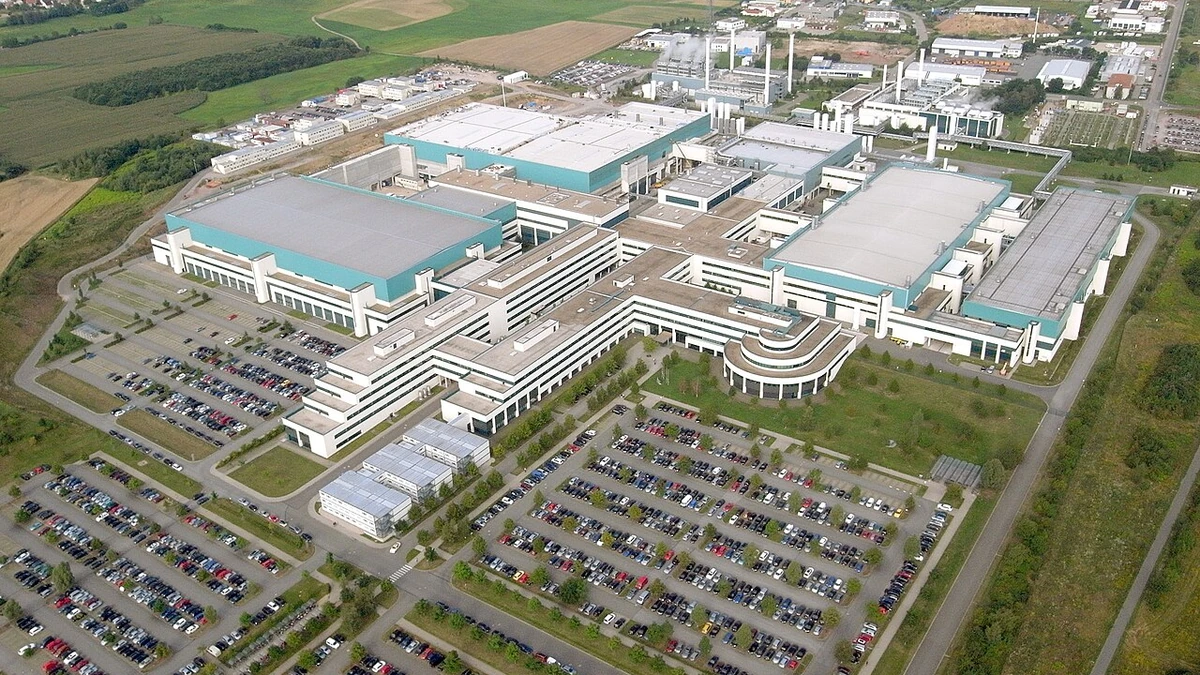
GlobalFoundries has agreed to manufacture silicon interposers for Taiwan Semiconductor Manufacturing Co. (TSMC) under a $2 billion agreement that will add U.S. production capacity for a component used in advanced AI chip packaging. The work will be carried out at GlobalFoundries’ existing manufacturing site in Malta, New York, with volume production expected to start ramping in the first half of 2028.
Announced on October 8, the arrangement brings GlobalFoundries into TSMC’s CoWoS advanced-packaging supply network as a manufacturing-service provider. TSMC will gain a U.S.-based source of interposers, the silicon components that help connect processing chips and high-bandwidth memory within increasingly complex semiconductor packages. GlobalFoundries said the deal has an initial term of five years, with room to expand capacity as demand develops.
In its announcement of the agreement, GlobalFoundries said it expects to establish the first U.S.-based source of silicon interposers for this category of advanced packaging. The company did not disclose manufacturing volumes, individual customer orders, or how the $2 billion agreement value is allocated over the five-year term.
The component GlobalFoundries will supply to TSMC
Interposers sit inside a chip package, providing dense electrical connections among components that cannot simply be treated as one conventional piece of silicon. In AI accelerators, those links are important because computing dies need to exchange data rapidly with nearby high-bandwidth memory. Packaging architecture therefore affects performance as well as the ability to assemble increasingly large, complex computing systems.
TSMC describes its CoWoS platform as a family of advanced packaging technologies designed to bring logic chips and memory stacks together. One member of the family, CoWoS-S, uses a large silicon interposer with high-density connections and embedded deep trench capacitors. These capacitors help support power delivery close to demanding computing components, a function that becomes more important as packages grow in size and complexity.
GlobalFoundries specifically said its planned interposer manufacturing will support technologies that include embedded deep trench capacitor components. That provides a technical link between the services it intends to supply and the requirements of advanced AI packaging, although the announcement does not identify the exact CoWoS product variants, customer chip designs, or manufacturing specifications covered by the agreement.
The distinction between a silicon interposer and a finished processor is important. GlobalFoundries is not announcing that it will fabricate TSMC’s leading-edge AI logic chips in New York, nor does the agreement say that all CoWoS packaging steps will move to the United States. The disclosed role is to manufacture a particular part of TSMC’s broader packaging process. TSMC’s CoWoS portfolio also includes approaches that use redistribution-layer structures or local silicon connections rather than the same full silicon-interposer design.
A five-year agreement, with production still ahead
For GlobalFoundries, the deal creates a defined manufacturing relationship with a major foundry customer while giving the Malta facility a larger role in advanced packaging. The company said it would add fabrication capacity at the New York site and establish a basis for further expansion if customer requirements grow. It did not announce a separate new factory as part of the October 8 release.
The $2 billion figure is the stated value of the multiyear agreement, not a disclosed capital-expenditure budget. GlobalFoundries has not provided a breakdown of spending on equipment or facilities, a timetable for recognizing revenue, or minimum annual purchase volumes. The number consequently should not be read as $2 billion of immediate revenue, or as proof that the company will spend that amount building out the site.
Timing is another important qualification. GlobalFoundries expects volume production to begin ramping in the first half of 2028, so the arrangement is about capacity under development rather than interposers already shipping from the new production program. The company has not publicly specified the output it expects at the start of the ramp, how quickly it could increase production, or what milestones must be met before that point.
A staged build-out would fit the demand-linked framework described in the announcement. Increasing capacity over time offers some flexibility if the types and quantities of AI packages sought by TSMC customers change, but it also leaves the eventual scale of the Malta operation open. No contractual price per interposer or disclosed share of TSMC’s packaging requirements provides a basis for estimating unit sales from the agreement alone.
Why the U.S. location matters for AI chip packaging
AI semiconductor supply chains involve more than the factories making the smallest logic transistors. Advanced packaging brings multiple completed dies, memory components and specialized interconnect structures into one working system. A shortage or delay in one part of that chain can constrain the amount of finished computing hardware available, even when other manufacturing steps have sufficient capacity.
TSMC says demand for its CoWoS technologies has grown with generative AI, following the platform’s introduction into volume production in 2012. The company has expanded its packaging options to accommodate more complex arrangements of computing chips and high-bandwidth memory. Against that backdrop, a second manufacturing footprint for an essential component gives TSMC another way to build supply capacity for future product generations.
GlobalFoundries’ stated plan is narrower than a shift of entire AI-chip production lines to America. The new work would establish a domestic supply of interposers for TSMC’s packaging ecosystem, while the October 8 announcement provides no indication that the associated logic processors, memory chips or final package assembly will all be made at the same site. It is a geographically distinct source for one specialized manufacturing step.
The project is also consistent with GlobalFoundries’ broader effort to sell more advanced-packaging capabilities alongside its semiconductor manufacturing services. Its published technology portfolio includes interposers and bridges that connect multiple dies, as well as support for deep trench capacitors. The TSMC agreement identifies a customer and a planned U.S. manufacturing location for a specific part of that offering, rather than introducing a wholly unrelated business.
Neither company disclosed downstream AI-chip customers associated with the agreement, and GlobalFoundries has not given a forecast for the resulting contribution to earnings. What the announcement establishes is the contract value, initial five-year term, location and intended production start. The first half of 2028 is the next stated manufacturing milestone against which the plan can be assessed.
More from Investing
Latest News
View all news- U.S. Initial Jobless Claims Fall to 197,000 as Layoffs Remain Historically Low
- New Zealand Household Net Worth Falls NZ$8.4 Billion in June Quarter
- Main Street Capital Originates $157.2 Million of New or Increased Private-Loan Commitments in Q3
- German Exports Fall 0.8% in August as Trade Surplus Narrows to €19.5 Billion
- Devon Energy Agrees to Sell Eagle Ford Assets to Crescent Energy for $4.2 Billion