Fed’s Goolsbee Warns Services Inflation Extends Beyond Tariff Pressures
The Chicago Fed president said faster services price increases complicate the idea that tariffs alone explain inflation, even as hiring and growth remain relatively stable.
Our editorial standards
MarketReview publishes clear, independently produced financial information using reliable sources and transparent editorial standards.
Read our Editorial Policy
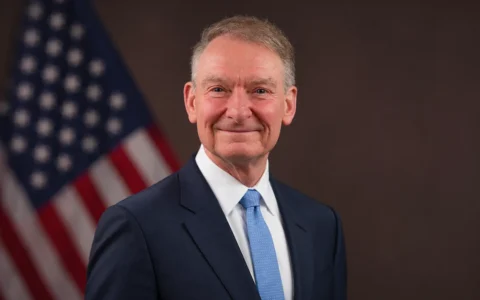
Federal Reserve Bank of Chicago President Austan Goolsbee warned Monday that rising prices for services are becoming harder to explain as a temporary effect of tariffs, pointing to a broader inflation problem even as employment and economic growth remain relatively steady.
His remarks at a Chicago economic forum put the emphasis on what happens after an initial import-price shock. If inflation is spreading through domestically supplied services rather than remaining concentrated in goods affected by trade policy, the Federal Reserve has less reason to expect price pressures to fade without a change in underlying demand.
Goolsbee addressed the issue during a November 9 question-and-answer session hosted by Leadership Greater Chicago. The Chicago Fed’s event announcement identified WBEZ and Chicago Sun-Times money editor Subrina Hudson as moderator. A contemporaneous account by FXStreet reported that he described services inflation as picking up in recent months and said the central bank needed to confront its difficulty bringing inflation under control.
The comments were not a policy announcement. They offered a view of the inflation risk facing officials ahead of the Fed’s next interest-rate meeting, particularly whether recent price increases stem from shocks that could dissipate or from spending and investment pressures that may prove more persistent.
Services prices complicate the tariff explanation
Tariffs can raise the cost of imported merchandise and of inputs used by U.S. producers. Those effects may filter into other prices over time, but a rise in the cost of services such as housing, transportation or medical care does not follow the same straightforward path as a tariff imposed on a physical good. Goolsbee’s concern is that the inflation picture cannot be understood by looking at imported merchandise alone.
September’s consumer price report gives some weight to that distinction. The Bureau of Labor Statistics said its index for services excluding energy services rose 0.4% from August, compared with increases of 0.3% in August and 0.2% in July. The index was up 3.1% over the 12 months through September. Those are different measures from the core CPI, which covers goods as well as services and excludes food and energy.
According to the BLS September CPI report, overall consumer prices climbed 0.6% during the month and 3.7% from a year earlier. Gasoline prices rose 9.1% in September, accounting for more than half of the month’s headline increase. That large energy contribution helps explain why the broader monthly figure was elevated, but it does not account for the continued rise in non-energy services.
The same report showed shelter costs advancing 0.4% in September after a 0.3% increase in August. Transportation services rose 0.6%, and medical care services increased 0.3%. The categories did not all move at the same pace, a reminder that services inflation is not one uniform trend. Still, the aggregate increase gives policymakers a reason to examine pressures outside the areas most directly exposed to tariffs or oil prices.
Core CPI, which excludes food and energy, increased 0.3% in September and 2.6% over the year. Its annual rate was below the headline reading because energy prices had risen sharply. Goolsbee’s warning is about the composition and persistence of inflation, not a claim that every underlying index is rising faster than the overall CPI.
Spending and hiring have not shown a broad downturn
The persistence question becomes more difficult when the economy is still expanding. In the account of Monday’s appearance, Goolsbee said employment and growth were relatively stable and identified inflation as the larger concern. That assessment is consistent with recent official releases showing ongoing hiring and consumer spending, although neither data series by itself establishes that demand is overheating.
U.S. employers added 165,000 jobs in October, according to the Labor Department’s November 6 employment report. The unemployment rate edged down to 4.1% from 4.2% in September. These figures do not portray a sudden collapse in labor demand, though they also do not mean that every worker, household or industry is experiencing the economy in the same way.
Household spending presents a related puzzle. The Bureau of Economic Analysis reported that nominal personal consumption expenditures increased 0.5% in September, but inflation-adjusted spending was little changed, rising less than 0.1%. The gap matters: households can spend more dollars because prices are higher without purchasing substantially more goods or services.
BEA’s preferred inflation gauge for Federal Reserve analysis, the personal consumption expenditures price index, rose 3.6% over the year through September. Its core measure, excluding food and energy, was up 3.1% and increased 0.3% over the month. The core PCE and core CPI indexes are constructed differently and should not be treated as interchangeable readings of the same basket.
Goolsbee also pointed to investment in data centers as an area where strong demand could create pressure on scarce resources, according to the FXStreet account. That observation is a possible channel for overheating rather than evidence that data-center construction has caused the broader increase in consumer-service prices. Isolating the source of the pressure remains important because the likely duration of inflation changes with its cause.
Rates are on hold as the Fed waits for more evidence
The Federal Open Market Committee left its benchmark rate in a 3.75% to 4.00% target range at its October 28 meeting. The decision passed 10 to 2, with Governors Lisa Cook and Beth Hammack favoring an increase of a quarter percentage point. The committee’s statement described economic activity as expanding strongly and inflation as still elevated.
Goolsbee’s remarks add to the debate over how much restraint is needed to return inflation to the Fed’s 2% objective. Rates can influence borrowing and spending, but they cannot directly reverse a tariff or increase the supply of energy. The distinction between an external price shock and demand-driven inflation therefore affects how policymakers assess the costs of acting too aggressively or waiting too long.
His comments should not be read as a signal that the committee has decided on another rate increase. Monetary policy is set collectively, and a regional Reserve Bank president’s public assessment does not establish how colleagues will vote. The October decision itself showed that officials could agree on the need to contain inflation while differing on the appropriate immediate step.
Fresh data will arrive quickly. The Labor Department is scheduled to release October consumer price figures on November 10, one day after Goolsbee’s appearance. A renewed rise in non-energy services would strengthen the concern he raised; moderation would provide evidence that the recent acceleration may not persist. The Fed’s next scheduled policy meeting is December 8-9.
More News


Latest News
View all news- RBI Injects ₹50,003 Crore Into Banking System Through Four-Day Repo Auction
- USDA Finalizes Rural Mortgage Rule Excluding Agent Commissions From Seller Concession Cap
- NRG Energy Agrees to Sell Six Natural Gas Power Plants to LS Power for $4 Billion
- New York Fed Research Finds Major U.S. Monetary-Policy Improvements Came Only in Recent Decades
- IRS Car Loan Interest Deduction Regulations Take Effect With $10,000 Annual Limit