

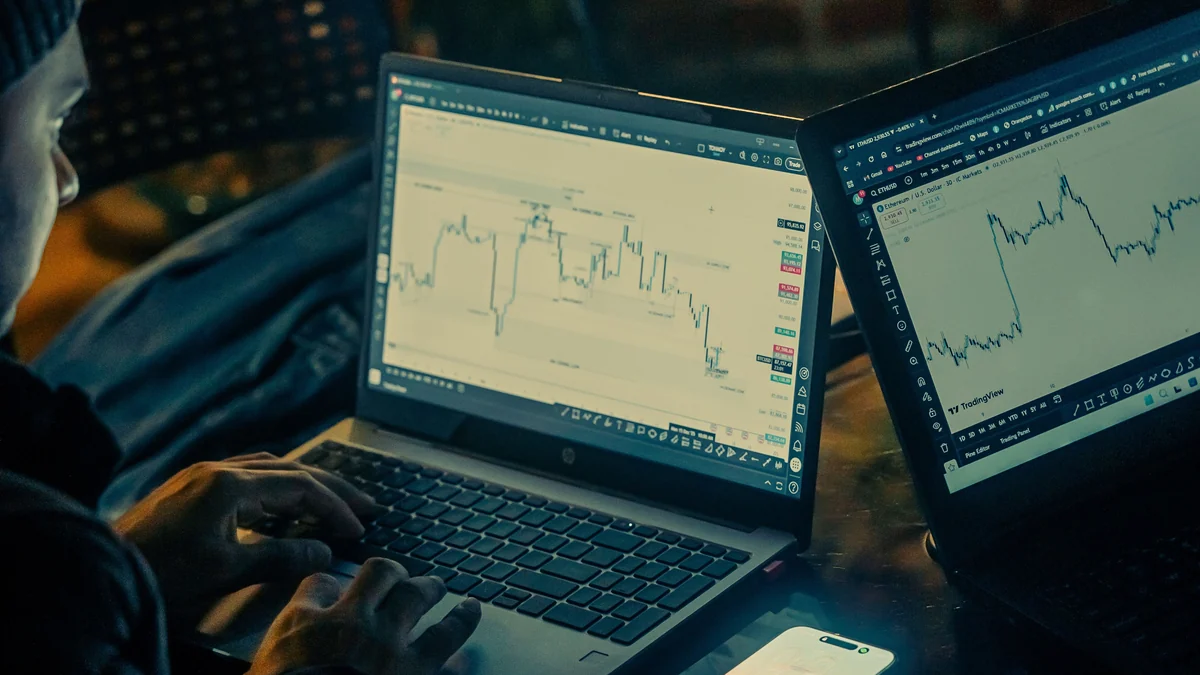
Stock trading looks simple at the screen level: choose a company, enter an order, and wait for the broker to confirm a fill. Behind that action is a chain of decisions and market processes involving your brokerage account, the quoted market, order instructions, execution venues, clearing, and settlement. Understanding that chain matters because the price you see before submitting an order is not necessarily the price you receive, and a trade is not fully complete merely because the app says it has been executed.
Trading also involves more than the mechanics of clicking buy or sell. The trader must decide what position to take, how much capital to commit, how long the position is expected to remain open, what would make the original idea wrong, and how much loss is acceptable if the market moves the other way. Those choices connect the mechanics of execution with the broader purpose of stock trading, which is to pursue a return while controlling the amount and type of risk taken.
What happens when you trade a stock
Most everyday stock trades take place in the secondary market. The company has already issued its shares, and investors are buying from or selling to other market participants rather than sending the purchase money to the company itself. When you are buying stock through a broker, the broker accepts your instructions and routes the order into a market structure designed to find an executable price under the terms you selected.
A completed transaction has several distinct stages. First, you decide what you want to trade and the conditions under which you are willing to trade it. Next, the broker receives the order and routes it to a trading venue or another market participant for execution. Once a compatible buyer and seller are matched, the trade is executed. Clearing and settlement then complete the exchange of securities and money. FINRA describes this as a trade lifecycle in which an investor’s order moves from account access and order entry through routing, execution, confirmation, clearing, and settlement.[1]
Those stages can happen so quickly that they appear to be one event, especially in liquid U.S. stocks during regular market hours. They are still economically different. Execution determines the actual trade price and quantity, while settlement is the later completion of the contractual exchange. That distinction becomes important when an order fills only partly, a market moves rapidly, a broker restricts an order type, or cash and securities are not yet settled.
The trade starts with a position, not an order ticket
Before choosing an order type, the trader must decide what position is being taken. A long position is the familiar case: you buy shares because you expect their value to rise or because you want to receive whatever shareholder benefits apply while you own them. Profit or loss is then determined by the difference between the purchase price and the eventual sale price, adjusted for trading costs, dividends, taxes where applicable, and other cash flows.
A short position works differently. In a conventional short sale, the trader sells shares that are borrowed for delivery and later buys shares to close the position. A falling price can produce a gain because the shares may be repurchased for less than the short-sale proceeds, while a rising price produces a loss. Short selling introduces risks that do not exist in the same form for an ordinary long purchase, including the possibility of losses continuing to grow as the stock price rises and the possibility that borrowed shares become difficult or expensive to maintain.
The account itself determines which transactions are available. A cash account generally requires purchases to be paid with available funds under the broker’s rules, while a margin account can permit borrowing against eligible securities and is normally required for conventional short selling. Borrowing magnifies exposure because the trader controls a larger position than the cash contribution alone would support. The amount of capital available is a fundamental one among the decisions that shape position size, but the more useful question is how much of that capital should be exposed to one trade.
Leverage should not be treated as a fixed characteristic of stock trading. Regulatory minimums, broker requirements, security eligibility, account type, concentration, and market conditions can all affect how much borrowing is available, and brokers may impose requirements above regulatory minimums. Products such as forex and contracts for difference have different structures and leverage rules, so comparisons with stock positions need to account for the actual product rather than assuming one universal leverage ratio.
Quotes, bids, asks, and the price you actually receive
A stock quote is not one guaranteed transaction price. At a given moment, the bid represents the highest displayed price at which someone is willing to buy under the quoted conditions, while the ask represents the lowest displayed price at which someone is willing to sell. The difference between the two is the bid-ask spread. A narrower spread usually reduces the immediate cost of crossing from one side of the market to the other, although the quoted spread is only one component of execution quality.
The last traded price is different from the current bid and ask. It simply reports the price at which a previous transaction occurred. If the market has moved since that trade, an investor who submits a new market order may receive a different price. In a fast market, a large order can also consume shares available at one price and continue filling at worse prices, which is one reason the displayed quote should not be confused with a promise.
Liquidity influences how readily a position can be entered or exited without materially moving the price. Highly traded large-cap stocks often have deep markets and small spreads, while less active securities can have fewer standing orders and wider gaps between available prices. The universe of different stocks in the market therefore includes meaningful differences in trading conditions even when the order ticket presented by a broker looks almost identical.
Market, limit, and stop orders control different risks
A market order tells the broker to seek execution promptly at the best available price under prevailing conditions. Its main advantage is execution priority rather than price certainty. Investor.gov notes that a market order generally seeks immediate execution but does not guarantee the execution price, so the final fill can differ from the quote that was visible when the order was entered.[2]
A limit order does the opposite trade-off. A buy limit order specifies the highest price the trader is willing to pay, and a sell limit order specifies the lowest price the trader is willing to accept. The order therefore protects the price boundary, but it does not guarantee that a trade will occur. If the market never reaches an executable price, or if other orders have priority at that price and available liquidity is insufficient, the order may remain unfilled or only partially filled.
That makes the old idea that limit orders are inherently a bad way to trade too broad. A limit order can be particularly useful when a stock has a wide spread, the trader is price-sensitive, the order is large relative to available liquidity, or the market is moving quickly enough that an uncontrolled execution price would undermine the trade. A market order can be appropriate when completing the transaction matters more than small price differences and the security is sufficiently liquid. The order type should match the risk the trader is trying to control.
Stop orders add another layer. A stop order is activated when a specified stop price is reached and then becomes an order to trade according to its terms, commonly a market order. A stop-limit order adds a limit price after the stop is triggered, which can prevent an execution at an unacceptable price but also introduces the possibility that the position will not be closed. Stop instructions can help formalize an exit, but they cannot guarantee the maximum loss when prices gap sharply or liquidity disappears.
What your broker does after you press Submit
Retail investors do not usually send orders directly to an exchange’s matching engine. The broker receives the order, checks that it can be accepted, and decides where to route it under the firm’s systems and regulatory obligations. Depending on the security and order, the destination can include an exchange, an alternative trading system, or an off-exchange market maker. A market maker is a firm prepared to buy and sell securities at quoted prices and may execute customer order flow against its own inventory or other liquidity.
The route matters because the market is fragmented across multiple venues rather than existing as one physical place where every order meets. Brokers are subject to best-execution obligations, which focus on seeking favorable execution terms for customer orders under the circumstances. Some brokers may receive payment for order flow from certain venues or market makers, which creates an economic relationship separate from the commission shown to the customer. Zero-commission trading therefore does not mean that execution has no costs or that every broker routes every order in the same way.
An order can also be filled in pieces. If you submit an instruction to buy 500 shares and only 200 shares are immediately available within your limit at the relevant venue, the first 200 might execute while the remainder waits, routes elsewhere, or is canceled depending on the order instructions. Large orders and less liquid stocks make partial fills more likely, but they can occur in ordinary trading as prices and available quantities change.
Time-in-force instructions determine how long an unfilled order remains active. A day order normally expires if it is not completed during the applicable trading session, while other instructions can keep an order active for longer or require immediate execution conditions. Broker terminology and available order qualifiers vary, so the practical meaning of an order depends on both the general order type and the specific instructions accepted by the broker.
Share quantity is not limited to 100-share lots
The traditional round lot for many U.S. stocks has long been associated with 100 shares, which helps explain older advice telling individual traders to buy in blocks of 100. That convention should not be confused with a requirement that an investor purchase at least 100 shares. Odd-lot transactions below the standard round-lot size are a normal part of modern markets, and many brokers also support fractional-share programs under their own terms.
The relevant position size should come from the trader’s capital, risk limit, stock price, expected volatility, and trading plan rather than a desire to force every trade into a 100-share block. Buying 100 shares of a $300 stock creates a $30,000 gross position, while ten shares create a $3,000 position. If the smaller exposure better matches the account and the amount the trader is prepared to lose, round-lot convention is not a sound reason to take ten times as much market risk.
Execution is followed by clearing and settlement
When an order is filled, the broker normally shows the transaction in the account quickly, but the market’s post-trade process is still continuing. Clearing determines what the parties owe, and settlement completes the delivery of securities and cash. For most U.S. securities transactions, the standard settlement cycle is T+1, meaning settlement occurs one business day after the trade date.[3]
The shorter settlement cycle does not turn every displayed account balance into unrestricted cash for every purpose. Brokers distinguish among trade date, settlement date, settled funds, margin buying power, and other account-specific figures. Traders using the same capital repeatedly need to understand those distinctions because transactions made with unsettled funds can create account problems under cash-account rules even when the previous sale already appears in the account history.
Settlement also explains why a trade confirmation contains more than the price visible on a chart. The confirmation records details such as the security, quantity, execution price, trade date, and settlement information, along with fees or other disclosures where applicable. Reviewing confirmations is a basic control because it allows the trader to verify that the broker’s record matches the instruction and the resulting position.
Stock selection and time horizon shape the trading plan
Trading mechanics tell you how a transaction occurs, but they do not tell you which stock to trade or whether the trade has a favorable expected outcome. Stock selection can be based on business fundamentals, valuation, price behavior, earnings events, macroeconomic conditions, quantitative signals, or a combination of methods. What matters is that the method gives the trader a reason for entering the position and a way to judge whether the original reasoning remains valid.
The holding period changes which information deserves the most weight. Someone making a multi-year investment may care primarily about earnings power, balance-sheet strength, reinvestment opportunities, and valuation. A swing trader might focus on an upcoming earnings report, a change in trend, or a sector move over days or weeks. Very short-term trading places greater emphasis on liquidity, spreads, volatility, and execution because a small price difference can represent a large share of the intended profit.
Trying to profit from shorter market movements also means timing the market for stocks becomes a larger part of the process. That does not make long holding periods automatically safe or short holding periods automatically reckless. A concentrated position in a weak business can remain risky for years, while a tightly controlled short-duration trade can have limited exposure per attempt. The relevant measure is the combination of probability, potential loss, potential gain, diversification, leverage, and the trader’s ability to execute the plan.
Risk and reward should therefore be assessed at the position level rather than through a slogan that higher return always requires proportionately higher risk. A sensible plan identifies how much can be lost if the thesis fails, what conditions would justify staying in the trade, and whether the potential upside is large enough to compensate for uncertainty and trading costs. A trader who cannot define the downside before entry is relying on the market to make the risk decision later.
Regular hours, extended hours, and trading halts
The quality of the market can change with the trading session. Regular U.S. exchange hours generally provide the deepest concentration of liquidity for listed stocks, while premarket and after-hours sessions often have fewer participants. Wider spreads, thinner order books, greater price jumps, and restrictions on available order types can make extended-hours execution materially different from trading in the main session.
Corporate news is often released outside regular hours, which creates a practical tension. A trader may want to react quickly, yet the thinner market can make the displayed price less reliable and the cost of immediate execution higher. The decision to trade outside regular hours should therefore account for both the information and the quality of the market available at that moment rather than treating access as equivalent to liquidity.
Trading can also be paused. Exchanges and regulators use trading halts and other mechanisms under specified circumstances, including certain news events, order imbalances, and extreme price movements. An open position cannot always be exited the instant a trader wants to leave it, so stop orders and planned exits reduce some forms of risk without eliminating market-structure risk.
Closing the position completes the trading cycle
A long position is normally closed by selling the shares that were purchased. A conventional short position is closed by buying shares to cover the borrowed position. The economic result is determined by the difference between entry and exit prices together with dividends, borrowing costs where relevant, commissions or fees, spread and execution costs, and taxes under the trader’s jurisdiction.
The exit should be part of the plan before the trade is entered. Some trades are designed around a price objective, others around an event or time window, and others remain open while a trend or business thesis stays intact. An exit can also be triggered because the evidence changed even if the price has not yet reached a predefined loss threshold. Treating every losing position as something that merely needs more time can turn a trade into an unintended long-term holding.
Likewise, an unrealized profit is not proof that the original analysis was sound. Markets can move favorably for reasons unrelated to the trader’s thesis, just as a well-researched idea can initially move in the wrong direction. A useful review process compares the result with the decision process: whether the entry conditions were present, whether position size matched the stated risk, whether execution was reasonable, and whether the exit followed the rules that were set in advance.
How the mechanics fit into a complete trading process
Stock trading works through a sequence rather than a single click. The trader chooses the security and direction, sizes the position, selects order instructions, sends the order through a broker, receives an execution if compatible liquidity is available, and then waits for clearing and settlement to complete the transaction. The position remains a live financial risk until it is closed, and the closing transaction goes through the same market process in reverse.
The broader choice between trading and investing changes the importance of each part of that sequence. A long-term investor may tolerate small execution differences because the expected holding period is measured in years, while an active trader pursuing modest price moves may be highly sensitive to spreads, slippage, partial fills, and session liquidity. Neither approach eliminates the need to understand what an order actually instructs the broker to do.
Good mechanics cannot turn a poor idea into a good one, but poor mechanics can damage an otherwise sound trade. Understanding how orders are priced, routed, executed, and settled gives the trader control over decisions that are actually controllable, while a defined thesis and risk plan address the market uncertainty that is not. That combination is a more accurate description of how stock trading works than the older picture of simply selecting a stock, choosing 100 shares, and pressing Buy.
Sources
- FINRA: How Online Stock Trading Works: Understanding the Trade Lifecycle
- Investor.gov: Types of Orders
- FINRA: Understanding Settlement Cycles