
SEC Charges Adit Ventures, CEO Over Alleged Pre-IPO Investment Fraud
The regulator alleges investors were misled about pre-IPO holdings, fees and the use of fund assets; the defendants agreed to a judgment without admitting the claims.
Our editorial standards
MarketReview publishes clear, independently produced financial information using reliable sources and transparent editorial standards.
Read our Editorial Policy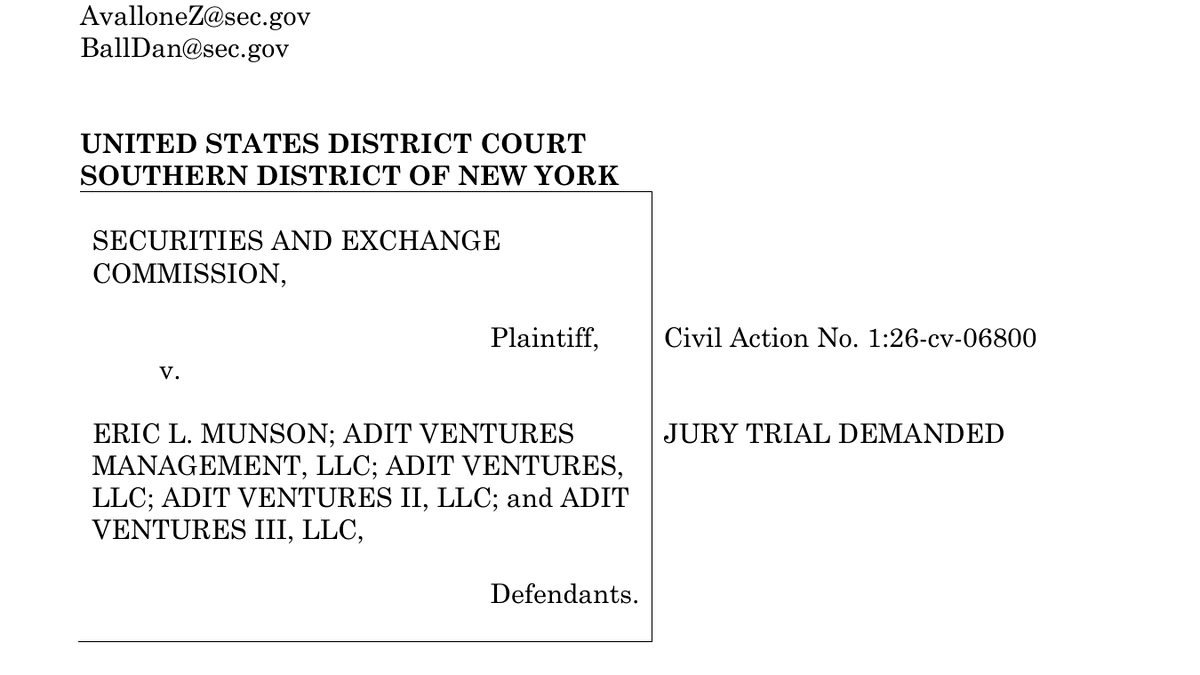
The Securities and Exchange Commission has charged New York-based Adit Ventures Management LLC, chief executive Eric Munson and three affiliated general partners with fraud tied to investments in private, pre-IPO companies, alleging that investors were misled about share ownership, transaction costs and the use of fund assets. The SEC said Monday the conduct involved investments including SpaceX and Klarna and ran from at least April 2019 through December 2024.
The case is a civil enforcement action, and the allegations have not been proven at trial. The defendants consented to the entry of a judgment without admitting the allegations, subject to approval by a federal judge. Munson separately rejected the SEC’s claims in a statement reported by Reuters, saying he was settling rather than pursuing litigation that he believed would not benefit him or his investors.
SEC says investors were misled over pre-IPO access
The SEC’s 49-page complaint says Adit Ventures Management and its affiliated general partners operated more than 60 private funds with more than 1,000 investors during the period at issue. Regulatory assets under management ranged from $123 million to $563 million over that span, according to the complaint, and the adviser reported about $465.9 million in regulatory assets under management in a March 2026 Form ADV.
The funds were marketed as vehicles that could give investors exposure to shares of private companies before an initial public offering or other liquidity event. The SEC says Munson controlled Adit Ventures Management’s operations and investment decisions, including transactions, loans, pricing for investor interests and payments from funds to affiliated general partners.
One of the regulator’s examples concerns a 2020 investment linked to Klarna. The complaint alleges that Munson told an investor that a special purpose vehicle controlled by Adit already owned 32,000 Klarna shares. According to the SEC, the vehicle did not own those shares when the representation was made, and the investor ultimately committed more than $15 million. The complaint says the investor generally would not invest in vehicles that did not already hold the underlying assets and likely would not have invested had it known the vehicle lacked the Klarna stock at the time.
The SEC describes a second example in which an investor contributed $5 million to an Adit-managed fund after Munson allegedly said he would personally invest $5 million of his own money alongside it. These claims are allegations in the Commission’s complaint, not findings by the court.
Complaint details alleged markups, fees and use of client assets
Beyond the solicitation claims, the SEC alleges a broader pattern in which client capital was used for the benefit of Adit-affiliated entities. The complaint says the defendants sometimes took unsecured loans from client funds on favorable terms, even though those loans were generally not authorized by fund agreements and were rarely disclosed to the funds or their investors.
The regulator also focuses on principal transactions involving pre-IPO shares. From April 2019 through November 2023, the complaint alleges, Adit-affiliated general partners completed more than 150 transactions in which they sold pre-IPO interests to client funds without the written disclosure and consent the SEC says were required. The Commission alleges that the general partners could buy shares or interests at one price and then cause a client fund to acquire them at a higher price, allowing the affiliate to keep the spread.
A SpaceX transaction cited in the complaint illustrates the allegation. The SEC says an Adit fund obtained an interest equivalent to about 13,100 SpaceX shares in 2021 at roughly $420 per share. The interest was then assigned to an affiliated general partner at cost and sold to another client fund at about $498 per share. The SEC alleges that the affiliate kept roughly $1.02 million in profit from the $78-per-share difference without the disclosures and client consent required for the transactions.
The complaint also alleges that Adit entities charged millions of dollars in unauthorized acquisition fees. In some cases, the SEC says fund agreements or side letters did not permit the fees, or investor documents showed an original purchase price equal to the investor price, which would indicate that no acquisition fee was due. The regulator says those payments reduced assets and cash that otherwise could have remained available for the funds and their investors.
Another part of the case concerns a $10 million third-party line of credit obtained for two affiliated general partners. The SEC alleges that Munson pledged assets belonging to multiple client funds as collateral, including millions of pre-IPO shares, and that investors were not told the assets had been transferred to a lender or could be liquidated if the general partners defaulted. The complaint says the facility carried a 17% annual interest rate and that the fund assets remained encumbered for about a year before the arrangement was restructured to remove them as collateral.
Defendants agree to judgment without admitting allegations
The SEC charged Munson, Adit Ventures Management and the three general partners with violations of antifraud provisions of the Securities Act, the Exchange Act and the Investment Advisers Act. The Commission also alleges that Adit Ventures Management operated for years without registering as an investment adviser when registration was required. The complaint says the firm had claimed the venture capital adviser exemption before registering with the SEC in March 2024, but the Commission alleges it did not qualify for that exemption.
Under the proposed resolution announced by the SEC, the defendants consented to permanent injunctions against violating the charged provisions. The court would also determine the amounts of disgorgement, prejudgment interest and civil penalties after a motion by the Commission. Munson agreed to a separate associational bar, with the right to seek reentry after three years. Because the judgment still requires court approval and the monetary amounts have not been set, those remedies are not yet final.
Munson’s denial is important to the legal posture of the case. Reuters reported that he said he rejected the allegations completely and chose to settle because continuing the fight would not benefit him or the investors he has served. The SEC’s complaint therefore sets out the government’s allegations and evidence theory, but it is not a judicial finding that each alleged act occurred as described.
The case also highlights a risk that can be harder for investors to evaluate in private markets than in exchange-traded securities: the structure between the investor and the underlying company can matter as much as the name of the company itself. SEC investor education materials warn that pre-IPO investments can be difficult to verify, may involve limited disclosure and can leave investors with restricted or illiquid interests rather than readily tradable shares. Those general risks do not establish wrongdoing in any particular offering, but they make disclosures about ownership, fees, conflicts and custody especially important when investors are seeking access to closely held companies.
The next formal step is court review of the defendants’ consented judgment in the Southern District of New York. The amount of any disgorgement, interest and civil penalty will be determined later if the proposed resolution is approved.
More from Investing

Latest News
View all news- Zscaler Reaffirms Q1 and FY2027 Financial Guidance at Investor Day
- U.S. Trade Deficit Widens 13.7% to $105.6 Billion in August as Imports Surge
- MIAX Hits Record 17.1% YTD U.S. Options Share as ADV Rises 22%
- Lamb Weston Raises FY2027 Outlook After First-Quarter Results
- Japan’s 10-Year Government Bond Auction Clears Near 3.10% With a 3.1% Coupon
