Pentagon Taps Boeing and RTX to Expand SM-3 Interceptor Production
Two framework agreements target component capacity for SM-3 Block IB and Block IIA interceptors, but the Pentagon did not disclose values, unit targets or production schedules.
Our editorial standards
MarketReview publishes clear, independently produced financial information using reliable sources and transparent editorial standards.
Read our Editorial Policy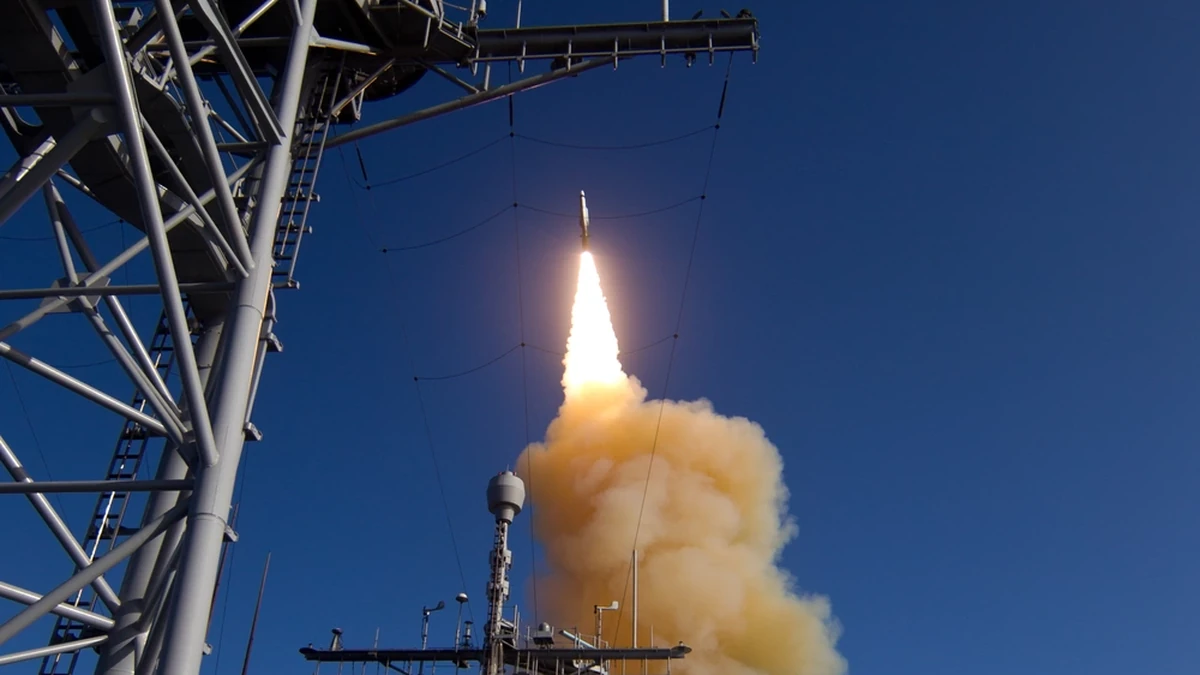
The Pentagon on Friday announced two framework agreements with Boeing and RTX aimed at expanding production of key components for Standard Missile-3 Block IB and Block IIA interceptors, adding another step to the U.S. military’s effort to increase missile-defense manufacturing capacity.
The agreements are a production-capacity signal rather than a disclosed contract-value event. The Pentagon did not announce dollar values, guaranteed purchase quantities, unit production targets or a schedule for when the additional output would reach the fleet. That limits what investors can reasonably infer about near-term revenue for either Boeing or RTX.
In its August 14 release, the U.S. Department of War said the agreements cover key components used in SM-3 Block IB and SM-3 Block IIA interceptors, which support the Aegis Ballistic Missile Defense System. The department said production of both variants will accelerate under the new frameworks, with Boeing driving component manufacturing.
Boeing will play a larger role in the production push
Boeing is not new to the SM-3 supply chain. The company says it manufactures critical hardware for multiple SM-3 variants used in the Aegis ballistic-missile defense system. Friday’s announcement matters because the Pentagon explicitly placed Boeing’s component manufacturing at the center of the planned production acceleration.
The SM-3 family is built to intercept ballistic missiles during the midcourse portion of flight. RTX’s Raytheon business describes the Block IB as an interceptor with an enhanced two-color infrared seeker and upgraded steering and propulsion capability. The Block IIA, developed in cooperation with Japan, uses larger rocket motors and a larger kinetic warhead to defend a broader area and address more demanding ballistic-missile threats.
Those differences make production capacity a supply-chain issue as much as a final-assembly issue. The Pentagon’s release did not identify the individual components Boeing will expand, the facilities involved or the capital spending required. It also did not say whether the Boeing framework contains minimum purchase commitments. The clearest confirmed point is that the department wants more component throughput for both SM-3 variants and has formally brought Boeing into that expansion effort.
For Boeing, the agreement lands inside a defense business that generated $7.48 billion of revenue in the second quarter of 2026, up 13% from a year earlier. Boeing Defense, Space & Security ended the quarter with an $85 billion backlog. Those figures show the scale of the segment, but the Pentagon’s new SM-3 frameworks cannot yet be tied to a specific share of that backlog or to a measurable revenue contribution because no financial terms were disclosed.
RTX had already committed to faster SM-3 output
The RTX side of the announcement builds on a broader production push already underway. In February, Raytheon entered into five up-to-seven-year framework agreements with the Pentagon covering Tomahawk, AMRAAM, SM-3 Block IB, SM-3 Block IIA and SM-6 production. RTX said at the time that it would increase SM-3 Block IIA production and accelerate SM-3 Block IB production, although it did not publish separate annual unit targets for the two SM-3 variants.
RTX also said many of the munitions covered by those February frameworks would eventually reach production rates two to four times existing levels. That statement applied to the broader group of weapons rather than establishing a specific multiplier for SM-3. The company said the associated production work would be performed at Raytheon facilities in Tucson, Arizona; Huntsville, Alabama; and Andover, Massachusetts.
Friday’s Pentagon release therefore does not appear to represent the first indication that Raytheon will expand SM-3 output. Its importance is that the government is now highlighting component-level capacity involving both RTX and Boeing, consistent with a broader acquisition strategy that seeks to work deeper into the supplier base rather than relying only on prime-contract awards.
That approach is especially relevant for missile systems, where production can be constrained by specialized components long before final assembly. The Pentagon said its Acquisition Transformation Strategy enabled the new frameworks by allowing the department to engage suppliers at every level of the industrial base. It framed the agreements as part of an effort to stabilize supply chains and move the defense industrial base toward higher munitions output.
RTX enters that push with strong defense demand already visible in its results. Raytheon’s second-quarter sales rose 18% to $8.27 billion, with RTX citing higher volume in land and air defense systems, naval programs, and air and space defense systems including Standard Missile. RTX ended the quarter with $119 billion of defense backlog within a total company backlog of $289 billion.
The investor signal is capacity, not disclosed revenue
For shareholders of Boeing and RTX, the most important distinction is between an agreement to expand production capacity and a fully quantified procurement award. The Pentagon’s announcement supports the view that demand for missile-defense hardware is moving toward sustained higher output. It does not, on its own, establish how much incremental revenue either contractor will recognize, what margins the work could carry or how quickly the production increase will translate into deliveries.
The same caution applies to Boeing. Although the Pentagon said Boeing will drive component manufacturing under the new frameworks, Boeing remains a diversified company whose second-quarter revenue was $24.6 billion, with commercial airplanes accounting for nearly half of that total. A production framework for SM-3 components may be strategically useful to its defense portfolio without being financially material at the company level unless follow-on orders are large enough.
RTX has more direct exposure to missile production through Raytheon, and Standard Missile programs were already contributing to higher segment sales before Friday’s announcement. Even there, the missing terms matter. Neither the Pentagon nor Reuters disclosed the value of the new frameworks, and the government release did not provide a production-rate target for SM-3 Block IB or Block IIA.
That makes Friday’s development most useful as evidence of the Pentagon’s intent to expand interceptor capacity across multiple suppliers. It confirms Boeing’s component-manufacturing role in the acceleration and reinforces RTX’s existing commitment to higher SM-3 output, but it does not yet provide enough information to model a contract-sized earnings impact for either company.
More News



Latest News
View all news- UK Trade Remedies Authority Proposes Five-Year Anti-Dumping Duty on Chinese Rutile Titanium Dioxide
- Safe Pro Expects Q3 Revenue Above $2.5 Million as U.S. Government Contract Work Accelerates
- OCC Launches Direct Payments-Fraud Reporting Tool for Community Banks
- Norway Proposes NOK 608.4 Billion in Wealth-Fund Spending and NOK 6.4 Billion Income-Tax Cut in 2027 Budget
- New York Fed Research Finds Most Firms Barely Change Investment After Rate Shocks, but a Small Minority React Sharply