
India, Uzbekistan Upgrade Economic Ties, Move Toward Preferential Trade Deal
India and Uzbekistan elevated ties to a Comprehensive Strategic Partnership, set a $5 billion trade target for 2030 and pushed ministries to advance the next steps toward a preferential trade deal.
Our editorial standards
MarketReview publishes clear, independently produced financial information using reliable sources and transparent editorial standards.
Read our Editorial Policy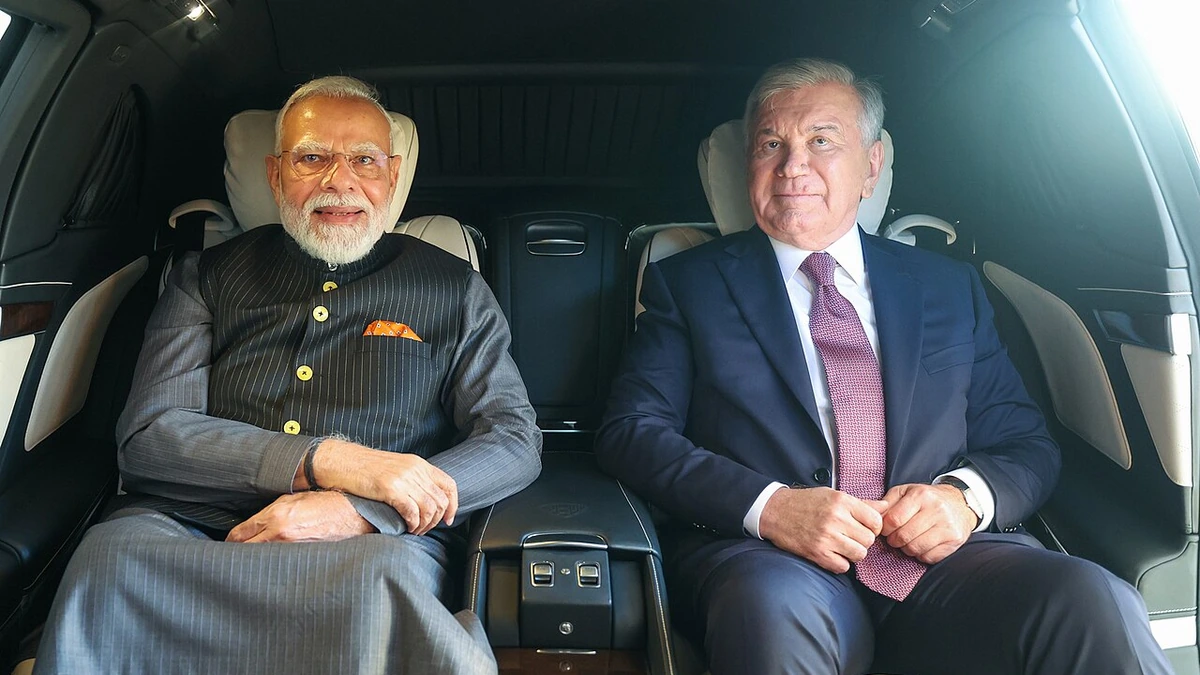
India and Uzbekistan agreed on Aug. 30 to elevate their relationship to a Comprehensive Strategic Partnership, set a bilateral trade target of $5 billion by 2030 and move ahead with the next steps toward a preferential trade agreement. The announcements came during Prime Minister Narendra Modi’s state visit to Tashkent, where he held delegation-level talks with Uzbek President Shavkat Mirziyoyev.
The economic message was broader than a single trade pledge. Both governments paired the new target with commitments to remove non-tariff barriers, promote industrial cooperation, deepen investment ties and widen work on digital trade, critical minerals, tourism and financial dialogue. At the same time, the language on a preferential trade deal remained carefully limited. No agreement was signed on Sunday, and neither side published tariff schedules or a closing timetable.
Instead, the joint statement released by the Indian government said the two leaders were acting after the conclusion of a Joint Feasibility Study on an Uzbekistan-India Preferential Trade Agreement. They directed the relevant ministries to explore the next steps on a time-bound basis. That makes the Aug. 30 development a meaningful policy advance, but still short of a completed trade accord.
Trade target puts structure around a broader economic upgrade
The clearest headline commitment was the decision to push bilateral trade to $5 billion by 2030. In a separate account of the talks, India’s Prime Minister’s Office said the two leaders paired that goal with plans to host a Business Summit aimed at deepening economic and investment ties. The same official summary said the broader bilateral Strategic Partnership would now be elevated to a Comprehensive Strategic Partnership, giving the trade agenda a higher political frame.
Trade policy details in the joint statement suggest both sides want something more practical than a symbolic target. India and Uzbekistan agreed to undertake joint measures to broaden the range of goods traded between them, address non-tariff restrictions and promote industrial cooperation. They also decided to create a Joint Working Group focused on non-tariff issues and investment barriers in key sectors of bilateral trade.
That point matters because preferential trade negotiations often stall well before tariff talks are finished. Market access can be shaped just as much by product standards, customs procedures, licensing hurdles and other administrative barriers. The joint statement therefore tied the proposed PTA pathway to a broader program of regulatory dialogue, with both sides agreeing to explore mutual recognition arrangements intended to support faster access to each other’s markets.
The sectoral emphasis was also quite specific. The two governments said they saw strong untapped trade potential in electrical goods, engineering products, automobiles and pharmaceuticals. They expressed interest in expanding e-commerce cooperation, digitalizing trade procedures and using digital platforms that could make it easier for small and medium-sized businesses to participate in bilateral trade.
Uzbekistan’s side also thanked India for supporting its accession to the World Trade Organization, and both governments said they would work to preserve a multilateral trading system centered on the WTO. That language does not directly change bilateral market access, but it shows the proposed preferential trade path is being framed as part of a wider effort to anchor commerce in more formal rules and institutions.
Agreements signed in Tashkent widen the commercial agenda
The trade push was backed by a larger package of agreements and announcements released in the official list of outcomes from the visit. Among the most directly economic items was a memorandum of understanding between India’s Ministry of Finance and Uzbekistan’s Ministry of Economy and Finance to create an Economic and Financial Dialogue. That mechanism should give the two sides a more regular forum for discussing macroeconomic and investment issues beyond leader-level visits.
Another business-relevant outcome was a memorandum between India’s Ministry of Mines and Uzbekistan’s Ministry of Mining Industry and Geology on cooperation in geology and mineral resources. Critical minerals also featured prominently in the leaders’ joint statement, which said the two countries would explore joint projects in geological exploration, mining, mineral processing and integrated value chains. India’s official account of the talks added that Modi welcomed progress in the long-term arrangement for uranium supply from Uzbekistan to India.
Digital payments and trade facilitation were part of the package as well. The outcomes list included a commercial agreement between NPCI International Payments Ltd. and Uzbekistan’s National Interbank Processing Centre to enable Indian UPI apps to scan Uzbekistan’s national QR system, UZQR, for merchant payments inside the country. That is not a trade pact in itself, but it can support tourism, business travel and smaller commercial flows by making cross-border retail payments easier for Indian users in Uzbekistan.
Investment promotion was another recurring theme. The joint statement said the leaders agreed to identify mutually beneficial investment opportunities and set up an institutional mechanism to address investors’ concerns and improve ease of doing business. It also called for closer cooperation between Uzbekistan’s Investment Promotion Agency and Invest India through business forums, roadshows, seminars and other stakeholder events designed to encourage two-way investment.
Several other signed documents were less directly tied to trade volumes but still relevant to the broader commercial relationship. The two governments signed arrangements in higher education and scientific research, tourism, environmental cooperation, archival work and Ayurveda. Gujarat and Uzbekistan’s Samarkand region also signed a partnership agreement, which could eventually support subnational business links and sector-focused cooperation.
Implementation will decide how far the economic reset goes
Sunday’s announcements clearly upgraded the tone and institutional depth of the India-Uzbekistan relationship. They also showed that the two governments want the economic side of the partnership to cover more than merchandise trade alone. The agenda now spans market access, supply chains, digital infrastructure, finance, mining, pharmaceuticals, connectivity and investment facilitation, while a new Foreign Ministers-led mechanism and a ministerial-level Inter-Governmental Commission are meant to keep the overall partnership moving.
Still, several of the most market-sensitive steps remain prospective. The preferential trade agreement is still at the post-feasibility stage. The joint statement did not specify which products could receive preferential access, what tariff reductions might be considered, or when formal negotiations might conclude. Likewise, the new Joint Working Group on non-tariff barriers and the proposed institutional channel for investor concerns will matter only if they begin producing measurable changes for exporters and companies on the ground.
For that reason, the visit’s economic significance lies as much in the direction of travel as in the signed texts themselves. India and Uzbekistan used the visit to formalize a more ambitious commercial relationship, attach a numerical trade goal to it and put ministries on notice that the trade framework should advance. Businesses now have a clearer political signal, but they still need the follow-through that turns declarations into easier market entry, smoother payments, investment protections and reliable project execution.
The next concrete markers are already built into the announcements. The leaders called for a Business Summit, agreed to raise the inter-governmental trade mechanism to the ministerial level and instructed ministries to work through the next steps on the proposed preferential trade agreement on a time-bound basis. Those implementation steps, rather than the symbolism of the visit alone, will show whether the new Comprehensive Strategic Partnership can deliver the $5 billion trade ambition by 2030.
More News
Latest News
View all news- Prologis Q3 Core FFO Rises to $1.60 a Share as Leasing Demand Holds Firm
- U.S. Natural Gas Storage Rises 67 Bcf to 3,567 Bcf, EIA Reports
- U.S. Business Inventories Increase 0.4% in August as Sales Climb 1.1%
- Philadelphia Fed Manufacturing Index Falls to 20.9 as Factory Growth Moderates
- New York Manufacturing Index Jumps to 25.5, Highest Since December 2021
