


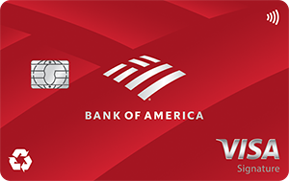
BankAmericard is a financing tool, not a rewards card
BankAmericard is easier to evaluate once you stop comparing it with cash-back and travel cards. It does not earn points, miles or cash back, and there is no conventional signup bonus. The product is built around one job: giving cardholders a long period of introductory financing on both new purchases and qualifying balance transfers.
Bank of America’s current online offer advertises 0% intro APR for 21 billing cycles. The formal pricing disclosure defines the period as the first 21 statement closing dates following account opening. The same 0% period applies to balance transfers, but only when those transfers are made within 60 days of opening the account. After the introductory period, the current variable APR is 14.99% to 25.99%, based on creditworthiness.
That structure can be valuable because 21 statement cycles is a long time to spread out repayment. It gives someone with a planned large expense more breathing room than a short promotional offer, and it can create a long interest-free payoff window for debt moved from another issuer. The card also has no annual fee, so there is no yearly charge reducing the value of the financing period.
The lack of rewards is not a minor omission. If you routinely pay your cards in full and do not need introductory financing, BankAmericard gives you very little ongoing economic value. A no-annual-fee cash-back card can return money on the same everyday purchases. BankAmericard is strongest when the interest savings are expected to be worth more than the rewards you are giving up.
That distinction drives our 4.6/5 MarketReview rating. The card is very good at the role it is designed to perform, but it is not a broad recommendation for every cardholder. A financing card should be judged on promotional length, fees, repayment flexibility and the cost after the promotion, not on how many unrelated perks can be added to the marketing page.
The 21-statement-cycle purchase offer is the cleanest use case
The purchase promotion is arguably BankAmericard’s best feature because there is no transfer fee involved. New purchases receive 0% intro APR for the first 21 statement closing dates after the account opens. If you have a necessary expense that you cannot or do not want to pay in one statement, the card can provide time to repay it without interest during the promotional period.
A planned purchase is very different from using a 0% offer as permission to overspend. The useful approach is to know the purchase amount, estimate how many statement cycles you actually have and set a repayment target before charging the expense. If you financed $6,300 and wanted to clear it evenly over 21 statement cycles, a simple illustrative target would be $300 per cycle. Paying faster would create more margin before the promotion ends.
The exact calendar length should not be treated as a guaranteed 21 months to a specific day. Bank of America’s disclosure ties the promotion to statement closing dates, not to a fixed number of calendar days. The first statement may close sooner than a full month after account opening, and billing-cycle timing can vary. A prudent repayment plan should therefore aim to finish early rather than assuming the last possible day will be available.
The current disclosure also says the purchase APR becomes 14.99% to 25.99% variable after the intro period. That makes the end date important. A remaining balance can become expensive quickly once the promotional rate expires. Someone using BankAmericard for a planned purchase should treat the 0% period as a deadline for repayment, not as a reason to make minimum payments indefinitely.
For this use case, the absence of rewards can be acceptable. If the alternative is carrying a large purchase at a normal credit-card APR, avoiding interest for the promotional period can be worth far more than earning 1% or 2% cash back. The key is that the financing benefit must solve a real cash-flow problem and the repayment plan must be realistic.
The balance-transfer offer is long, but the 5% fee changes the math
BankAmericard offers the same 0% introductory period on balance transfers made within 60 days of account opening. That creates a long debt-payoff window, but every transfer currently carries a 5% fee. Unlike some cards that discount the transfer fee during an introductory window, the current BankAmericard disclosure lists 5% of the amount of each balance-transfer transaction.
That fee deserves as much attention as the promotional APR. Moving a $5,000 balance would create a $250 transfer fee. If that fee is added to the balance, the starting amount becomes $5,250. Dividing that amount evenly across 21 statement cycles produces a simplified repayment target of $250 per cycle. A $10,000 transfer would create a $500 fee and a $10,500 starting balance, which works out to $500 per cycle over 21 cycles in the same simplified illustration.
Those numbers make BankAmericard’s trade-off clear. You are paying a relatively high upfront price for a long 0% period. That can still be a good exchange when the existing debt has a high APR and you genuinely need most of the 21-cycle window. It can be a poor exchange when the balance is small, the current APR is modest or you could repay the debt quickly enough that the 5% fee would approach the interest you would otherwise pay.
Consider a hypothetical $4,000 balance that could be repaid in four months. A 5% transfer fee would cost $200 immediately. If the existing card’s interest over those four months would be less than $200, transferring purely because the new card advertises 0% APR would not save money. The correct comparison is the transfer fee against the interest you expect to avoid, not 0% against the old APR in isolation.
The long window becomes more valuable as the required payoff period increases. Someone who needs 18 to 21 statement cycles to eliminate a high-rate balance may accept the 5% fee because the alternative is many months of expensive interest. Someone who can eliminate the same debt in three or four months should calculate the actual expected interest before paying a large transfer fee.
This is why BankAmericard can rank highly as a balance-transfer card without being the cheapest transfer in every situation. Promotional length and transfer cost are separate dimensions. Readers should compare it with the cards in our best balance transfer credit cards guide and choose the combination that fits their payoff timeline.
The 60-day transfer deadline is easy to underestimate
To receive the introductory balance-transfer APR, Bank of America currently requires the transfer transaction to be made within 60 days of opening the account. That is an important operational deadline. Getting approved for the card does not mean you can wait six months, decide to transfer a balance and still expect the original 0% offer to apply.
Anyone opening BankAmericard specifically for debt consolidation should have the transfer plan ready before applying. Know which outside balances you want to move, confirm they are eligible and make the request early enough to handle processing delays. Bank of America’s disclosure tells applicants to allow at least two weeks from account opening for balance-transfer processing and to continue paying the old creditor until the transfer appears as a credit.
That last instruction matters. A requested transfer does not instantly erase the old obligation. Missing a payment on the old account while waiting for a transfer can create late fees, credit-report problems or other consequences. Continue following the old account’s payment schedule until the transfer is visibly completed.
Bank of America also states that balance transfers cannot be used to pay or pay down an account issued by Bank of America or its affiliates. BankAmericard is therefore not a way to move existing Bank of America credit-card debt into a new BankAmericard promotional balance. The transfer strategy is intended for eligible debt from other issuers.
The 60-day requirement also means BankAmericard is less flexible for someone who wants a card “just in case” a transfer becomes useful later. Its value is highest when the debt-payoff need already exists at account opening and the transfer can be executed promptly.
No penalty APR helps, but late payments still matter
BankAmericard currently has no penalty APR. Bank of America specifically markets this as a feature: paying late will not automatically raise the interest rate to a higher penalty APR. That is genuinely useful on a financing card because a punitive rate increase could otherwise make an already difficult repayment plan more expensive.
No penalty APR does not mean there are no consequences for paying late. The current pricing disclosure lists late-payment fees of $30, with $41 for certain subsequent late payments within six billing cycles, subject to the disclosure’s limits. A missed payment can also have consequences outside the card’s APR, including possible credit-report effects depending on how late the payment becomes.
The practical value of the no-penalty-APR feature is resilience, not permission. A cardholder who makes a mistake is not automatically pushed into a special penalty interest rate, but the account still needs to be managed carefully. Automatic payments for at least the minimum due can reduce the risk of an accidental missed date, while a separate payoff schedule can target the larger amount required to finish before the introductory period ends.
Bank of America’s disclosure also explains how payments are allocated. Amounts above the total minimum payment generally go to higher-APR balances before lower-APR balances, after certain required allocations. This matters if the account contains different balance types. A simple BankAmericard strategy is easier to manage when the card is used primarily for the promotional purpose rather than mixing purchases, transfers and cash advances unnecessarily.
Using purchases and a balance transfer on the same card can complicate repayment
BankAmericard promotes 0% intro APR on both purchases and qualifying balance transfers, so using the card for both can appear harmless during the promotional window. The problem is not necessarily immediate interest during the intro period. It is that two different repayment goals can become one large balance, and the transfer fee increases the debt before any new purchase is added.
Suppose you transfer $8,000, incur a $400 fee and then charge another $3,000 of purchases. The account now has $11,400 of promotional balances before any additional activity. Even at 0%, clearing $11,400 over 21 statement cycles would require an illustrative average of about $543 per cycle. A borrower who originally budgeted only for the transferred debt may suddenly find the monthly target much harder to meet.
For that reason, we prefer BankAmericard as a focused financing tool. If the main goal is debt payoff, avoid adding discretionary purchases just because they also receive an introductory rate. If the main goal is a large purchase, think carefully before adding a balance transfer that makes the payoff target larger. Combining both can work, but only when the total repayment plan remains realistic.
The formal disclosure also contains detailed language about how interest can apply when balances are revolved and how different transaction types are treated. Cardholders should read the current application disclosure and account agreement rather than relying on a generic assumption about grace periods. The safest strategy is to minimize complexity and aim to clear all promotional balances before the intro period ends.
There is no rewards program, and that is a feature only in a narrow sense
BankAmericard does not earn cash back, points or miles. It also does not currently advertise a conventional cash or points signup bonus. That makes the product look thin next to cards with long benefit lists, but the omission keeps the economics easy to understand. The card is not asking you to justify a transfer fee by chasing rewards at the same time.
Still, no rewards should be treated as a real opportunity cost. If you put $15,000 of ordinary purchases on BankAmericard after you no longer need the introductory financing, you earn nothing from those purchases. A 2% cash-back card would return $300 on the same hypothetical spending, assuming all purchases qualified for the standard rate and balances were paid appropriately.
That is why BankAmericard’s long-term role can shrink after the promotion. There is no annual fee, so keeping the account open does not create a yearly charge, but new spending may be better directed to a rewards card once the financing need is gone. The account can remain a backup while another card handles everyday purchases.
The card does include Bank of America’s $0 Liability Guarantee for unauthorized transactions, subject to prompt reporting and verification. That is useful consumer protection, but it is not a rewards proposition. The product’s value should continue to be measured mainly by interest saved during the introductory period.
The foreign transaction fee makes this a poor travel card
BankAmericard currently charges 3% of the U.S. dollar amount of transactions made in a foreign currency. That alone is enough to make the card a poor choice for routine international spending. There are no travel rewards or travel credits to offset the fee.
A $2,000 equivalent of eligible foreign-currency purchases would create about $60 in foreign transaction fees at 3%. Since BankAmericard earns no rewards, the fee is a pure cost. Someone traveling abroad should generally use a card with no foreign transaction fee instead.
This limitation reinforces the product’s narrow role. BankAmericard is not trying to become your travel card, rewards card and financing card simultaneously. It is strongest when used for the introductory APR and weakest when used for spending that another product can handle more efficiently.
Who should consider BankAmericard?
The best candidate is someone with a specific financing need and a credible payoff plan. That could be a large necessary purchase that can be repaid over the first 21 statement cycles or high-interest debt from another issuer that can be transferred within 60 days and paid down before the promotional period expires.
For a purchase, the case is especially clean because there is no balance-transfer fee. You receive the long 0% period without paying an upfront transaction charge. If you already know the cost of the purchase and can calculate the required monthly payment, BankAmericard can be a practical cash-flow tool.
For a balance transfer, the candidate needs to be more selective. The 5% fee is easiest to justify when the existing debt is expensive and the long promotional period is necessary. Someone who can repay the old debt quickly should compare the transfer fee with the interest that would actually accrue before deciding.
The card can also appeal to someone who values the absence of a penalty APR. A late payment is still costly and should be avoided, but not automatically triggering a special penalty interest rate provides a degree of protection that is relevant on a debt-management card.
Finally, BankAmericard fits a user who does not care that the product has little long-term rewards value. If the financing objective is large enough, saving hundreds or thousands of dollars of interest can be much more important than earning a modest amount of cash back during the same period.
Who should skip BankAmericard?
Skip it if you pay every statement in full and have no planned use for the 0% APR. Without a financing need, the card’s main advantage disappears and the lack of rewards becomes the dominant feature. A strong no-annual-fee cash-back card is usually a better everyday tool.
It is also a weak fit for someone who needs a cheap balance transfer rather than a long one. The 5% fee is significant. A competing offer with a shorter 0% period and a 3% transfer fee can be less expensive if the balance can be repaid within the shorter window.
Bank of America customers trying to transfer debt from another Bank of America credit card cannot use BankAmericard for that purpose under the current terms. Transfers may not be used to pay Bank of America or affiliated accounts.
International travelers should avoid using it abroad because of the 3% foreign transaction fee. Rewards seekers should skip it because there is no rewards program. And anyone who is not confident about repaying before the promotional period ends should be cautious, since the ongoing variable APR can be costly once 0% financing expires.
Is BankAmericard worth it?
BankAmericard is worth considering when the long 0% period solves a specific financing problem. The purchase offer is particularly strong because it gives you the first 21 statement closing dates at 0% without charging an annual fee or a purchase transaction fee. For a large planned expense, that can be a straightforward way to spread payments while avoiding interest, provided the balance is eliminated before the regular APR begins.
The balance-transfer case is more conditional. Twenty-one statement cycles is a long payoff runway, but the 5% transfer fee is expensive. The fee can still be worthwhile on high-rate debt that would otherwise accrue substantial interest for well over a year. It is much harder to justify on a balance that could be repaid quickly.
No penalty APR is a meaningful supporting feature, and the current post-intro variable APR range starts lower than many mainstream credit-card ranges. Neither point changes the basic rule: the goal should be to repay during the 0% period, not to plan around the ongoing APR.
The lack of rewards keeps BankAmericard from being a compelling everyday card after the financing need ends. That is acceptable because the product does not need to do everything. A card that saves a borrower far more in interest than a rewards card would return in cash back can create substantial value even if it earns zero points.
We therefore rate BankAmericard 4.6/5. It is one of the stronger long-intro-APR options for someone who values time more than rewards and can tolerate the 5% transfer fee when moving debt. Readers focused on purchase financing should compare our best 0% APR credit cards. Readers focused on debt consolidation should compare the fee and promotional length across our best balance transfer credit cards before applying.