


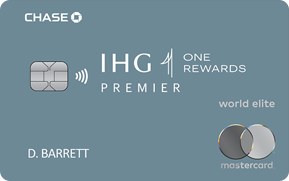
The $99 fee is really a question about one free night
IHG One Rewards Premier is easiest to evaluate by starting with the Anniversary Free Night rather than with the points multipliers. Each account anniversary year, the card currently provides a certificate good for an eligible Reward Night priced at 40,000 points or less. If the hotel costs more than 40,000 points, IHG currently lets the cardholder add points from the IHG account to cover the difference.
That benefit can make the $99 annual fee relatively easy to justify. A traveler who uses the certificate for a hotel night that would otherwise have cost more than $99 can recover the fee through one stay before considering Platinum Elite status, fourth-night-free award stays, the United TravelBank benefit or any points earned from purchases.
The benefit is only valuable when it gets used. A cardholder who does not stay at IHG during the certificate window cannot bank the full face value of the free night as cash. Hotel availability, dynamic award pricing and travel plans all affect whether the certificate turns into useful value.
This is the central question for the card: can you use one IHG night naturally each year? If the answer is yes, the annual-fee hurdle can be modest. If the answer is no, the card has to work much harder through rewards and secondary perks.
The Anniversary Free Night is more flexible now that points can top it up
A 40,000-point certificate can be restrictive when hotel award prices move above that threshold. IHG’s current rules improve the benefit by allowing existing IHG One Rewards points to be added when redeeming the Anniversary Free Night at a property priced above 40,000 points.
That top-up option matters because it reduces the risk of the certificate becoming unusable in expensive destinations. A property priced modestly above the certificate cap can still be within reach if the cardholder has enough points to cover the difference.
The option does not make the certificate unlimited. The cardholder still needs IHG points for the amount above 40,000, and award availability can vary. A hotel requiring a very large number of points can still be a poor use of the certificate if the top-up consumes too much of the points balance.
The best use is usually a hotel that fits the trip first and produces a reasonable cash or points savings second. Booking an unnecessary night solely to avoid wasting a certificate converts a benefit into extra spending.
The fourth Reward Night free can be more valuable than another earning category
IHG One Rewards Premier currently makes the fourth Reward Night free when points are redeemed for a stay of four or more consecutive Reward Nights. This can create substantial value on longer award stays because the benefit reduces the points required rather than simply giving a small rebate after the stay.
Imagine a four-night award where each night is priced at 30,000 points. Without the benefit, the simplified total would be 120,000 points. With the eligible fourth night free, the simplified requirement falls to 90,000 points. Real IHG stays can price differently from night to night, but the example shows why this perk matters.
The benefit becomes more powerful for travelers who accumulate enough IHG points for multi-night awards. A person who only stays one or two nights at a time may rarely use it, while someone taking longer family trips can save a meaningful number of points.
This perk also makes IHG Premier more interesting than a card evaluated only on annual fee versus free-night certificate. The combination of an anniversary certificate and fourth-night-free award stays can create recurring value for a traveler who is active in the IHG program.
The current 140,000-point offer is large, but hotel points are not bank points
Chase currently offers 140,000 IHG One Rewards bonus points after $3,000 in purchases within the first three months from account opening. The raw number is large, but 140,000 hotel points should not be compared directly with 140,000 transferable bank points.
IHG uses dynamic award pricing, so the number of points required for a room can vary by hotel, date and demand. The welcome bonus might cover several lower-priced nights, fewer expensive nights or a larger portion of a premium stay depending on where and when it is redeemed.
Chase’s current marketing says the offer can be worth up to four nights at thousands of IHG properties. That is useful context, not a guarantee that every cardholder will receive four nights from the bonus. A traveler targeting a high-demand luxury property can need far more points per night than someone booking a modest Holiday Inn Express.
The right way to value the bonus is to look at hotels the applicant is realistically likely to use. Search actual award prices for upcoming destinations, then decide whether IHG points solve a real travel need.
The $3,000 spending requirement averages $1,000 per month over three months. That is manageable for some households but should not become a reason to accelerate purchases or carry debt.
The separate 10,000-point authorized-user bonus should stay separate
Chase currently offers another 10,000 IHG points after the primary cardholder adds an authorized user within the first three months from account opening. The bonus is awarded once for the first authorized user added under the current terms.
That is real additional value, but it should not be casually folded into the 140,000-point headline offer. Adding an authorized user creates an account relationship. The primary cardholder remains responsible for purchases made on the account, and Chase reports account information for account users to the credit bureaus under its current terms.
An extra 10,000 points is worthwhile when adding the person already makes sense. It is not a good reason to give account access to someone whose spending the primary cardholder does not want to be responsible for.
Keeping the bonuses separate also makes the offer easier to compare. The main acquisition hurdle is $3,000 in purchases for 140,000 points. The authorized-user bonus requires a different action with different consequences.
The 24-month eligibility rule applies across personal IHG cards
Chase currently states that IHG One Rewards Premier is not available to current cardmembers of any personal IHG One Rewards credit card. The offer is also unavailable to previous personal IHG cardmembers who received a new-cardmember bonus for any personal IHG One Rewards credit card within the last 24 months.
This is broader than a rule that only looks at whether the applicant previously held Premier itself. Someone coming from another personal IHG card should read the application language carefully before assuming eligibility.
Business IHG cards are treated separately in the current public wording. Product and bonus rules can change, so the specific application page used at the time of applying should control.
The eligibility rule is especially important for hotel-card users who may have moved between IHG products in the past. A large bonus is only relevant when the applicant actually qualifies to receive it.
The advertised up to 26X at IHG is a stack, not a 26X card multiplier
IHG and Chase currently advertise up to 26X total points per dollar at participating IHG Hotels & Resorts for a Premier cardholder. The number is accurate in the context of the program, but it combines three separate earning layers.
The credit card itself earns 10X points at eligible IHG properties. IHG One Rewards members can earn up to 10X base points from the hotel program on qualifying stays. Platinum Elite status, which comes with the card, can add up to a 60% bonus on those base points, described by Chase as up to another 6X.
Ten plus ten plus six produces the advertised up-to-26X total. The full amount therefore depends on earning through the IHG loyalty program as well as paying with the card. It should not be interpreted as 26 points per dollar supplied solely by the credit card.
This distinction matters when comparing cards. A general travel card might advertise 3X hotel points from the card itself, while a hotel card advertises a larger total that includes loyalty-program earnings a member may receive even without the card.
Automatic Platinum Elite status is useful, but expectations should stay realistic
IHG One Rewards Premier currently includes automatic Platinum Elite status for as long as the eligible card account remains open. IHG lists benefits including a 60% bonus on base points, a welcome amenity at check-in, elite rollover nights, reward-night discount access and complimentary upgrades when available.
Status can improve the hotel experience, but it does not guarantee a suite, a specific room category or a particular check-in benefit at every property. Upgrade language is subject to availability, which means the actual experience can vary by hotel and occupancy.
The 60% bonus on base hotel points is more predictable because it is tied to eligible earning under program rules. For a frequent IHG guest, that additional program earning can compound with the 10X card rate.
Platinum status is most valuable to someone who stays enough to encounter the benefits repeatedly. An occasional guest may appreciate the welcome amenity and possible upgrade but should not assign premium-hotel-status value to benefits used once every few years.
Five points per dollar on travel, dining and gas makes the card usable away from IHG
IHG Premier earns 5 IHG points per dollar on eligible travel, dining and gas-station purchases. That gives the card useful bonus categories beyond hotel stays and can help build an IHG points balance between trips.
The rate is better than the 3X base earning on other purchases, but the value of five IHG points should be considered in the context of IHG redemption value rather than assumed to equal 5% cash back.
A traveler who is actively saving for an IHG redemption may find 5X attractive. Someone who does not have a specific IHG use for the points may prefer transferable points or cash back even when the numerical multiplier looks smaller.
Dining and gas are common household categories, which makes the card easier to use regularly than a hotel card that only earns well at its own brand. Travel is also broad enough to capture more than IHG hotel transactions under Chase’s current category rules.
Three points per dollar on other purchases sounds stronger than it necessarily is
IHG Premier earns 3 IHG points per dollar on purchases outside its higher-earning categories. Numerically, 3X looks better than a 1X base rate on many travel cards. The currencies are not equivalent.
IHG points are tied to IHG redemptions and can fluctuate in practical value as award prices change. Three hotel points per dollar should therefore not be assumed to beat 2 transferable points per dollar or 2% cash back.
A cardholder trying to maximize rewards may use IHG Premier for IHG stays and its 5X categories, then use a stronger catch-all card for large uncategorized spending. That can preserve the hotel-card benefits without forcing every purchase into one ecosystem.
For someone who wants simplicity and is happy earning IHG points everywhere, the 3X floor is still useful. The key is understanding the currency rather than comparing multipliers in isolation.
Up to $50 in United TravelBank Cash can reduce the effective fee for some travelers
Premier cardholders can currently receive up to $50 in United TravelBank Cash each calendar year after registering the eligible IHG Premier card with a MileagePlus account under the benefit terms.
This is potentially useful for someone who already flies United. It can create another recurring value stream alongside the Anniversary Free Night.
The benefit is not universal cash. Registration is required, the value lives in United TravelBank and the cardholder has to have a practical use for United travel. Someone who never flies United should value the benefit at little or nothing rather than automatically subtracting $50 from the annual fee.
Recurring credits are most useful when they fit existing behavior. The card becomes more compelling when IHG stays and United travel already appear in the household’s plans rather than when the cardholder has to manufacture transactions to use the perks.
The trusted-traveler credit is valuable, but it is not an annual benefit
IHG Premier currently reimburses up to $120 every four years for an eligible Global Entry, TSA PreCheck® or NEXUS application fee charged to the card.
That can offset most or all of an eligible application fee depending on the program, but the four-year cadence means the benefit should not be treated as $120 of value every year.
Spread mechanically over four years, the maximum reimbursement averages $30 per year before considering whether the cardholder would have paid for one of those programs anyway. The actual value is lumpy: it arrives when the application or renewal occurs.
The benefit is a useful extra for a traveler who already wants a trusted-traveler program, but it is not strong enough by itself to justify keeping a $99 hotel card.
The $20,000 spending bonus can be useful, but it should not dictate card choice
Chase currently offers a $100 statement credit and 10,000 bonus IHG points in each calendar year when at least $20,000 in qualifying purchases is made on the card.
That adds a milestone for higher spenders, but $20,000 is enough annual spending that opportunity cost matters. Routing those purchases to IHG Premier means giving up whatever rewards another card would have earned.
If a large portion of the $20,000 falls in IHG Premier’s 5X or 10X categories, reaching the threshold can make sense naturally. If most of it would otherwise earn 3X IHG points, a stronger flat-rate or transferable-points card might produce more value even after considering the $100 credit and 10,000-point bonus.
The threshold should be treated as an extra reward for spending that already belongs on the card, not as a target to chase at the expense of better earning opportunities.
The $40,000 Diamond Elite path is for committed IHG users
Primary cardmembers who make at least $40,000 in qualifying purchases during a calendar year can currently earn IHG One Rewards Diamond Elite status through December 31 of the following year.
Diamond can provide a stronger hotel-status package than the automatic Platinum status that comes with the card. The spending requirement is substantial, however.
Forty thousand dollars routed to a hotel card carries a large rewards opportunity cost. Someone considering the threshold should compare the incremental value of Diamond benefits with what $40,000 could earn on other cards.
The path is most relevant to an IHG loyalist who values Diamond specifically and can reach the threshold with spending that already fits the card. For a casual traveler, the automatic Platinum status is the more sensible benefit to evaluate.
No foreign transaction fee makes sense for an international hotel card
IHG Premier currently charges no foreign transaction fee. That is essential for a hotel card tied to a global lodging network because many IHG stays occur outside the United States.
A card charging 3% abroad would add $90 in issuer fees to $3,000 of foreign spending. Premier avoids that surcharge while continuing to earn under its normal category structure when transactions qualify.
The card can therefore be useful for IHG stays abroad as well as eligible dining and travel purchases. Dynamic currency conversion remains a separate issue, so choosing local currency is generally preferable when a foreign merchant offers to convert the transaction into U.S. dollars at its own rate.
The travel protections are solid for a $99 hotel card
IHG Premier includes travel protections under Chase’s current benefit structure. Eligible trip cancellation and interruption coverage can reimburse qualifying prepaid, non-refundable travel expenses up to current limits, including up to $5,000 per covered traveler and $10,000 per covered trip under the product materials we verified.
The value of protection depends on the claim, payment method and exclusions. A benefit headline is not the same as universal travel insurance. The Guide to Benefits should be checked before relying on coverage for an expensive trip.
Still, having meaningful protection on a $99 co-branded hotel card adds credibility to using the account for travel purchases instead of keeping it in a drawer solely for the annual free night.
The regular APR makes this a rewards card, not a financing card
Chase currently lists a 19.24% to 27.74% variable purchase APR for IHG Premier. The current public offer does not prominently advertise a 0% introductory purchase APR.
That makes carrying a balance expensive. A large welcome bonus can create the temptation to put $3,000 of purchases on the account quickly, but the bonus only creates net value when the spending fits the repayment plan.
Interest on a carried balance can erase the value of hotel points surprisingly quickly. A cardholder should not justify revolving debt by pointing to 10X, 5X or a 140,000-point signup offer.
Premier is best used as a pay-in-full rewards and benefits card. Someone needing long-term financing should compare a dedicated 0% APR product instead.
Who should consider IHG One Rewards Premier?
The clearest fit is someone who already stays at IHG at least once or twice per year and can use the Anniversary Free Night naturally. That recurring certificate can make the $99 annual fee easy to defend.
The card becomes more attractive for travelers who redeem IHG points for four-night stays because the fourth Reward Night free can stretch a points balance materially.
Regular IHG guests can also benefit from automatic Platinum Elite status, 10X card earning at IHG and the additional program earning that status can produce.
A traveler who uses United can add value through TravelBank, while someone approaching a Global Entry, TSA PreCheck or NEXUS application can benefit from the periodic statement credit.
Who should choose a more flexible travel card?
A traveler who does not favor IHG should not pay $99 simply because the welcome bonus number is large. Hotel points are most valuable when the traveler actually wants the hotels they can book.
Someone who wants transferable points across several airline and hotel programs may prefer a general travel card. Flexible currencies reduce the risk of being tied to one hotel brand’s award pricing.
A person who rarely takes four-night award stays and cannot use the anniversary certificate may leave the card’s two strongest recurring benefits unused.
Heavy general spenders should also compare the 3X IHG base earning with stronger catch-all cards rather than assuming the larger numeral means a better return.
The card earns its place in a wallet through use, not through the size of the bonus
IHG Premier can look irresistible when the discussion begins with 140,000 bonus points and an up-to-26X hotel earning headline. Those numbers are attention-grabbing, but they are not the best reason to keep paying $99 year after year.
The recurring case is more practical. Use the Anniversary Free Night for a stay you already wanted. Redeem points for four nights and pay for only three with points when the benefit applies. Take the Platinum status benefits when the hotel can provide them. Register for United TravelBank if United already fits your travel.
When those benefits overlap with real trips, the card can remain valuable long after the welcome bonus is gone. When they do not, the large first-year points balance can hide a weak long-term fit.
That is the right dividing line for IHG Premier. It is not a card to collect because the bonus looks big. It is a card to keep because IHG is already part of how you travel.