


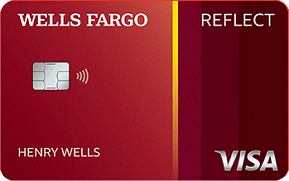
Reflect gives you more time, and charges more to move the balance
Wells Fargo Reflect is built around a simple trade-off. The card currently gives qualifying balance transfers a 0% introductory APR for 21 months from account opening, provided the transfer request is made within 120 days. In exchange, Wells Fargo charges 5% of each transfer, with a $5 minimum.
That makes Reflect almost the mirror image of a lower-fee, shorter-duration card such as PenFed Gold. PenFed can reduce the upfront transfer cost, while Reflect can reduce the monthly payment required to finish before interest begins.
Neither approach is automatically better. A borrower who can comfortably eliminate a transferred balance in 15 months should be reluctant to pay 5% simply to obtain six additional months that are not needed. A borrower whose budget becomes strained by a 15-month target may find the 21-month window much more valuable than the fee savings.
Reflect therefore needs to be judged by total repayment feasibility rather than by the fee or intro period in isolation. The best offer is the one that gets the balance to zero at the lowest realistic total cost.
The 5% balance-transfer fee is expensive enough to calculate before applying
A 5% balance-transfer fee sounds like a small percentage until it is applied to a large balance. A $5,000 transfer costs $250. A $10,000 transfer costs $500. A $15,000 transfer costs $750.
That fee becomes part of the economics immediately. If the fee is added to the account balance, a $10,000 transfer can begin as roughly $10,500 before any new purchases or other account activity.
A competing card charging 3% would cost $300 on the same $10,000 transfer, a $200 difference. On $15,000, the 5% fee costs $750 versus $450 at 3%, a $300 difference.
The extra fee should not be dismissed merely because the APR is 0%. Zero interest does not mean zero financing cost. Reflect is compelling when the additional months create enough repayment flexibility to justify paying more upfront.
Twenty-one months can materially change the monthly payoff target
The easiest way to understand Reflect’s value is to convert the transferred balance into a monthly target. Assume a $10,000 transfer and the current 5% fee. The simplified starting balance is $10,500.
Spread evenly across 21 months, the payoff target is $500 per month. A $7,500 transfer plus a $375 fee creates a simplified $7,875 starting balance, or $375 per month over 21 months.
A $5,000 transfer plus the $250 fee creates $5,250 to repay, which works out to $250 per month over 21 months.
Those figures ignore timing details, minimum-payment mechanics and any additional transactions, but they provide the most important planning information: the amount that has to leave the monthly budget if the balance is to reach zero before the promotional period ends.
A borrower who cannot support that payment should not assume the 21-month offer will solve the debt automatically. The promotional period creates time, not repayment capacity.
Why paying a 5% fee can still beat a cheaper transfer
Suppose a competing card charges 3% but offers only 15 months. A $10,000 transfer would create a $300 fee and a simplified $10,300 starting balance. Repaid across 15 months, that requires about $687 per month.
Reflect charges $500 on the same transfer, creating a $10,500 simplified starting balance. Across 21 months, the monthly target is $500.
The lower-fee card saves $200 upfront, but Reflect lowers the illustrative monthly payment by roughly $187. For a household whose budget can handle $500 but not nearly $700, the higher transfer fee may purchase something genuinely useful: a realistic repayment schedule.
For a borrower who can already afford $700 per month, the opposite conclusion may be correct. Paying Reflect’s higher fee can be unnecessary when a cheaper card already provides enough time.
This is why a balance-transfer comparison should start with the monthly payoff target, not with whichever card advertises the longest promotion.
The 120-day transfer deadline is a real competitive advantage
Reflect currently gives the cardholder 120 days from account opening to request a qualifying balance transfer for the introductory APR. That is a much longer decision window than offers requiring transfers within 60 days.
The extra time can be useful when a borrower has several balances, is waiting for statements to close or wants to confirm which debts should be transferred first. It can also reduce the pressure to submit every transfer request immediately after receiving the card.
The 120-day window should not become an excuse to wait until the last moment. Wells Fargo says a balance transfer can take up to 14 days to post. A cardholder approaching the deadline should account for processing time and the exact wording in the promotional terms.
The longer deadline is especially valuable when the approved credit line is lower than expected. A borrower can prioritize which balances to move instead of assuming the entire intended amount will fit.
Processing time means the old card still needs attention
Wells Fargo says balance-transfer requests may take up to 14 days to post. During that period, the borrower remains responsible for the original account.
A common mistake is to stop paying the old card as soon as a transfer request is submitted. The old issuer can still require a payment before the transfer arrives. Missing that payment can create late fees, interest and credit-reporting problems.
The safer approach is to keep making required payments on the old account until the transfer has posted and the remaining balance has been confirmed.
If Wells Fargo approves less than the full requested transfer amount because of the available credit line, the old card can also retain a balance. Checking both accounts after the transfer is essential.
You cannot use Reflect to move another Wells Fargo credit-card balance
Wells Fargo explicitly states that balance transfers are not available between credit-card accounts issued by Wells Fargo or its affiliates.
That matters because a Wells Fargo customer with debt on another Wells Fargo card cannot simply open Reflect and move that balance internally to receive the 0% promotion.
The card is more useful for debt held with other issuers. Someone already carrying a Wells Fargo credit-card balance should confirm that the target debt is actually eligible before applying specifically for the transfer offer.
This is an easy restriction to miss when a card is compared only on intro length and fees.
The purchase promotion is equally long
Reflect also currently offers 0% introductory APR for 21 months from account opening on purchases. That gives the card a second job beyond balance transfers.
A planned $4,200 purchase divided evenly across 21 months produces an illustrative payment target of $200 per month. A $6,300 planned expense would require about $300 per month in a simplified no-interest repayment schedule.
The promotion can be useful for a necessary appliance, home repair, medical cost or another expense that has already been budgeted. The cardholder gets time without paying an annual fee.
The danger is treating 21 months as permission to spend more. A long 0% period can make a large balance feel less urgent because no interest is appearing on the statement. The repayment deadline still exists, and the regular APR after the promotion is high enough to matter.
Using one card for a transfer and new purchases can make the plan harder to read
Reflect allows both purchases and qualifying balance transfers to receive the 0% introductory APR under the current offer, but using both at once can complicate a payoff strategy.
A cardholder who transfers $8,000 and then adds $500 of new purchases every month can make large payments without seeing the total balance fall as quickly as expected.
The account may still be at 0%, but the required payoff amount at the end of the 21-month period keeps growing. A promotional APR does not prevent overspending.
Someone opening Reflect to consolidate debt may prefer to reserve the card for the transferred balance and use another account or debit card for routine spending. Someone opening it for a single planned purchase can define that purchase before the card arrives.
A financing card works best when it has one clear job.
No rewards can help keep that job clear
Reflect has no standard cash-back or points program. That is a weakness for someone looking for a long-term everyday card, but it can be useful during a debt-payoff period.
There is no signup-spending threshold to chase and no bonus category encouraging continued use. The cardholder does not need to rationalize new purchases as a way to “earn something back.”
A 2% reward is trivial compared with the cost of carrying thousands of dollars at a regular APR after the promotion ends. Reflect keeps the value proposition focused on avoiding interest rather than generating rewards.
Once the balance is gone, a separate rewards card can handle everyday spending more efficiently.
The post-intro APR makes month 21 a deadline, not a suggestion
Wells Fargo currently lists one of three variable APRs after the introductory period: 17.49%, 23.99% or 28.24%, based on creditworthiness. The same current APR structure applies to purchases and qualifying balance transfers after the promotion.
The upper end is expensive enough to erase the benefit of a carefully planned 0% transfer if a large balance remains. Even the lowest current rate is still a meaningful borrowing cost.
A borrower should therefore build a schedule that reaches zero before the promotional period ends rather than treating month 21 as the date to begin thinking about the remaining balance.
If the plan shows a large amount left after 21 months, the problem is not that Reflect’s promotion is too short. The starting balance or monthly payment target may simply be too large for a credit-card transfer to solve on its own.
The 3% foreign transaction fee makes Reflect a poor travel-spending card
Reflect currently charges a 3% foreign transaction fee. That reinforces the card’s domestic financing role.
A $2,000 equivalent of foreign purchases would create about $60 in issuer foreign transaction fees. Because Reflect does not earn standard rewards, there is no offsetting cash-back or points return to soften that cost.
A no-foreign-transaction-fee Visa or Mastercard is a better option for routine international spending. Reflect should be carried for its intro-APR function, not as a general-purpose travel card.
Cell-phone protection is the strongest reason to keep using the card after payoff
Reflect’s most notable ongoing card benefit is cellular telephone protection. Under the current Wells Fargo Guide to Benefits, eligible cardholders can receive up to $600 per approved claim when the covered monthly wireless bill is paid with the card, subject to a $25 deductible.
Current terms allow up to two paid claims and $1,200 in total coverage during a 12-month period, subject to exclusions and the benefit guide.
That can give Reflect a modest ongoing role after the financing balance is gone. Paying the monthly wireless bill with the card can preserve access to a useful protection benefit even though the account earns no standard rewards.
The coverage should not be treated as universal phone insurance. Eligibility, excluded losses and documentation requirements matter when a claim is filed.
Auto-rental coverage and Roadside Dispatch add secondary utility
Wells Fargo’s current benefits guide also includes eligible auto-rental collision damage waiver coverage, subject to rental, payment and coverage requirements.
Roadside Dispatch® provides 24/7 access to pay-per-use roadside services without a separate membership requirement. The cardholder pays the current service-call charge and any additional eligible charges.
These benefits are useful extras but they do not turn Reflect into a travel-rewards card. The 3% foreign transaction fee and absence of rewards remain important limitations for broader travel use.
Credit Close-Up can help monitor credit without changing the card’s purpose
Eligible Wells Fargo Online customers can enroll in Credit Close-Up® for monthly FICO® Score updates and personalized credit insights under the current program.
The score shown is educational and may differ from a score Wells Fargo or another lender uses for a specific credit decision. It should be treated as one monitoring tool rather than a promise about future approval.
My Wells Fargo Deals can also provide personalized merchant offers when activated. These offers are separate from a standard rewards program and can vary by customer and merchant.
Neither feature should determine whether Reflect is worth opening. The 21-month financing period remains the core reason to consider the card.
Recent Wells Fargo card history can affect eligibility
Wells Fargo currently states that an applicant may not qualify for an additional Wells Fargo-branded consumer credit card if they opened one within the last four months.
The issuer also states that introductory APRs, fees and bonus offers may be unavailable if the applicant currently has Wells Fargo Reflect or opened one within the last 48 months, even if the prior account is closed and has a $0 balance.
Those restrictions matter because Reflect’s value depends almost entirely on receiving the promotional financing terms. An applicant with recent Wells Fargo card history should read the application disclosures carefully before assuming the 21-month offer will apply.
The exact terms presented during the application should control because issuer eligibility rules can change.
Reflect versus PenFed Gold: more time or a lower fee?
PenFed Gold and Wells Fargo Reflect illustrate the central balance-transfer trade-off clearly. PenFed currently charges a lower 3% transfer fee but provides a 15-month promotional period. Reflect charges 5% but provides 21 months and gives the borrower 120 days to request qualifying transfers.
On a $10,000 transfer, the simplified PenFed fee is $300 and the Reflect fee is $500. PenFed begins $200 cheaper.
But the simplified monthly payoff target is about $687 on a $10,300 balance over 15 months versus $500 on a $10,500 Reflect balance over 21 months.
A borrower who can comfortably support the higher monthly payment can save money with the lower-fee option. A borrower who needs the lower monthly target may find Reflect’s extra six months worth more than the $200 fee difference.
The best choice is the one that fits the actual monthly budget rather than the one that wins a single fee comparison.
Reflect versus a rewards card with a shorter 0% period
Some no-annual-fee cards pair rewards with a shorter introductory APR. They can be attractive because the account remains useful after the balance is repaid.
The comparison turns on how much financing time is needed. A borrower who can finish within 12 or 15 months may prefer a rewards card and avoid keeping a no-rewards account afterward.
A borrower who needs close to 21 months should prioritize the longer financing period. The value of a future 1.5% or 2% rewards rate is small compared with the cost of interest if a large balance survives a shorter promotion.
Debt payoff and long-term rewards do not have to be solved with the same card.
Who should consider Wells Fargo Reflect?
The strongest fit is someone with a balance large enough that 21 months materially improves the monthly repayment target compared with a shorter offer.
Reflect also suits a borrower who values the 120-day transfer window and wants more time to decide which balances to move.
A household with a large planned purchase can use the 21-month purchase promotion when the expense is necessary and the payoff schedule is defined in advance.
The card is most effective for someone who is comfortable paying a higher 5% transfer fee in exchange for more time and who does not need rewards from the account.
Who should choose another card?
A borrower who can comfortably repay the balance within 15 months should compare lower-fee transfer cards first. Paying 5% for unused time is expensive.
Someone transferring debt from another Wells Fargo-issued credit card cannot use Reflect for that internal transfer under current rules.
International travelers should avoid using Reflect for routine foreign purchases because of the 3% foreign transaction fee.
And someone looking for a long-term everyday rewards card will find little reason to put broad spending on Reflect after the financing period ends.
Reflect is worth the higher fee only when the extra six months change the outcome
The strongest argument for Wells Fargo Reflect is not that 21 months sounds better than 15. It is that six additional months can lower the monthly payment required to reach zero by enough to make the plan sustainable.
That is what the 5% transfer fee is buying. If the extra time changes a $700 monthly target into something closer to $500 and that difference determines whether the debt can actually be eliminated before interest begins, the higher fee can be rational.
If the borrower could finish in 15 months anyway, the same fee becomes difficult to defend. Reflect’s value disappears when the extra runway is merely comfortable rather than necessary.
The card is therefore best used with a payoff schedule written before the transfer is submitted. Twenty-one months is a valuable tool, but only when every one of those months has a job.