
Lamb Weston Raises FY2027 Outlook After First-Quarter Results
The frozen potato products maker raised its sales, adjusted EBITDA and adjusted EPS outlook after a first quarter led by stronger North America demand and cost savings.
Our editorial standards
MarketReview publishes clear, independently produced financial information using reliable sources and transparent editorial standards.
Read our Editorial Policy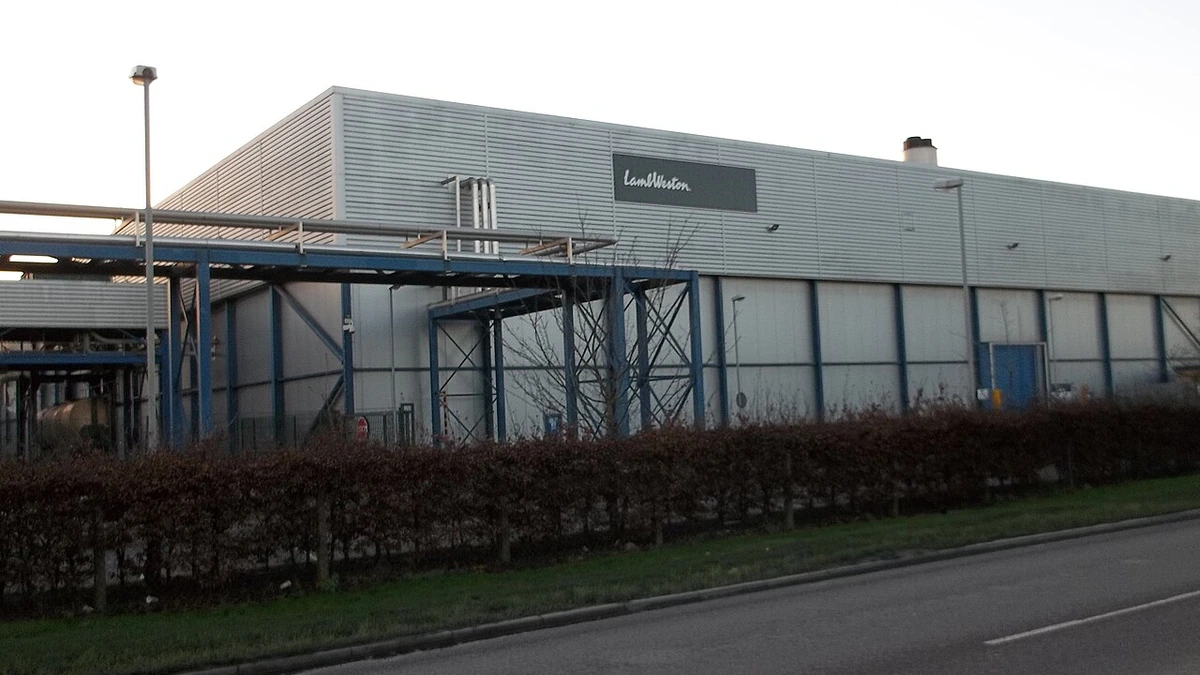
Lamb Weston raised parts of its fiscal 2027 outlook after reporting first-quarter results that came in above its own guidance, helped by stronger North America demand, higher plant utilization and cost savings. The frozen potato products producer said net sales for the quarter ended August 30 rose 1% from a year earlier to $1.67 billion, while adjusted diluted earnings per share reached $0.75 and adjusted EBITDA totaled $286 million.
Management increased its full-year sales target from growth of 0% to 1% to growth in the low single digits. It also lifted adjusted EBITDA guidance to $1.125 billion to $1.215 billion from $1.10 billion to $1.20 billion and raised adjusted diluted EPS guidance to $3.05 to $3.35 from $2.95 to $3.25. Capital expenditure guidance was left unchanged at $380 million to $410 million.
In its October 6 earnings release, Lamb Weston said first-quarter net income was $29 million and adjusted net income was $103 million. Chief Executive Officer Mike Smith said the quarter started solidly, with North America continuing to gain momentum, while the international business performed broadly in line with management’s expectations despite difficult conditions in Europe, the Middle East and Africa.
North America provided the main lift
The strongest part of the quarter came from Lamb Weston’s North America segment. Net sales in the region rose 5% to $1.141 billion, supported by a 7% increase in sales volume. The company said demand improved from existing customers and customer wins, continuing a multi-quarter run of volume growth. Price and mix, however, moved the other way, falling 2% as Lamb Weston provided price and trade support and continued to skew toward faster-growing chain customers and private-label products.
North America segment adjusted EBITDA increased 11% to $287 million. Lamb Weston said higher sales volumes, cost savings, a $5 million benefit from tariff refunds and improved equity method investment earnings more than offset the pressure from customer mix, product mix and inflation in key input categories. That result was important because it showed that cost savings and better factory efficiency are still doing real work for margins even when pricing is not the primary driver.
Utilization was another part of the story. Smith said the company has benefited from capacity optimization initiatives launched more than a year ago, which together have produced an approximate 10 percentage point increase in utilization. He also said those efforts are putting Lamb Weston in position to exceed the savings it had forecast under its broader cost savings program. That provides some context for why management was willing to raise its full-year profit outlook after only one quarter.
Cash generation remained positive, though not as strong as the prior-year quarter. Cash provided by operating activities was $235 million, down $117 million from a year earlier. Lamb Weston said the prior-year period had benefited from a $136 million improvement in inventories as the company was beginning its cost savings program. Capital expenditures were $91 million in the quarter, up from $79 million a year earlier, reflecting reliability and optimization projects across the manufacturing network.
International operations are still under pressure
The more difficult picture remained outside North America. International net sales fell 8% to $529 million, as sales volume declined 6% and price and mix slipped 2%. Segment adjusted EBITDA dropped 54% to $27 million. Lamb Weston said that weakness was in line with its expectations and was driven by lower sales volume, lower net sales mostly in Europe, and higher manufacturing costs per pound.
Management pointed to several pressures behind that result. They included the carry-in effect of prior-year higher potato costs, factory underutilization and continued inflation. Smith said EMEA markets remain challenging, though he added that profitability there improved sequentially as the company worked through those carry-in crop costs. In other words, the international business is still weak, but management is arguing that some of the worst cost pressure is beginning to ease.
The quarter also came after Lamb Weston decided to end production at its Broekhuizenvorst facility in the Netherlands. In a June 1 current report, the company said the closure was intended to improve operational efficiency and better align its manufacturing footprint with customer needs. On Tuesday, management said production has ended there and customer fulfillment has been transitioned within Lamb Weston’s network, a move it said should support additional cost optimization over time.
Even so, international conditions continue to put limits on how much of the North American improvement can flow through to consolidated earnings. Management also flagged unexpected inflationary pressure in freight and key inputs across the business. The raised full-year guidance therefore reflects a better first quarter and more confidence in North American execution, not a clean all-clear signal across every region.
What changed in the fiscal 2027 outlook
The most visible change was the sales outlook. Instead of predicting only flat to 1% growth from the fiscal 2026 adjusted base, Lamb Weston now expects net sales to rise by low single digits in fiscal 2027. The upgraded EBITDA and adjusted EPS ranges point to a similar message: the company now expects a better earnings year than it did when it gave its initial fiscal 2027 outlook in July.
Lamb Weston also updated several other full-year financial targets. Adjusted income from operations is now expected to be $730 million to $810 million. Interest expense, net, is projected at roughly $185 million to $190 million, while the adjusted effective tax rate is expected to be about 25% to 27%, excluding comparability items. The company still expects diluted outstanding common shares in a range of 137.5 million to 139.0 million and net cash provided by operating activities of $750 million to $800 million.
There were also a few capital-allocation updates. Lamb Weston ended the quarter with $166 million of cash and cash equivalents and said it had another $1.24 billion of available liquidity under its revolving credit facility. It returned $52 million to shareholders through dividends during the quarter and did not repurchase any shares. The board separately declared a quarterly dividend of $0.38 per share payable on December 4 to shareholders of record on November 6.
For investors, the key point is that Lamb Weston did not simply report a decent quarter. It also used the quarter to reset expectations higher for the full year, even while acknowledging that its international business remains difficult and inflation has not gone away. The next major company milestone is an Investor Day planned for early calendar 2027, when management has said it expects to share more about the roadmap for long-term shareholder value.
More News


Latest News
View all news- Google, Constellation Sign 3.59-GW PJM Power Deal, With $4.3 Billion-Plus Going to Nuclear Uprates
- RPM Posts Record $2.22 Billion Fiscal Q1 Sales, Narrows FY2027 Outlook
- Type One Energy Raises $200 Million Series B to Advance Tennessee Fusion Project
- MIAX Hits Record 17.1% YTD U.S. Options Share as ADV Rises 22%
- Informa to Buy Clarion for £2.24 Billion, Plans £940 Million Equity Raise and Taylor & Francis Separation
