
Anthropic Co-Founder Cites Scenario of $44 Trillion U.S. GDP by 2030 as AI Advances
Jack Clark highlighted Anthropic's most aggressive AI growth scenario at an IMF gathering, alongside concerns about job disruption and the distribution of economic gains.
Our editorial standards
MarketReview publishes clear, independently produced financial information using reliable sources and transparent editorial standards.
Read our Editorial Policy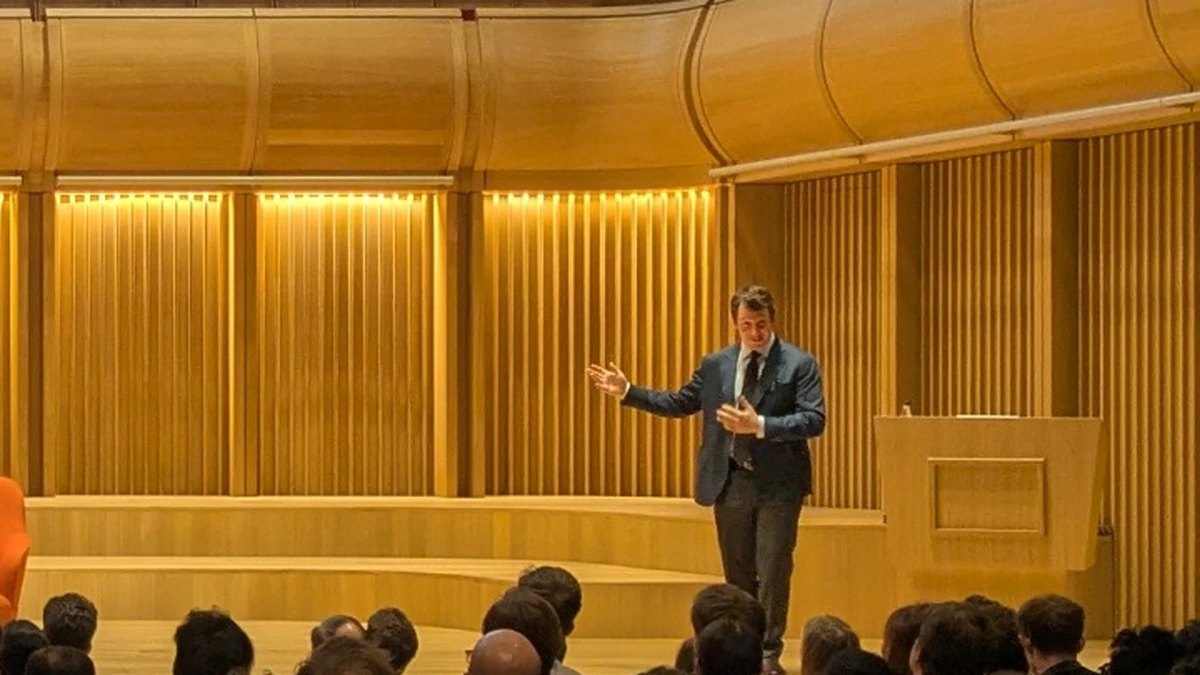
Anthropic co-founder Jack Clark pointed to a scenario in which U.S. economic output reaches roughly $44 trillion by 2030 as he addressed policymakers at the International Monetary Fund and World Bank annual meetings in Bangkok on Saturday. The estimate illustrates how much artificial intelligence might change the economy if capabilities and adoption advance unusually fast. It is not Anthropic’s central forecast for U.S. growth.
Clark delivered the Per Jacobsson Foundation lecture on October 17, arguing that the pace of AI development could accelerate scientific work and reshape the choices facing governments. Reuters, reporting from the event, said he urged international cooperation on stronger safeguards as AI systems become more capable. The growth scenario was one part of a wider warning about the speed and consequences of technological change.
The figure comes from Anthropic’s economic scenario explorer, which puts U.S. gross domestic product at $44.4 trillion in 2030 under its most extreme assumptions. Measured in 2025 prices, that is 32.4% above the model’s reference path without the additional AI-driven gains. The same exercise produces $34.1 trillion in a modest scenario and $36.3 trillion in a substantial one.
Those three outcomes should not be confused with three competing official GDP forecasts. Anthropic designed the model to explore what different levels of AI capability, workplace adoption and labor-market adjustment could imply. The most expansive case requires changes far beyond the way most organizations currently use AI.
What the $44.4 trillion scenario assumes
Anthropic starts with the tasks performed across occupations rather than assigning a single AI-exposure score to an entire job. Its framework draws on the U.S. Department of Labor’s O*NET classification and asks whether technology would leave individual tasks unchanged, help people perform them more efficiently, automate them or lead to entirely new kinds of work. Those choices then feed into possible outcomes for productivity, employment and wages.
This distinction matters because the ability to carry out a task is not the same as using AI for that task throughout the economy. Businesses have to decide whether the tools are reliable and economical enough to deploy. Workers may still need to supervise output, and entire workflows must change before improvements in individual tasks become lasting gains in national production.
In Anthropic’s modest scenario, AI delivers benefits comparable in broad terms to an earlier general-purpose technology such as the internet. Its substantial scenario is more disruptive: by 2030, AI can handle about half of knowledge work, much of it autonomously, but adoption remains incomplete. A considerable amount of work that could be assisted by AI continues to be done without it.
The extreme case assumes systems outperform people on the vast majority of knowledge-work tasks, execute nearly all of those tasks autonomously and create essentially no new knowledge-work tasks for human workers. Anthropic says such an outcome would likely depend on AI systems helping improve subsequent generations of AI, with businesses adopting those advances rapidly. Under that set of assumptions, its model shows annual GDP growth reaching 15% as the technology spreads.
There is no assurance that either the technological advances or the adoption timetable will occur. The $44.4 trillion number is stated at constant 2025 prices, so it is also not directly comparable with a future GDP total quoted in inflated, current-year dollars. The scenario is a way to test the consequences of an unusually fast change in productive capacity, not a commitment that the U.S. economy will reach that size.
The gains could bypass many knowledge workers
The model’s most striking result is not only the amount of additional output. It is how differently the benefits might be distributed. Anthropic estimates that labor would receive 59.4% of national output in its modest scenario and 56.1% in the substantial case. In the extreme scenario, labor’s share falls to 45.2%, leaving 54.8% for capital. The shift reflects machines and other productive assets performing an increasingly large proportion of economic work.
A smaller labor share does not automatically mean every worker earns less in dollar terms. The economy in the extreme scenario is much larger. But the distribution is sufficiently uneven that Anthropic says total labor income is barely changed by 2030 even as output surges. For workers facing direct competition from automation, the result could be considerably worse than the headline GDP figure suggests.
Knowledge workers are particularly exposed in this exercise. In the extreme case, their wages fall by more than 10% relative to an otherwise similar economy without the modeled AI changes. The company also envisages substantial movement out of occupations where tasks are automated, potentially pushing unemployment beyond levels associated with ordinary recessions if new positions do not become available quickly enough.
Moving between occupations presents a practical constraint. A call-center employee or software worker whose tasks can be automated may not be able to move immediately into nursing, electrical work or another field that is less exposed to the same tools. Retraining takes time, and vacancies do not necessarily appear in the places or at the wages displaced workers need. Those frictions are central to the labor-market warning in the model.
The less aggressive scenarios look materially different. Anthropic says unemployment generally stays within historically familiar ranges when AI’s impact is modest or substantial, although pay outcomes vary across occupations. In the substantial case, the company’s model has knowledge-worker wages roughly flat even as other groups receive gains from the productivity improvements spreading through the economy.
Anthropic also surveyed more than 10,000 Americans in August about their expectations for AI capabilities, adoption and how readily displaced workers could find new jobs. Responses from the typical participant implied an outcome closer to the substantial scenario, while about one in ten respondents expressed expectations consistent with the extreme case. Those responses describe views held by survey participants, not probabilities that any particular economic future will occur.
Why the economic upside brings a policy warning
Clark’s appearance formed part of a broader debate over how governments should respond to increasingly capable AI. An official Thai government account of the October 17 discussion described his emphasis on scientific discovery, including applications in mathematics, biological research and drug development. It also identified cyber risks, labor-market disruption and international AI governance as subjects raised at the meeting.
The promise of faster research is economically relevant because productivity gains may come from inventions as well as cheaper execution of existing tasks. Clark argued that AI could allow scientific teams to tackle problems at greater speed. Reuters reported that he also stressed the potential for misuse in biological and cyber-related fields, calling for stronger human oversight even as the technology creates opportunities for research.
The IMF’s program described the lecture, titled ‘Inside the Event Horizon: Why Everyone Should Take AI Progress Seriously,’ as a discussion of scientific discovery, robotics, machine-driven businesses and systems that might help improve their own successors. The session included discussants from India and China and brought those questions into a forum usually focused on international economic policy. That setting was significant because the decisions about AI deployment will not be made solely by technology companies.
In remarks reported by Reuters, Clark said AI remained under human control but the period available to establish effective safeguards was narrowing. His concern extended beyond whether models could boost output: more capable systems might also expand the scale of security threats, and individual countries could struggle to manage risks that cross national borders. The Thai government’s event account likewise emphasized international cooperation and the need to prepare workers for changes in employment.
Anthropic acknowledges that its own model cannot settle these questions. The September 2026 version of the explorer leaves out policy responses, business cycles, possible demand disruptions and some financial-market effects. Its treatment of displaced workers is deliberately coarse. External economists reviewed the underlying research, but Anthropic says those reviewers were not asked to endorse its conclusions, and some considered the extreme case better understood as a thought experiment.
Anthropic says it will continue refining the model as evidence develops. Among the unresolved questions raised by external reviewers is whether occupations most exposed to AI will shrink at all, rather than expanding as the technology changes their economics. The company also says the current version does not capture the broader demand effects of building the data centers needed to run AI systems.
More News



Latest News
View all news- NMI Resolves Payment Settlement Delays That Could Have Affected Merchant Funding
- Bank of Korea Governor Says International Won Payment Network Is Being Tested Ahead of January Launch
- Bank of Canada Signals Sharply Higher Inflation Forecast as Oil Prices Surge
- Bank of England’s Bailey Calls for Stronger AI Testing and Built-In Fraud Protection in Payments
- Switzerland Commits CHF 40 Million to IMF Capacity-Building Work Through 2030
