Australia-Led COP31 Talks End Without Overarching Climate Accord After Fossil Fuel Standoff
Countries failed to adopt the proposed Antalya pact as disputes over fossil-fuel language and climate finance divided negotiators, even as separate decisions went through.
Our editorial standards
MarketReview publishes clear, independently produced financial information using reliable sources and transparent editorial standards.
Read our Editorial Policy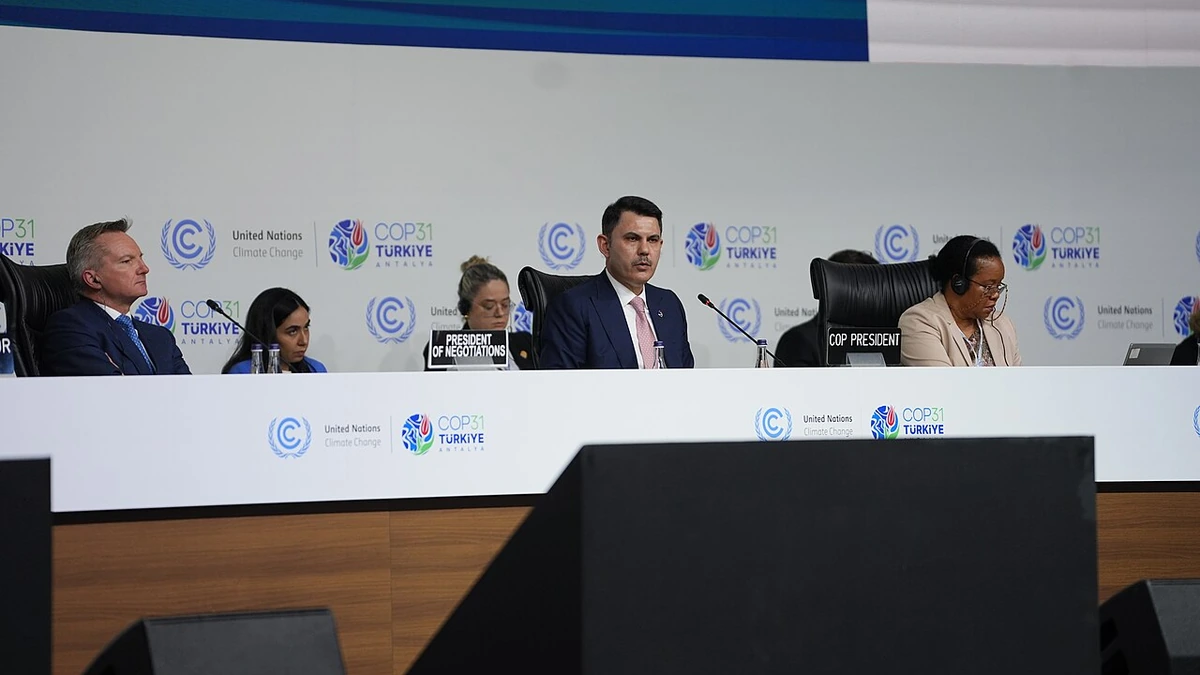
The COP31 United Nations climate conference closed in Antalya, Türkiye, on Sunday, November 22, without an overarching agreement after governments failed to settle a dispute over how the summit should address fossil fuels. Differences over climate finance also complicated efforts to reach a common outcome, leaving the proposed Antalya pact unadopted after talks extended beyond their scheduled finish.
The breakdown was a setback for an unusual leadership arrangement in which Türkiye hosted and presided over the conference while Australia led the formal negotiations. Turkish Environment Minister Murat Kurum served as COP31 president, and Australian Climate Change and Energy Minister Chris Bowen was president of negotiations. Their task was to find language acceptable to countries with sharply different energy systems, financing needs and climate priorities.
UN Climate Change Executive Secretary Simon Stiell acknowledged the failure in his closing remarks, saying countries had been unable to resolve issues related to both presidency-led decisions. He also made a distinction that matters for assessing the summit: negotiators had adopted individual decisions, including on just transition, even though they could not agree on the broad political text.
The conference was formally scheduled for November 9 to 20. Negotiations continued into November 22 as delegates tried to settle language that could command consensus. Failure to agree on a cover decision does not cancel the Paris Agreement or erase decisions adopted at earlier climate summits. It does, however, mean governments left Antalya without the fresh collective political signal that the COP31 leaders had sought.
Fossil-fuel language became the central obstacle
The most visible disagreement concerned the absence of an explicit reference to fossil fuels from the proposed overarching decision. The European Union and several other delegations objected to accepting a new climate outcome that did not directly address the coal, oil and gas use driving greenhouse-gas emissions. Other countries resisted such language, leaving negotiators without a formulation that both sides would accept.
That dispute had an important precedent. At COP28 in Dubai in 2023, governments agreed to language calling for a transition away from fossil fuels in energy systems, in a just, orderly and equitable manner. The Antalya debate was therefore not simply about adding a new phrase. It raised the question of whether the next major consensus text would explicitly reaffirm a commitment already made through the UN climate process.
The proposed cover decision had also been framed around implementing existing commitments, including accelerating electrification. Electrification can reduce fossil-fuel demand when electricity generation becomes cleaner, but a reference to electrification alone was not regarded by critics as an adequate substitute for naming the fuels whose use must decline. Some delegations also questioned draft language on carbon capture and storage, fearing it could place too much emphasis on managing emissions rather than preventing them.
Bowen had made the link explicit in a November 20 press conference, describing electrification as central to transitioning away from fossil fuels. He stressed that the negotiating process was driven by consensus and that difficult talks were not unusual at a COP. The eventual outcome showed the limit of that approach: support for clean-energy deployment did not resolve disagreement over the wording of a collective fossil-fuel commitment.
A cover decision is not the entire body of work conducted at a UN climate conference. It is the prominent political decision through which governments can draw together priorities and signal how they intend to implement existing goals. Without a mutually accepted text, Antalya could not deliver that shared message, even though negotiations on individual agenda items followed separate tracks.
Funding differences added pressure to the talks
Climate finance was the other major source of contention. Developing countries have pressed for more predictable support to adapt to higher temperatures, extreme weather and other climate impacts, as well as funding to shift to lower-emission energy. Access matters alongside headline totals: grants and concessional finance can be easier for vulnerable countries to use without increasing already heavy debt burdens.
The financing discussion sits on top of commitments made at earlier conferences. At COP29 in Baku in 2024, governments agreed on a goal of at least $300 billion a year by 2035 for developing countries, with a wider effort to scale public and private finance to $1.3 trillion annually by the same year. COP30 in Brazil subsequently called for efforts to triple adaptation finance by 2035. Those are existing goals, not new sums secured at COP31.
The questions in Antalya concerned how earlier promises translate into accessible financing, who provides it and what further guidance governments should adopt. The presidency’s November 19 work update identified the climate finance work programme, the Adaptation Fund and discussions over aligning financial flows with the Paris Agreement among the matters still requiring agreement. Finance ministers and other senior negotiators were brought into consultations as the summit approached its planned end.
These issues intersect with the energy debate. Countries asked to accelerate their transition may also need financing for electricity grids, cleaner generation and resilience to climate damage. A statement endorsing faster action without comparable clarity on support can be difficult for lower-income governments to accept. Conversely, a stronger funding formulation could not, by itself, bridge the dispute over whether the cover text should mention fossil fuels.
The failure to reach an overarching accord should not be interpreted as evidence that all climate-finance arrangements stopped operating or that every finance agenda item failed. Existing funds and prior commitments continue under their own rules. The narrower conclusion is that governments were unable to convert the outstanding political disagreements into the common COP31 package they had been negotiating.
Separate decisions survived, but the main signal was lost
The summit did not end without any results. Stiell pointed to decisions in the formal negotiating process, notably on a just transition, which concerns how workers and communities are supported as economies change. Other work advanced through separate agenda items, including international cooperation under Article 6 of the Paris Agreement. Those outcomes have to be assessed individually rather than treated as equivalent to the failed cover decision.
Outside the intergovernmental negotiating text, COP31 also featured an electrification delivery package and announcements by participating countries. In his closing statement, Stiell said commitments presented at the summit indicated that economies accounting for roughly half of global output were accelerating electrification. That is an account of pledges and initiatives, not proof that the full conference agreed to the proposed political pact or that associated investments have already been delivered.
The distinction has practical consequences for governments and businesses making long-term decisions. National energy policies, existing climate-finance agreements and private-sector investments can continue, but a missing collective statement leaves less clarity about the direction of the next round of negotiations. It also makes it harder to assess which elements of the Antalya proposals have broad political backing and which remain contested.
COP31 underscored the difficulty of reconciling different demands within a process built on consensus. Fossil-fuel producers and consumers, economies dependent on international climate support, and governments seeking more forceful language all have leverage over a final text. That makes a broadly supported agreement meaningful when it is reached, but also leaves a high threshold for adopting one.
The unresolved questions will carry into subsequent UN climate negotiations, including COP32 in 2027. Stiell described that meeting as an important step in preparing the second global stocktake of progress under the Paris Agreement. For now, the formal record from Antalya is mixed: progress on some negotiated decisions and climate initiatives, alongside failure to adopt the overarching agreement that was meant to connect them.
More News

Latest News
View all news- BILL Agrees to $6 Billion Take-Private Acquisition Led by TPG, With Corpay Taking Minority Stake
- South Korea Readies Stock Market Stabilization Fund After Emergency Meeting
- U.S. Rail Exemption Takes Effect for Nearly 60 Miles of Pennsylvania Rail Lines
- Qatar’s Inward Foreign Investment Stock Rises 5.2% to QAR 180.6 Billion
- Taiwan Expands Insurance Manager Eligibility as 12-Field Rule Takes Effect