


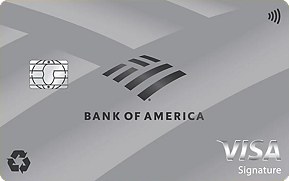
The base card is simple, but 1.5% is no longer a standout rate
Unlimited Cash Rewards has one of the easiest rewards structures to understand: eligible purchases earn unlimited 1.5% cash back, with no rotating calendar, category activation or published spending cap. That simplicity is useful for someone who wants one card for groceries, utilities, medical bills, online shopping and other everyday purchases without deciding which card earns more at each merchant.
The problem is not complexity. It is competition. A 1.5% flat rate was once a strong baseline for a no-annual-fee card, but several current cards can return 2% on broad purchases without charging an annual fee. If you do not receive a BofA Rewards bonus, Unlimited Cash Rewards can leave meaningful cash back on the table over a full year.
For example, $20,000 of qualifying annual purchases would earn $300 at 1.5%. A no-fee card earning 2% would produce $400 on the same simplified spending, a $100 difference. At $30,000 of annual spending, the gap grows to $150. The larger your uncategorized spend, the more important that half-percentage-point difference becomes.
The $0 annual fee prevents the card from becoming expensive to keep. You do not need to spend a certain amount just to recover a yearly charge, and there is no pressure to force purchases onto the card after your rewards strategy changes. That makes Unlimited Cash Rewards a reasonable long-term backup even if another card eventually becomes your primary spender.
The real reason to look past the ordinary 1.5% base rate is Bank of America’s relationship-rewards structure. For eligible BofA Rewards members, this can become a very different card.
BofA Rewards is the feature that can change the entire comparison
Bank of America currently gives eligible BofA Rewards members a credit-card rewards bonus based on relationship tier. For Unlimited Cash Rewards, the issuer’s published table shows the standard 1.5% rate rising to 1.65% at Member tier, 1.87% at Preferred Plus, 2.25% at Preferred Honors and 2.62% at Premier.
Those rates turn a mediocre flat-rate card into a competitive or even excellent one. A Preferred Honors member earning 2.25% can beat a standard 2% cash-back card on every qualifying purchase. At Premier, the published 2.62% effective rate is unusually strong for uncapped, category-free cash back.
The difference is easy to see with the same $20,000 annual-spending example. At 1.5%, the card earns $300. At 2.25%, the same spending earns $450. At 2.62%, it earns about $524. That is a major change without altering where you shop or which categories are active.
The relationship bonus should not be treated as free money for everyone. Bank of America sets BofA Rewards tiers using qualifying banking and investment relationships. Moving savings or investments solely to earn a higher credit-card rate would be a much larger financial decision than choosing between two rewards cards. Account fees, investment costs, service quality, yield and broader financial goals matter more than an extra fraction of a percent in cash back.
The right way to value the bonus is as an existing-customer advantage. If you already qualify for Preferred Honors or Premier because of money you would hold with Bank of America or Merrill anyway, Unlimited Cash Rewards becomes significantly more attractive. If you do not qualify, compare the card at its standard 1.5% rate rather than assuming you will eventually reach a higher tier.
The current $250 online offer gives the first year much better economics
Bank of America’s current limited-time online offer provides a $250 cash rewards bonus after at least $1,000 in purchases within the first 90 days of account opening. For a no-annual-fee card, that is a meaningful first-year incentive.
A $1,000 requirement over 90 days averages roughly $333 per month. Many households can reach that amount through normal groceries, transportation, utilities and other planned expenses without changing their budget. That matters because a welcome offer should reward existing spending rather than encourage unnecessary purchases.
The bonus is especially useful because it compensates for the card’s modest base rate in year one. At 1.5%, earning an additional $250 from ordinary rewards alone would require about $16,667 in purchases. The welcome offer delivers that amount after a much smaller threshold, provided the applicant qualifies for the offer and completes the required spending.
Bank of America describes the $250 offer as an online promotion and warns that it may not be available through every application channel. The offer displayed on the actual application should therefore be treated as controlling. A branch, mailed or personalized offer can differ from the public online version.
The spending threshold should not be financed simply to earn the bonus. The card’s 0% purchase APR provides temporary breathing room, but the long-term APR can be expensive. The strongest use of the offer is meeting the requirement with purchases you already planned and repaying them on a deliberate schedule.
The 15-billing-cycle purchase APR is more valuable than the rewards for some applicants
Unlimited Cash Rewards currently offers 0% intro APR for the first 15 statement closing dates on purchases. After the promotional period, Bank of America lists a variable APR of 17.49% to 27.49% based on creditworthiness and other factors.
This can be useful for a planned expense that needs several months of repayment. A $3,000 necessary purchase spread evenly over 15 billing cycles would require an illustrative $200 payment per cycle to reach zero before the promotional APR ends. A $6,000 expense would require about $400 per cycle.
The phrase “15 billing cycles” deserves attention. It should not be interpreted as a guaranteed 15 calendar months to a specific date. The first statement can close sooner than a full month after account opening, so a repayment plan should target an earlier payoff rather than relying on every last day.
For someone with a large planned purchase, avoiding interest for more than a year can be worth far more than the difference between 1.5% and 2% cash back. That is why comparing credit cards only by rewards rate can be misleading. Financing features can dominate the economics when they solve a real short-term need.
The intro period should still be used cautiously. Once the promotion ends, any remaining balance can begin accruing interest at the regular variable APR. A strong plan starts with the monthly payment required to finish before the rate changes.
The balance-transfer offer is useful early, then becomes less attractive
The card extends its 0% introductory APR for the first 15 billing cycles to balance transfers made within 60 days of account opening. Bank of America currently charges a 3% introductory transfer fee during that 60-day period, then 5% on future balance transfers.
The early fee is materially better than the later one. A $5,000 transfer costs $150 at 3% but $250 at 5%. A $10,000 transfer costs $300 during the introductory fee window and $500 afterward. Someone applying primarily for a balance transfer should be ready to act within the first 60 days rather than waiting.
If a $5,000 transfer incurs a $150 fee and the fee is added to the balance, the starting amount becomes $5,150. Spread evenly over 15 billing cycles, the simplified payoff target would be about $343 per cycle. That may be manageable for some borrowers and unrealistic for others.
A 15-cycle window is useful but not among the longest financing periods available. Someone moving a large balance may be better served by an 18-, 20- or 21-cycle offer even if the rewards program is weaker. The relevant question is whether the monthly payment required here fits your budget.
Bank of America also states that balance transfers cannot be used to pay another account provided by Bank of America. Existing Bank of America credit-card debt therefore cannot simply be moved into Unlimited Cash Rewards for the introductory offer.
For debt payoff, rewards should remain secondary. Earning 1.5% cash back later is much less important than choosing a transfer fee and promotional window that actually reduce the cost of eliminating the debt.
The 3% foreign transaction fee is a major weakness for an otherwise simple card
Unlimited Cash Rewards currently charges 3% of the U.S. dollar amount of each transaction made in a foreign currency. That makes it a poor default card for international spending.
A $2,000 equivalent of foreign purchases would create about $60 in foreign transaction fees. At the standard 1.5% cash-back rate, those purchases would earn only $30 in rewards, so the fee would exceed the rewards by about $30 before considering any other costs.
Even a Premier-tier BofA Rewards member earning the published 2.62% effective rate would generate roughly $52.40 of cash back on $2,000 of spending, still less than a $60 foreign transaction fee. Relationship bonuses therefore do not solve the international-spending problem.
This is one of the clearest reasons to pair Unlimited Cash Rewards with another card. It can be excellent for domestic general spending at higher BofA Rewards tiers, while a no-foreign-transaction-fee Visa or Mastercard handles international purchases.
The foreign fee also distinguishes this card from Bank of America’s Travel Rewards products, which are designed with no foreign transaction fee. A customer choosing within the same issuer should decide whether domestic flat-rate cash back or international usability is more important.
The lack of bonus categories is both the point and the limitation
Unlimited Cash Rewards does not permanently pay 3%, 4% or 5% at grocery stores, restaurants, gas stations or travel merchants. Every ordinary qualifying purchase receives the same base rate before any BofA Rewards bonus.
That simplicity can be valuable. Category cards often require knowing merchant definitions, tracking caps or using different cards for different purchases. Unlimited Cash Rewards avoids all of that. If you qualify for a strong relationship bonus, you can earn an attractive rate without thinking about where a purchase fits.
The downside is that a 1.5% base card can be inefficient for someone whose spending is concentrated in predictable categories. A household spending heavily at supermarkets and restaurants may earn more by using cards that reward those areas at 3% or higher.
A two-card strategy can solve this. Use a category card for the purchases where it earns substantially more, then use Unlimited Cash Rewards as the catch-all for everything else. At a 2.25% or 2.62% relationship-enhanced rate, that catch-all role can be extremely strong.
Without a relationship bonus, the same strategy is harder to justify because a no-fee 2% card can perform the catch-all job better. This is another example of why the customer’s Bank of America relationship matters more than the card’s marketing headline.
Cash rewards are easier to value than travel points
Unlimited Cash Rewards uses cash rewards rather than airline miles or transferable points. That makes valuation straightforward. A dollar of cash back is a dollar of value under the program’s eligible redemption options, without award availability or transfer ratios.
Bank of America says cash rewards do not expire while the account remains open under current program terms. That removes pressure to redeem on a specific schedule merely to avoid expiration.
The issuer provides redemption options that can include statement credits and eligible deposit-account redemptions. The exact mechanics can vary with the account and current program interface, but the core proposition remains simple: this is cash value rather than a speculative travel currency.
That simplicity matters for readers who dislike loyalty-program complexity. There is no need to compare airline award charts or decide whether a point is worth 1.2 or 1.8 cents. The more difficult calculation is on the earning side: whether you are getting 1.5%, 1.65%, 1.87%, 2.25% or 2.62% based on your BofA Rewards tier.
There is little premium-card value beyond rewards and financing
Unlimited Cash Rewards is not designed as a travel or premium-benefits card. There is no airport-lounge membership, annual travel credit, hotel status or transferable-points ecosystem built into the product.
That is not necessarily a weakness on a $0-annual-fee card. Premium benefits usually come with higher annual fees or more complicated eligibility rules. Unlimited Cash Rewards is intentionally focused on earning and introductory financing.
Bank of America also provides its standard $0 Liability Guarantee for unauthorized transactions, subject to prompt reporting, verification and applicable terms. Eligible cardholders may see promotional features such as Refer-a-Friend opportunities, but those offers can vary and should not drive the core card decision.
The absence of expensive extras helps keep the product simple. The challenge is that simplicity alone does not justify a 1.5% base rate when competing no-fee cards can earn more. BofA Rewards is what gives this otherwise plain product a reason to stand out.
Who gets the most from Unlimited Cash Rewards?
The strongest fit is an existing Bank of America or Merrill customer who already qualifies for a higher BofA Rewards tier. At Preferred Honors or Premier, the card’s effective flat rate becomes strong enough to compete with or beat many no-fee 2% products.
A customer at Premier is the clearest example. Bank of America’s current table shows a 2.62% effective rate on every qualifying purchase. That combines high flat-rate earning with no annual fee and no category management.
The card also fits someone who wants a first-year combination of a welcome offer and temporary financing. The current $250 bonus after $1,000 in 90 days is approachable, and the 15-cycle 0% purchase APR can help with a planned expense if repayment is managed carefully.
Someone who strongly prefers cash to travel points may also like the product. The rewards are easy to understand, and there is no need to learn a loyalty ecosystem to get value.
Finally, the $0 annual fee makes the card easy to keep as a long-term backup. Even if another card later becomes better for daily spending, Unlimited Cash Rewards does not impose an annual charge just for remaining open.
Who should choose a different flat-rate card?
A reader with no meaningful Bank of America relationship should compare the base 1.5% rate against no-fee 2% cards. If all else is equal, giving up half a percentage point on every purchase is hard to justify over the long run.
Frequent international travelers should also choose something else for foreign purchases because of the 3% foreign transaction fee. A no-foreign-transaction-fee card can save more than the rewards difference.
Category optimizers may find the product too plain. If groceries, dining, gas or travel dominate your budget, cards offering 3% to 5% in those areas can generate more rewards than a flat 1.5% base rate.
Someone focused primarily on debt payoff should compare longer 0% APR offers. Fifteen billing cycles can help, but it may not provide enough time for a large transfer balance. A longer promotional window can be more valuable than the card’s cash-back program.
And a traveler who wants airline or hotel transfer partners will not find them here. Unlimited Cash Rewards is a cash product, not a travel-rewards platform.
This card makes more sense as a Bank of America ecosystem tool than as a universal cash-back pick
Unlimited Cash Rewards is not difficult to understand. The difficult part is deciding which version of the card you are evaluating. At 1.5%, it is a convenient but ordinary flat-rate product. At 2.25% or 2.62% through BofA Rewards, it becomes one of the more compelling uncapped catch-all rates available without an annual fee.
The current $250 online bonus and 15-cycle 0% APR give the first year additional appeal, especially for someone with a planned purchase. Those features eventually expire. The relationship-enhanced earning rate is what can make the card worth using for years rather than months.
The 3% foreign transaction fee prevents the account from becoming a true one-card solution, and the lack of bonus categories means some households can earn more with a specialized setup. Neither drawback is fatal when the card is used for the role it handles best.
For an existing high-tier Bank of America customer, that role is obvious: use Unlimited Cash Rewards as a low-maintenance catch-all and let other cards handle only the categories where they can beat the relationship-enhanced rate. For everyone else, the simpler comparison is whether 1.5% plus the first-year offer is enough to pass up a permanent 2% alternative.
That is a much more useful question than whether unlimited cash back sounds convenient. Convenience is valuable, but with this card, the Bank of America relationship determines how much you are being paid for it.