
Canada Announces Nearly C$270 Million for New Brunswick Hydro and Grid Investment
The support includes a C$219 million loan for Mactaquac planning and C$50 million to strengthen voltage stability at the Salisbury Terminal.
Our editorial standards
MarketReview publishes clear, independently produced financial information using reliable sources and transparent editorial standards.
Read our Editorial Policy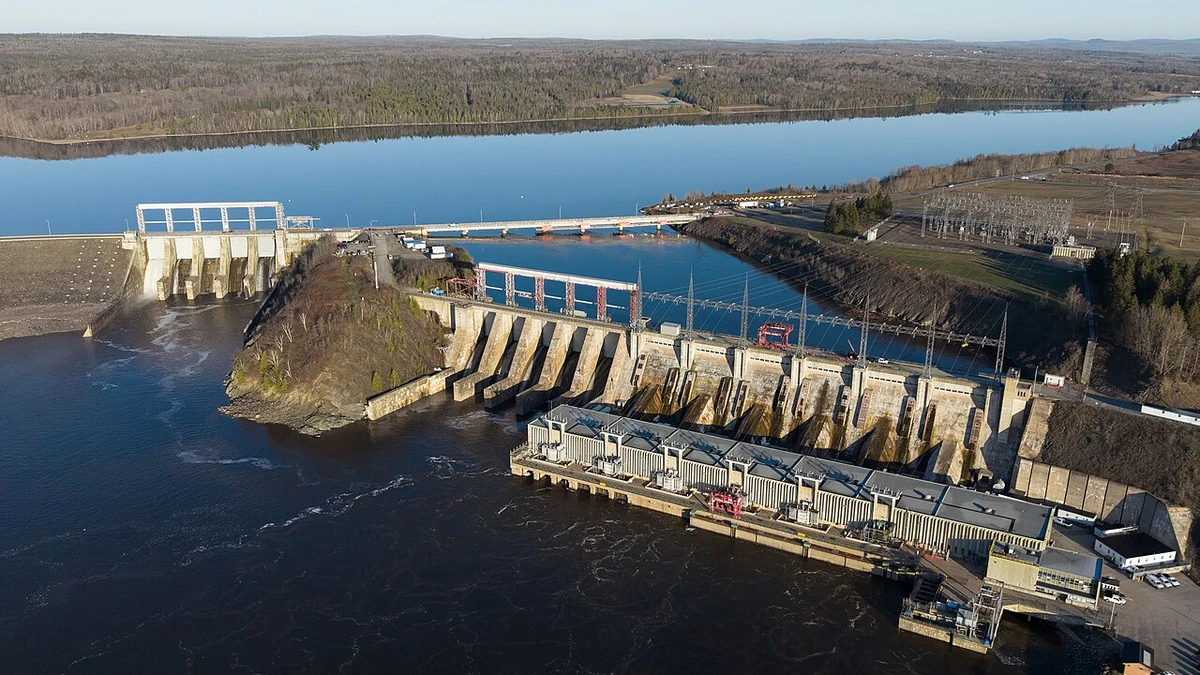
Canada announced C$269 million in support for two electricity projects in New Brunswick on Tuesday, with a C$219 million infrastructure loan directed toward early work at the Mactaquac hydroelectric station and C$50 million in federal funding for equipment intended to stabilize the province’s southern power grid. NB Power, the provincial utility, is the recipient of both commitments.
The projects address different problems. At Mactaquac, the immediate priority is preparing a much larger rehabilitation of an aging generating station. At the Salisbury Terminal, the funding will help install fast-acting technology that supports voltage stability when the network comes under stress. The total should not be confused with C$269 million in grant funding or with the full cost of rebuilding Mactaquac.
Mactaquac loan covers development work, not the full rebuild
The Canada Infrastructure Bank said it had reached financial close on its C$219 million loan for the Mactaquac Life Achievement Project. The money will support engineering and environmental investigations, assessments of options, regulatory reviews, early supply activities, and engagement with First Nations and nearby communities. Those steps are necessary before NB Power and the provincial government make further decisions on the large-scale rehabilitation.
A three-year term applies to the site-development financing, which the bank says is intended to limit pressure on electricity ratepayers. That does not establish the eventual cost of the overall project or how its construction would be financed. It also does not amount to a guarantee that customers’ power bills will decline. The loan finances work that will help define the next phase of a much larger capital program.
Located on the Saint John River west of Fredericton, Mactaquac is NB Power’s largest hydroelectric facility. The 672-megawatt run-of-river station supplies electricity equivalent to about 30% of New Brunswick’s legislated renewable energy requirements and provides about 20% of the capacity needed to meet peak demand, according to the infrastructure bank. Preserving that generating capacity is an important consideration as the province plans its future mix of electricity sources.
Commissioned in the late 1960s, the station has suffered premature deterioration of its concrete. NB Power identifies alkali-aggregate reaction, a chemical process that causes concrete to expand, as the underlying problem. The resulting movement and cracking affect equipment such as spillway gates and turbines. Mechanical and electrical systems also need replacement, while fish-passage facilities are part of the proposed improvements. Without major intervention, the utility says the station would likely stop operating by 2030.
Preparations were advancing before Tuesday’s financing announcement. In July, NB Power entered a 12-month development-phase agreement with a civil-works partnership involving Aecon, FlatironDragados and Green Infrastructure Partners. In August, it signed an agreement with Andritz Canada to advance planning for turbines and generators. NB Power has explicitly said that the civil-works development agreement does not authorize construction. The federal loan supports the preparatory work that must come before decisions on the main building program.
Salisbury funding targets voltage stability in southern New Brunswick
The remaining C$50 million will support a static synchronous compensator, known as a STATCOM, at NB Power’s Salisbury Terminal. Natural Resources Canada announced the funding alongside the Mactaquac loan as part of the federal government’s efforts to improve electricity reliability and prepare for greater demand.
A STATCOM does not produce electricity. It is power-electronics equipment that can respond quickly to voltage changes on a transmission network, helping the system remain stable when disturbances occur or power flows shift. NB Power says parts of the southern New Brunswick grid do not always have enough fast-acting voltage support to deal with certain events. The Salisbury installation is intended to address that weakness and help the network accommodate more renewable generation.
NB Power plans to install the equipment at its existing high-voltage terminal in Salisbury, with most construction taking place within the substation site. The New Brunswick Energy and Utilities Board approved the project in July 2025, and preliminary vegetation clearing was completed later that year. NB Power’s current schedule calls for grading and foundation work in fall 2026, followed by equipment installation and other construction through 2028. Commissioning is expected by the end of 2028.
Salisbury’s funding comes through Ottawa’s C$4.5 billion Smart Renewables and Electrification Pathways Program, which supports grid modernization, storage and renewable electricity projects across the country. Here, the federal contribution is directed toward voltage-control technology at an existing substation, not a new generating plant. The distinction matters as demand rises: providing more electricity and keeping the network that carries it stable are separate infrastructure requirements.
A multibillion-dollar project still faces key approvals
The C$219 million loan is small relative to the proposed rehabilitation. NB Power estimates the full Mactaquac Life Achievement Project could cost between C$7.6 billion and C$9 billion, including interest and inflation over the project’s life. That range remains an estimate, not a final construction price. The scope includes repairs to concrete structures, replacement or modernization of generating equipment and other upgrades intended to extend the station’s operating life toward its original 100-year design horizon.
Financing arrangements matter to the utility’s customers. NB Power reported C$6.05 billion in net debt for the fiscal year ended March 31, 2026, reflecting capital spending on infrastructure and modernization. On October 7, it filed a proposed three-year rate plan with the provincial regulator, citing the need to maintain aging assets and invest in reliability. Neither that filing nor Tuesday’s federal announcement establishes the final effect of Mactaquac rehabilitation costs on electricity rates. The infrastructure bank says its development financing is intended to reduce the near-term impact on ratepayers.
Major approvals are still outstanding, regardless of the new development loan. New Brunswick approved the project’s environmental impact assessment in June 2025, but NB Power still lists a federal Fisheries Act authorization targeted for March 2027 and shareholder review in spring 2027 among its outstanding steps. The utility plans to phase work so most of the station can continue producing electricity during construction, with replacement of the first generating unit scheduled to begin in 2028 or 2029. Its current target for completing the broader rehabilitation is 2037–38.
More News


Latest News
View all news- U.S. Crude Inventories Fall 3.1 Million Barrels in Latest EIA Report
- Thermo Fisher Scientific Reports 9% Revenue Growth to $12.14 Billion
- OCC Issues Final Rule to Implement GENIUS Act Stablecoin Regulations
- Ohio Auto Parts Manufacturer Agrees to Pay $3 Million Over PPP Loan Allegations
- CFTC Announces $9.2 Million Penalty in Louisiana Forex Fraud Case
