
Cava Revenue Jumps 31% as Customer Traffic Fuels 9% Same-Store Sales Growth
Guest visits accounted for more than half of CAVA's comparable-sales growth, even as restaurant-level margin slipped 60 basis points amid higher menu, delivery and wage costs.
Our editorial standards
MarketReview publishes clear, independently produced financial information using reliable sources and transparent editorial standards.
Read our Editorial Policy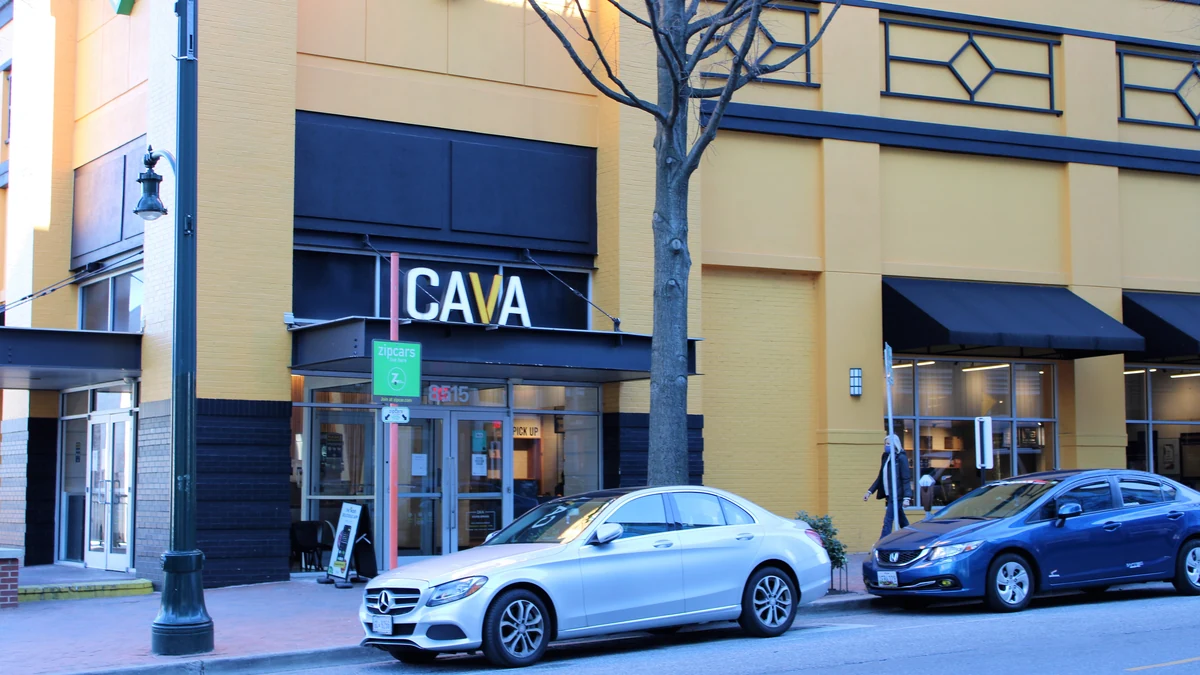
CAVA Group’s restaurant business kept growing at a rapid pace in its fiscal second quarter, with CAVA revenue rising 31.3% from a year earlier to $365.4 million as higher guest traffic and new restaurant openings lifted sales. Same-restaurant sales increased 9.0%, and more than half of that gain came from customers visiting more often rather than from higher prices.
Guest traffic increased 5.3%, while menu price and product mix added 3.7 percentage points to same-restaurant sales growth. The traffic contribution gives the quarter added significance at a time when restaurant operators are closely watching whether consumers, especially value-conscious diners, continue eating out despite lingering inflation and broader economic uncertainty.
The company also kept expanding its store base, opening 17 net new CAVA restaurants during the 12-week quarter ended July 12. That brought the total to 476 locations, up 19.6% from a year earlier. CAVA’s second-quarter results show that the combination of more restaurants and stronger sales at established locations is still producing double-digit revenue growth, even as some operating costs are rising faster than sales.
Traffic did more of the work than pricing
CAVA’s 9.0% same-restaurant sales increase was a sharp improvement from the 2.1% growth reported in the same quarter a year ago and followed 9.7% growth in the first quarter of 2026. Average unit volume reached about $3.1 million, compared with $2.9 million a year earlier, another indication that the chain is generating more sales per restaurant as it scales.
The composition of the comparable-sales gain matters. A 5.3% increase in guest traffic means visits accounted for nearly three-fifths of the 9.0% increase, with the remainder coming from menu pricing and product mix. For investors, traffic-led growth is generally a stronger signal of underlying demand than a comparable-sales increase driven mostly by price increases, because it suggests customers are continuing to choose the brand even as household budgets remain under pressure.
CAVA has also been relatively restrained on pricing compared with a strategy that relies heavily on passing costs to diners. Reuters reported after the earnings release that Chief Financial Officer Tricia Tolivar said lower-income customer cohorts were generating the strongest same-restaurant sales results and that the company’s effort to minimize price increases was helping support demand. That detail strengthens the consumer-resilience angle in the quarter, although it remains a company-specific result rather than evidence that restaurant spending is broadly strong across the industry.
Digital sales remained an important part of the business, accounting for 39.0% of revenue. CAVA also said the 94 net new restaurants opened during or after the second quarter of fiscal 2025 were exceeding its performance expectations. The combination of traffic growth at mature locations and productive new units helps explain why the chain can continue expanding revenue at a pace well above its store-count growth alone.
Restaurant profit rises, but margin slips
The quarter was not uniformly stronger. CAVA restaurant-level profit increased 28.1% to $93.8 million, but restaurant-level profit margin declined to 25.7% from 26.3% a year earlier, a decrease of 60 basis points. In other words, the company generated substantially more restaurant profit dollars, but retained a slightly smaller share of each sales dollar at the restaurant level.
CAVA attributed the margin pressure to several specific factors. Food costs increased with the April launch of Pomegranate Glazed Salmon, while a higher mix of third-party delivery also weighed on the margin rate. The company said both factors still contributed positively to profit dollars because they carried higher guest prices. Incremental wage investments were another drag, partly offset by the benefit of spreading fixed restaurant costs across higher sales.
The cost detail is visible in the segment figures. Food, beverage and packaging costs rose to 30.0% of CAVA revenue from 29.5% a year earlier, and labor increased to 25.3% from 25.0%. Occupancy costs moved the other way, falling to 6.3% of revenue from 6.8% as higher sales provided leverage. Other operating expenses rose to 12.8% from 12.4%.
Despite the modest restaurant-margin decline, profitability improved at the company level. Net income increased 25.3% to $23.0 million from $18.4 million, and diluted earnings per share rose to $0.19 from $0.16. Adjusted EBITDA increased 30.0% to $54.7 million, or 14.9% of consolidated revenue. General and administrative expenses also declined as a percentage of revenue, to 10.8% from 11.4%, as sales growth absorbed a larger corporate cost base.
Expansion continues, but guidance stays unchanged
CAVA reaffirmed its full-year 2026 outlook rather than raising it after the strong quarter. The company still expects 75 to 77 net new restaurant openings, same-restaurant sales growth of 4.5% to 6.5%, restaurant-level profit margin of 23.7% to 24.3%, and adjusted EBITDA of $181 million to $191 million. It also expects pre-opening costs of $22.0 million to $22.5 million.
Management’s caution reflects risks that were not obvious from the headline sales numbers alone. Reuters reported that broader consumer concerns around leafy greens and produce weighed on sales around the end of the quarter following a multistate cyclosporiasis outbreak, even though CAVA said it did not use the ingredients linked to the outbreak. Same-restaurant sales slowed to roughly flat to slightly positive growth in early July before improving week by week and recovering to mid-single-digit growth, according to comments reported from the earnings call.
CAVA therefore enters the second half with two different signals. The underlying quarter showed strong traffic growth, rising average unit volumes and productive restaurant openings, while management is still planning around inflation, food-safety concerns and a fluid macroeconomic backdrop. Tolivar told Reuters that current trends did not suggest the company would finish at the low end of its guidance range, but CAVA chose to keep the range intact.
The next several quarters will test whether CAVA can keep customer visits growing as its restaurant base becomes larger and whether the 60-basis-point margin decline proves temporary. The company has room to grow from 476 restaurants and is still adding locations at a fast rate, but the investment case increasingly depends on balancing that expansion with restaurant-level economics. For now, the second quarter suggests demand remains the stronger part of that equation: traffic rose faster than pricing, sales per unit improved, and new restaurants continued to add meaningful revenue.
More from Investing


Latest News
View all news- FTC, USDA Launch Joint Inquiry Into Agricultural Equipment Market Practices
- VAALCO Completes Gabon Phase 3 Drilling as ETSEM-3H Starts at About 2,000 BOPD
- U.S. Crude Inventories Fall 3.2 Million Barrels in Latest EIA Report
- UK Trade Remedies Authority Proposes Five-Year Anti-Dumping Duty on Chinese Rutile Titanium Dioxide
- OCC Launches Direct Payments-Fraud Reporting Tool for Community Banks
