
EU Finance Ministers Hold Second Day of Informal ECOFIN Meeting in Dublin
Saturday’s session focused on AI’s economic impact, energy-market pressures and Europe’s financial competitiveness after Friday talks on banking reform and financial innovation.
Our editorial standards
MarketReview publishes clear, independently produced financial information using reliable sources and transparent editorial standards.
Read our Editorial Policy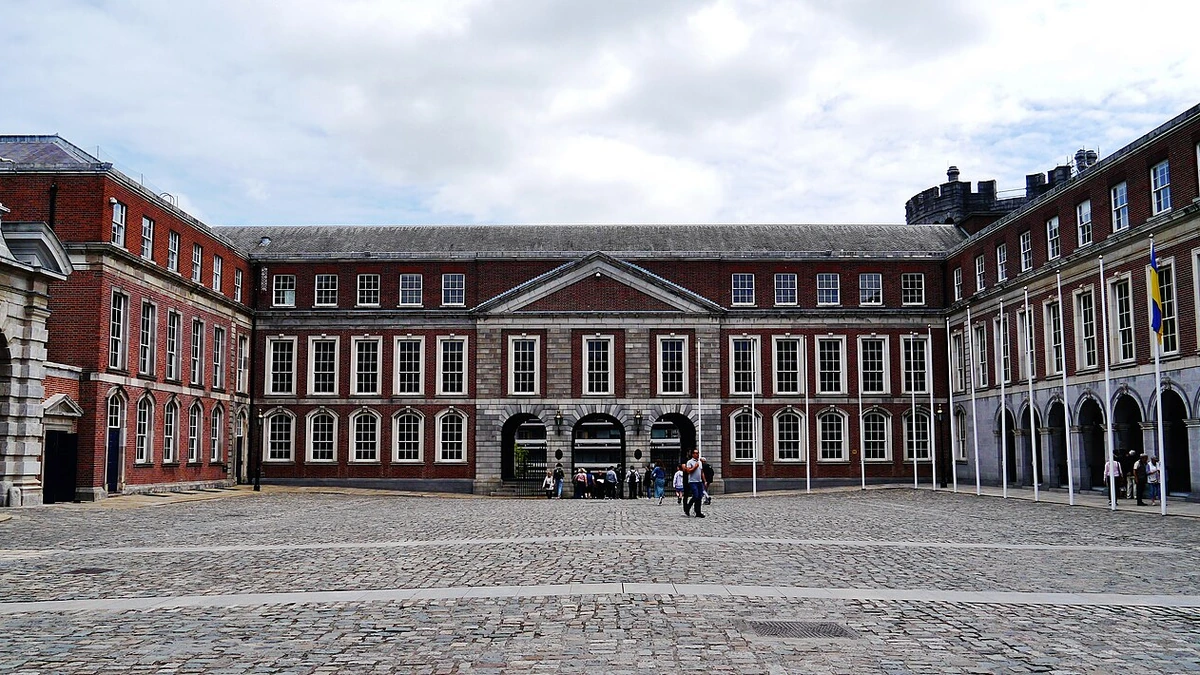
EU finance ministers returned to Dublin Castle on Saturday for the second and final day of an informal ECOFIN meeting hosted by Ireland’s Presidency of the Council of the European Union, with artificial intelligence, energy-market pressures and Europe’s broader competitiveness agenda among the main subjects under discussion.
The official Saturday schedule set aside arrivals for third-country guests from 8:55 a.m., followed by a finance-ministers working session from 9:30 a.m. to 12:30 p.m. and an informal ECOFIN press conference around 12:40 p.m. Ireland’s Tánaiste and Minister for Finance, Simon Harris, is chairing the meeting. In its pre-meeting outline, the Irish Presidency described the two-day gathering as centered on banking reform, financial innovation, competitiveness and AI under the theme “Europe’s digital moment.”
The European Commission said ahead of Saturday’s session that ministers would examine the economic impact of AI in Europe, including its implications for productivity, labor markets, energy and geopolitics. That discussion follows Friday’s exchanges involving finance ministers and central bank governors, which covered banking competitiveness and technological change in finance.
AI, productivity and energy dominate Saturday’s discussion
The focus on AI places a fast-moving technology question inside a broader economic-policy debate. The Irish Presidency has framed the issue around whether Europe can use new technology to raise productivity and growth while keeping financial stability and consumer protection in view. That makes the discussion wider than the use of AI by banks or financial firms alone. The Commission’s briefing for the meeting specifically pointed to labor-market effects, energy use and geopolitical implications alongside productivity.
Energy markets are another part of the Dublin agenda. The Irish Presidency said ministers would discuss recent energy-market developments, including the issue of windfall profits in the energy sector and whether there is scope for further coordinated action at EU level. The Presidency did not present that discussion as a settled policy decision. Instead, it described the meeting as an opportunity for ministers to compare views on what an appropriate European response could look like as energy costs continue to affect households and businesses.
The Saturday session also broadens the room beyond the EU. Finance ministers from Canada, the United Kingdom, Ukraine and Switzerland were invited to participate in the Dublin meeting. The Presidency also said European Central Bank President Christine Lagarde and International Monetary Fund Managing Director Kristalina Georgieva would participate in the two-day discussions, bringing central-bank and international-financial-institution perspectives to talks on the economic outlook, financial stability and technological change.
That international participation matters to the way Ireland has framed the meeting. Rather than treating competitiveness only as an internal single-market question, the Presidency has linked it to wider geopolitical uncertainty, energy pressures and cooperation with like-minded economies. Saturday’s agenda therefore connects the narrower questions around AI and finance with the wider issue of how Europe finances investment and protects economic resilience in a more difficult external environment.
Banking competitiveness sets the policy backdrop
The Dublin talks are also taking place shortly after the European Commission set out a new policy direction for the EU banking sector. In July, the Commission published a communication on banking competitiveness aimed at strengthening the single market for banking and improving the sector’s capacity to finance growth, innovation and strategic priorities without weakening financial stability.
The Commission has identified three broad obstacles: continued fragmentation of banking activity along national lines, the need to reflect characteristics of the EU banking system when international standards are implemented, and regulatory complexity that can add cost and reduce efficiency. Its proposed direction includes making cross-border capital and liquidity management easier, improving proportionality for smaller banks and simplifying parts of the regulatory framework while retaining safeguards built after the global financial crisis.
Those issues gave Friday’s first working session a concrete policy backdrop. The Irish Presidency said ministers would hold an initial exchange on the Commission’s banking work ahead of legislative proposals expected next year. The Commission has said it plans to bring forward those proposals in the first quarter of 2027. Its stakeholder feedback period on the banking initiative closed on September 17, one day before the Dublin meeting began, which means the informal ECOFIN discussion comes at a point when the Commission is moving from consultation toward legislative preparation.
The banking debate also fits into the EU’s wider Savings and Investments Union agenda. European policymakers are trying to make it easier for savings to reach productive investment while reducing barriers that keep financial activity segmented across member states. Banks remain a central part of that effort because they provide much of the financing used by European households and smaller businesses. For finance ministers, the policy question is therefore not only whether banks are resilient, but whether the structure of the banking market allows capital to move efficiently enough to support investment and growth.
Dublin talks feed into the EU’s autumn policy calendar
The informal ECOFIN meeting is part of Ireland’s six-month EU Council presidency, which runs from July through December 2026. Ireland has made competitiveness one of the central themes of its presidency programme, alongside work on economic resilience, fiscal sustainability, the Savings and Investments Union and the digital euro. The Dublin meeting gives ministers room to test policy positions before those issues return to the formal Council process.
The timing also links the discussion to a busy autumn economic calendar. The next formal Economic and Financial Affairs Council is scheduled for October 9 in Luxembourg. That meeting will provide another opportunity for ministers to address files that require formal Council work, while the Commission continues preparing its banking proposals for early 2027.
More News

Latest News
View all news- Sequoia ETF Registration Amendment Takes Effect Ahead of $3.6 Billion Fund’s October Conversion
- Akari Therapeutics Showcases New ADC Payload Approach at Global XDC Conference
- Berkshire Names Howard Buffett Chairman as Warren Buffett Becomes Chairman Emeritus
- CoreWeave Prices Upsized $3.7 Billion Convertible Notes Offering
- MISTRAS Agrees to $866 Million H.I.G. Capital Takeover at $20.35 a Share
