Gold Hits Two-Month High Before U.S. Inflation Report
Gold touched its highest level since June 5 before easing as traders positioned for U.S. inflation data and monitored renewed Middle East risks.
Our editorial standards
MarketReview publishes clear, independently produced financial information using reliable sources and transparent editorial standards.
Read our Editorial Policy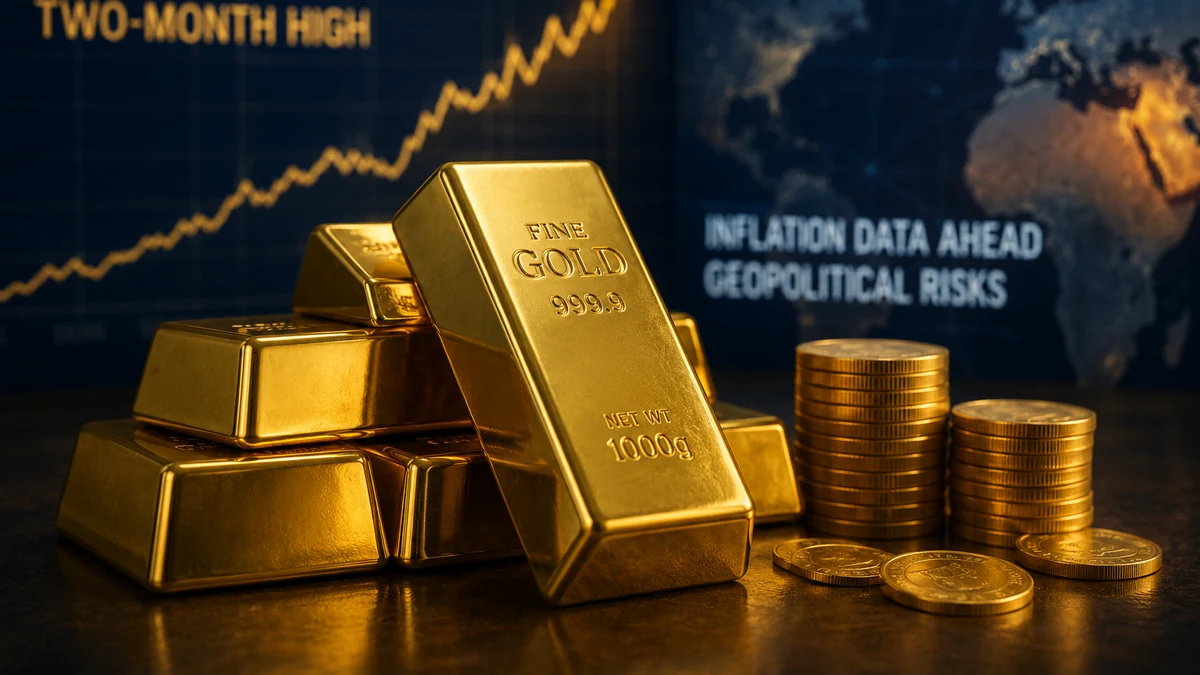
Gold climbed to its highest level in more than two months on Tuesday before giving back part of the advance, as traders positioned ahead of the next U.S. inflation report and kept an eye on renewed geopolitical tension in the Middle East. Reuters reported that spot gold rose to $4,434.84 an ounce earlier in the session, its highest level since June 5.
By 9:37 a.m. EDT, spot gold was up 0.1% at $4,393.69. U.S. gold futures were 0.8% higher at $4,453.40. The move extended a rebound that has pushed gold roughly 8% higher so far in August, even though prices remain below the record levels reached earlier this year.
The immediate focus is the U.S. consumer price report due Wednesday. The Bureau of Labor Statistics says July CPI will be released on August 12 at 8:30 a.m. ET. That report could reshape expectations for the Federal Reserve’s September meeting, which matters for gold because changes in interest-rate expectations affect the opportunity cost of holding a non-yielding asset.
Gold’s rebound has gathered pace in August
Tuesday’s intraday high continued a sharp recovery from the weakness that dominated parts of the first half of the year. The World Gold Council said gold traded above $5,500 an ounce intraday in January before falling below $4,000 in late June. That swing left the metal well below its record even after the recent rebound, but it also showed how quickly positioning can change when investors reassess inflation, interest rates and geopolitical risk.
Reuters reported that gold gained 2.4% in a single session after the latest U.S. employment report weakened expectations for a September rate increase. BLS data show nonfarm payroll employment fell by 23,000 in July while the unemployment rate declined to 4.1%. The combination complicated the policy outlook by pairing softer payroll growth with an inflation picture that still leaves room for debate about the timing of further rate increases.
The June CPI report had already produced an unusual mix. Headline CPI fell 0.4% from the previous month, with a 5.7% drop in the energy index making the largest contribution to the monthly decline, while the all-items index was still 3.5% higher than a year earlier. Core CPI, which excludes food and energy, was unchanged on the month and up 2.6% over 12 months. July’s report will show whether that moderation continued before the latest rise in oil prices.
Rate expectations are important because gold does not pay interest. When expected policy rates and bond yields rise, cash and fixed-income assets can become more competitive with bullion. When markets move toward lower-rate expectations, that opportunity-cost pressure can ease. Reuters said traders were pricing roughly a 48% chance of a September rate increase and a 78% chance by December, based on CME FedWatch data at the time of its report.
Those probabilities can change quickly after major economic releases, which is why Wednesday’s CPI number has become the next clear catalyst for bullion. A cooler reading could reinforce the idea that the Fed can move cautiously after the weak jobs report. A hotter reading could revive expectations for tighter policy and put upward pressure on yields, a combination that can work against gold even when inflation concerns themselves support demand for a hedge.
Inflation and geopolitics are pulling on gold at the same time
Gold’s latest advance is not only a rates story. Middle East tensions are again affecting energy markets and broader risk sentiment. Reuters reported Tuesday that negotiations between the United States and Iran over a peace agreement and the reopening of the Strait of Hormuz had reached an impasse. Brent crude was trading around $88 a barrel, up about 5% over two days and nearly 25% from early-July lows.
The most recent energy move will not be fully reflected in July CPI because much of it occurred after the period covered by the report. It still matters for investors trying to assess where inflation may go next. Higher oil prices can raise transportation and production costs, and a prolonged disruption to Middle East energy flows could keep inflation expectations elevated even if Wednesday’s backward-looking CPI data show some improvement.
That creates a mixed setup for bullion. Persistent inflation can strengthen gold’s appeal as a store of value, but a renewed inflation problem can also push interest-rate expectations and bond yields higher. The World Gold Council’s mid-year outlook describes risk and uncertainty, opportunity cost and momentum as important drivers of gold prices. It also notes that persistent inflation has historically been more supportive for gold than short-lived inflation spikes, while geopolitical shocks can lift demand for portfolio protection.
The current market reflects that tension. Gold is rising alongside oil and remains well bid despite expectations that the Fed may still raise rates later this year. At the same time, the metal has not returned to its January peak, and the scale of the first-half decline is a reminder that safe-haven demand does not override every other driver. Dollar moves, bond yields, positioning and profit-taking can all alter the response.
Silver, platinum and palladium did not share gold’s strength on Tuesday. Reuters said spot silver fell 1.4% to $64.81 an ounce, platinum slipped 0.2% to $1,749.51 and palladium declined 1.3% to $1,364.75. That divergence suggests the session was not a broad-based rally across precious metals.
Wednesday’s CPI report is the next test
For gold investors, the next scheduled event is unusually clear. The July CPI report arrives Wednesday at 8:30 a.m. ET, followed by producer-price data on Thursday. Both releases can change expectations for the Fed, but CPI will come first and is likely to set the initial direction for rates, the dollar and bullion.
The key distinction is between what has already happened and what traders are anticipating. Gold has already touched a two-month high. The inflation outcome that could validate or reverse some of the recent positioning has not yet been released. That makes Tuesday’s move a pre-data market signal rather than a reaction to July CPI itself.
A softer inflation reading would not automatically guarantee further gains in gold, just as a hotter reading would not necessarily trigger a lasting selloff. The metal is being pulled by several forces at once, including policy expectations and geopolitical risk. The most concrete near-term milestone is therefore not a price target but the 8:30 a.m. ET data release, when investors will get the next official reading on U.S. consumer inflation.
More from Investing


Latest News
View all news- FTC, USDA Launch Joint Inquiry Into Agricultural Equipment Market Practices
- VAALCO Completes Gabon Phase 3 Drilling as ETSEM-3H Starts at About 2,000 BOPD
- U.S. Crude Inventories Fall 3.2 Million Barrels in Latest EIA Report
- UK Trade Remedies Authority Proposes Five-Year Anti-Dumping Duty on Chinese Rutile Titanium Dioxide
- OCC Launches Direct Payments-Fraud Reporting Tool for Community Banks