Japan, Turkmenistan Sign 2027-2029 Cooperation Program as Energy and AI Talks Expand
Foreign ministers Toshimitsu Motegi and Rashid Meredov signed a new three-year framework in Ashgabat while discussing energy, AI and resource-circulation cooperation, with an economic committee meeting planned in Tokyo later this year.
Our editorial standards
MarketReview publishes clear, independently produced financial information using reliable sources and transparent editorial standards.
Read our Editorial Policy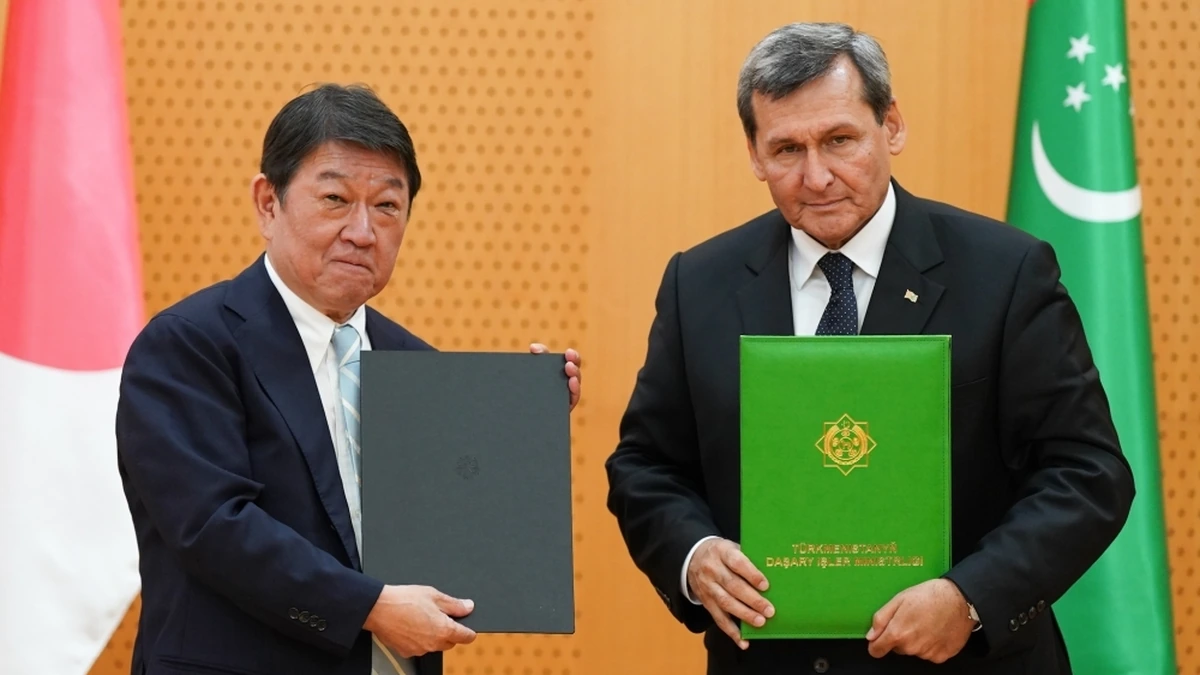
Japan and Turkmenistan signed a new foreign-ministry cooperation program covering 2027 through 2029 on Sunday, extending their diplomatic framework as the two governments look to broaden economic ties beyond an established base in natural gas, petrochemicals and power infrastructure.
Japanese Foreign Minister Toshimitsu Motegi and Turkmenistan’s Foreign Minister Rashid Meredov signed the program in Ashgabat after a meeting and working lunch that lasted about three hours, according to Japan’s Foreign Ministry. Their talks covered natural resources and energy, artificial intelligence and what Tokyo calls resource circulation, alongside wider political and educational cooperation.
The agreement extends a diplomatic framework through 2029
Japan’s Foreign Ministry said the 2027-2029 program was signed during Motegi’s visit to Turkmenistan, following a year of high-level exchanges that included two visits to Japan by Turkmen President Serdar Berdimuhamedov in 2025. The new document succeeds an earlier 2024-2026 cooperation program between the two foreign ministries.
Neither government published the text of the new program with Sunday’s announcement or attached a list of projects, financing commitments or investment values. That distinction is important: the program is a framework for cooperation between the two foreign ministries, while energy, AI and resource-circulation projects were subjects discussed alongside the signing rather than disclosed as binding commitments under the document itself.
Motegi pointed to existing cooperation in natural resources and energy and told Meredov that Japan was ready to expand mutually beneficial work in AI and resource circulation by continuing to use Japanese technology. Meredov, according to the Japanese account, said Japanese technology has helped diversify Turkmenistan’s economy and called for deeper cooperation in the newer fields.
Turkmenistan’s Foreign Ministry put more detail around the commercial agenda. It said the two sides reviewed cooperation in the gas-chemical industry, electric power and transport, named advanced technologies and AI as promising areas, and discussed Japanese participation in projects intended to further diversify Turkmenistan’s economy. The Turkmen side also highlighted Sumitomo Corporation, Toyo Engineering, Kawasaki Heavy Industries, Itochu and Mitsubishi Heavy Industries as companies with experience in the country.
A joint meeting of the Turkmen-Japanese and Japanese-Turkmen committees on economic cooperation is planned in Tokyo later this year, according to the Turkmen Foreign Ministry. That meeting offers a more concrete venue for assessing whether Sunday’s diplomatic language develops into new company-level agreements.
Energy and industrial projects remain the commercial base
The economic relationship already has a sizable industrial footprint. At an April 2025 summit in Tokyo, Japan’s government identified a second gas-to-gasoline plant and an ammonia and urea plant in Kiyanly as projects through which Japanese technology could support Turkmenistan’s energy transition and deepen bilateral economic ties. The wording at that stage described projects Japan wanted to promote, rather than completed investments.
By December 2025, a business meeting during Berdimuhamedov’s visit to Japan produced a broader set of memorandums involving Japanese companies and Turkmen state entities. Turkmenistan’s parliament said the signed documents included cooperation between the Communications Ministry and Mitsubishi Corporation Machinery on the effective use of AI and digital technologies through information exchange, as well as an agreement between state gas concern Turkmengaz and Sumitomo Corporation Europe.
Other documents were tied directly to industrial assets. Kawasaki Heavy Industries and state chemical concern Turkmenhimiya signed a memorandum on extending technical maintenance at the Ahal gas-to-gasoline plant. Toyo Engineering and a Turkish partner signed a memorandum concerning a second phase of work at the Kiyanly polymer plant. Another memorandum covered cooperation on a proposed urea complex in the Balkan region with annual capacity of 1.155 million metric tons involving Mitsubishi Heavy Industries, Mitsubishi Corporation and a Turkish partner.
Those memorandums show why energy and industrial technology continue to dominate the bilateral commercial relationship, but they should not be read as equivalent to final construction contracts or completed capital spending. Sunday’s statements did not announce contract awards, project costs or financing packages for those initiatives.
The resource-circulation language also has a concrete history. During the December 2025 business meeting, Berdimuhamedov proposed projects involving household and construction-waste recycling, wastewater reuse, plastic-bottle recycling and processing of discarded household appliances. Japan’s latest statement suggests those ideas remain part of the agenda, now grouped with AI as areas in which Japanese technology could support Turkmenistan’s effort to diversify beyond traditional resource industries.
The bilateral push fits Japan’s wider Central Asia strategy
The talks also sit inside a broader Japanese effort to expand business and economic-security ties across Central Asia. At the first leaders-level “Central Asia plus Japan” summit in Tokyo in December 2025, Japan set a target of 3 trillion yen in business projects across the five Central Asian countries over five years. The regional initiative identified green and resilience, connectivity and human-resource development as priority areas.
Japan also launched a Central Asia AI cooperation partnership and highlighted stronger critical-mineral supply chains, energy transition and the Trans-Caspian transport route. The 3 trillion yen figure is a regional business-project target, not a Turkmenistan allocation or a government funding commitment, but it gives context to Tokyo’s push for more company participation in economies where Japanese industrial technology can be paired with energy and mineral resources.
Turkmenistan is one of the clearest examples of that model because Japanese engineering groups already have experience with gas processing, fertilizers, polymers and power infrastructure there. The next phase, based on the official statements, is aimed at adding digital technology and resource circulation without abandoning the older industrial base.
Sunday’s meeting did not settle which new projects will proceed or how they would be financed. The more immediate test will come at the planned economic-cooperation committee meeting in Tokyo later in 2026, where government officials and businesses can move from broad diplomatic priorities toward specific commercial proposals.
More News

Latest News
View all news- Prologis Q3 Core FFO Rises to $1.60 a Share as Leasing Demand Holds Firm
- U.S. Natural Gas Storage Rises 67 Bcf to 3,567 Bcf, EIA Reports
- U.S. Business Inventories Increase 0.4% in August as Sales Climb 1.1%
- Philadelphia Fed Manufacturing Index Falls to 20.9 as Factory Growth Moderates
- New York Manufacturing Index Jumps to 25.5, Highest Since December 2021