Riot Platforms Signs $9.1 Billion AI Data Center Deal in Major Shift Beyond Bitcoin Mining
The 20-year Rockdale lease covers 191 MW and could grow to $16.1 billion with extensions as Riot builds a much larger AI data center business.
Our editorial standards
MarketReview publishes clear, independently produced financial information using reliable sources and transparent editorial standards.
Read our Editorial Policy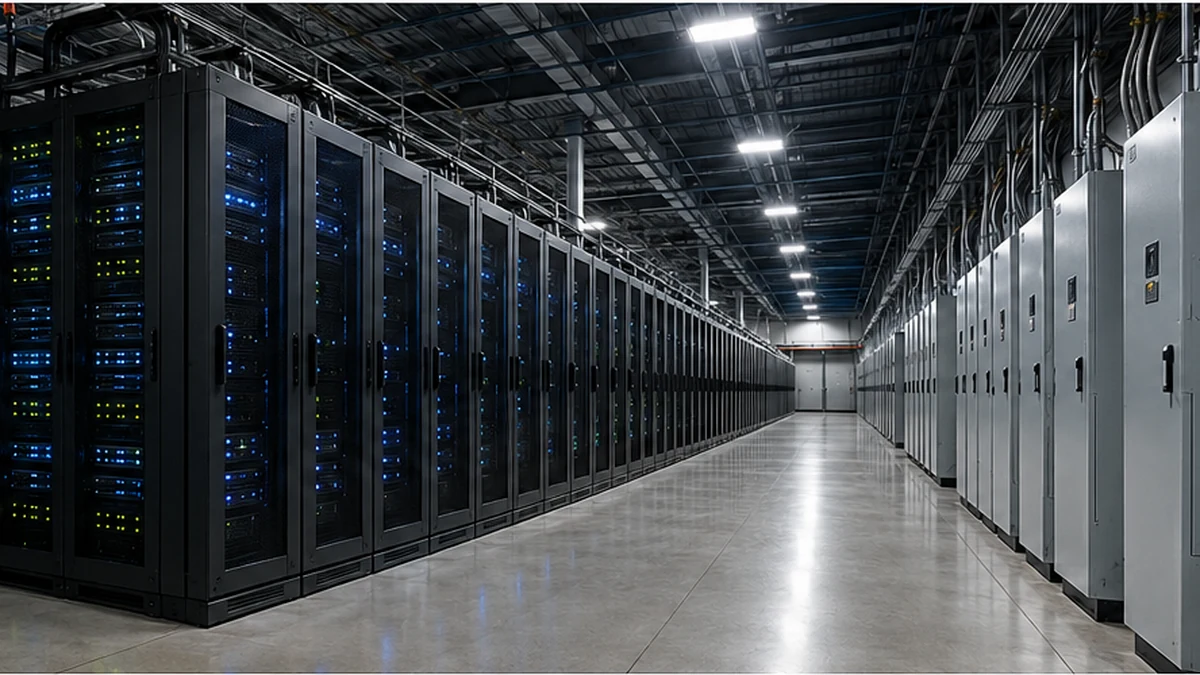
Riot Platforms has signed a 20-year data center lease expected to generate about $9.1 billion of contract revenue, giving the Bitcoin miner its largest step yet toward becoming a major supplier of infrastructure for artificial intelligence workloads.
The agreement covers 191 megawatts of critical IT capacity at Riot’s Rockdale, Texas, campus. It is striking in relation to Riot’s current scale: the $9.1 billion base-term contract value is roughly 14 times the company’s entire 2025 revenue of $647.4 million. That comparison is not an annual revenue forecast, because the lease runs through June 2048, but it shows how much larger the company’s contracted data center opportunity has become than the business it reported only last year.
Riot said in its second-quarter earnings release that the customer is a “leading frontier AI lab.” The company did not publicly identify the tenant. Barron’s reported, citing a source, that the customer is Anthropic. MarketReview has not independently confirmed that identification.
A 20-year lease turns Rockdale into a much larger AI project
The lease is for a build-to-suit Tier 3 data center at Rockdale, where Riot already has power infrastructure and has begun serving Advanced Micro Devices. The initial 96 MW is expected to be delivered in December 2027, with the remaining 95 MW scheduled by June 2028. The tenant has two five-year extension options that could raise the total potential contract value to about $16.1 billion if both are exercised.
Riot’s earnings materials put average annual revenue from the 191 MW lease at about $457 million over the initial term, including contractual escalators. Management estimates that the project could contribute average annual net operating income of $365 million to $411 million, with cumulative NOI of $7.3 billion to $8.2 billion over the base lease term. Those figures are company estimates rather than guaranteed results and depend on construction, financing, delivery and the tenant remaining in place under the contract.
The development will require far more capital than Riot’s existing AMD deployment. The company estimates $2.1 billion to $2.3 billion of capital expenditures for the new AI-lab project, excluding existing infrastructure. Riot has secured a $573 million interim financing facility from Morgan Stanley to fund initial development and long-lead equipment while an investment-grade credit backstop is finalized. Riot’s Form 8-K formally incorporates the lease disclosure into the company’s current report.
Riot’s financing plan assumes debt could ultimately cover 80% to 90% of the project cost. Its earnings presentation estimates a project equity requirement of $210 million to $460 million before recycling expected proceeds from financing tied to the AMD buildout. After accounting for an expected roughly $180 million term loan associated with AMD’s initial 25 MW deployment, Riot estimates net new equity required for the AI-lab project at $30 million to $280 million. Those financing assumptions remain forward-looking and could change as the project is built.
The contract is huge relative to Riot’s existing business
Riot generated $647.4 million of revenue in 2025, with $576.3 million coming from Bitcoin mining. Against that base, the $9.1 billion lease is a very large contracted-revenue commitment even though it is spread across two decades. The roughly $457 million average annual revenue Riot projects from the lease is equivalent to about 71% of its total 2025 revenue.
The company is already beginning to show what recurring data center revenue looks like on a much smaller scale. Riot recorded $23.2 million of data center revenue in the second quarter of 2026, its second quarter with revenue from the segment. That included $4.9 million of operating lease revenue and $18.3 million from tenant fit-out services related to AMD.
The economics of those two revenue streams differ sharply. Riot reported an 84% gross margin on its data center operating lease revenue in the second quarter, compared with 13% on tenant fit-out services, which largely involve customer-specific equipment procurement and installation reimbursed on a cost-plus basis. The lease business is therefore the more important model for understanding what the new 20-year contract could eventually add if Riot delivers the capacity on schedule.
The AMD agreement also gives Riot a smaller operating proof point. The company completed AMD’s initial 25 MW deployment in May 2026 and said it was delivered on time and on budget. Another 25 MW is under construction, with 10 MW expected in November 2026 and the final 15 MW in May 2027. Once that expansion is complete, AMD will have 50 MW of contracted capacity at Rockdale.
Together, the AMD lease and the new 191 MW agreement give Riot 241 MW of contracted critical IT capacity at Rockdale and about $9.8 billion of long-term contracted data center revenue, according to the company. Riot also has an additional 150 MW expansion option associated with AMD, though that capacity is not part of the currently contracted 241 MW.
Bitcoin mining still dominates today’s revenue
The size of the AI deal does not mean Riot has already transformed its income statement. Bitcoin mining remained the company’s largest revenue source in the second quarter, producing $113.7 million of the quarter’s $174.2 million total. Data centers contributed $23.2 million and engineering contributed $37.3 million.
Bitcoin mining revenue fell from $140.9 million a year earlier even though Riot produced 1,587 bitcoin, up from 1,426. The company attributed the revenue decline mainly to a lower average bitcoin price and a higher global network hash rate, partly offset by its own larger operating hash rate. Its average cost to mine one bitcoin, excluding depreciation, increased to $49,912 from $48,992.
Riot reported a second-quarter net loss of $237.2 million and adjusted EBITDA of negative $69.7 million. The quarter also included non-cash mark-to-market effects and other adjustments, so those figures do not map directly to the economics of the new data center lease, but they underline that the company is still in the expensive buildout phase of its diversification.
Liquidity is central to that transition. Riot ended June with more than $1.2 billion of liquid assets, including $548.9 million in cash and 11,380 bitcoin valued at about $666 million at the June 30 market price used by the company. Its earnings presentation said continued sales of bitcoin inventory are a primary source of funding for the equity component of data center capital expenditures.
That creates a notable link between the old and new business models. Bitcoin mining and Riot’s accumulated bitcoin holdings are helping provide capital for infrastructure intended to produce longer-duration lease revenue from AI customers. The strategic shift is therefore not an immediate exit from Bitcoin mining, but a redeployment of power, land, engineering capabilities and balance-sheet resources built around the mining business.
Bitcoin miners are competing to turn power access into AI infrastructure
Riot’s move fits a wider shift among cryptocurrency miners that control large blocks of electricity, land and grid interconnections. AI data centers need the same scarce foundations, but they also require more demanding reliability, cooling, networking and construction standards than a conventional mining operation.
Other former or current miners have already signed large AI infrastructure contracts. TeraWulf announced a 20-year lease with Anthropic in July that it said could generate about $19 billion of contracted revenue. Hut 8 followed with a 15-year, $9.8 billion AI data center lease at its Beacon Point campus in Texas, adding to a growing pipeline of power-heavy sites being converted or developed for AI workloads.
The common asset is not the mining hardware. It is access to electricity and sites where large amounts of power can be delivered on a schedule that AI customers can use. Riot’s Rockdale campus has an existing approved interconnection, and the company says that helps it move faster than developers starting from an unpowered site. Its engineering businesses also manufacture and support electrical infrastructure that can be used in data center construction.
Execution remains the main test. Riot must deliver 96 MW for the new tenant by December 2027 and the full 191 MW by June 2028 while arranging long-term financing and controlling a project budget that could exceed $2 billion. Construction delays, equipment constraints, financing costs or changes in the leasing arrangement could alter the economics outlined in the company’s current projections.
If Riot meets those milestones, the composition of the company could look very different from the one investors knew as a Bitcoin miner. The next concrete step comes sooner: Riot is scheduled to deliver another 10 MW to AMD in November 2026, followed by 15 MW in May 2027, before the much larger AI-lab deployment is due to start producing rent at the end of 2027.
More from Investing

Latest News
View all news- U.S. Manufacturing Expands for Ninth Month as ISM PMI Holds at 54.5
- U.S. Initial Jobless Claims Slip to 197,000 as Continuing Claims Fall to 1.701 Million
- U.S. Construction Spending Rises 0.9% in August to $2.20 Trillion Annual Rate
- UK House-Price Growth Halves to 0.8% in September, Nationwide Says
- Italy’s Unemployment Rate Rises to 6.2% as Jobless Count Increases by 48,000