South Korean Consumer Sentiment Falls for First Time in Four Months
Bank of Korea data showed the August confidence index slipped to 104.5 as stock volatility and accumulated price increases weighed on households, though it remained above its long-term benchmark.
Our editorial standards
MarketReview publishes clear, independently produced financial information using reliable sources and transparent editorial standards.
Read our Editorial Policy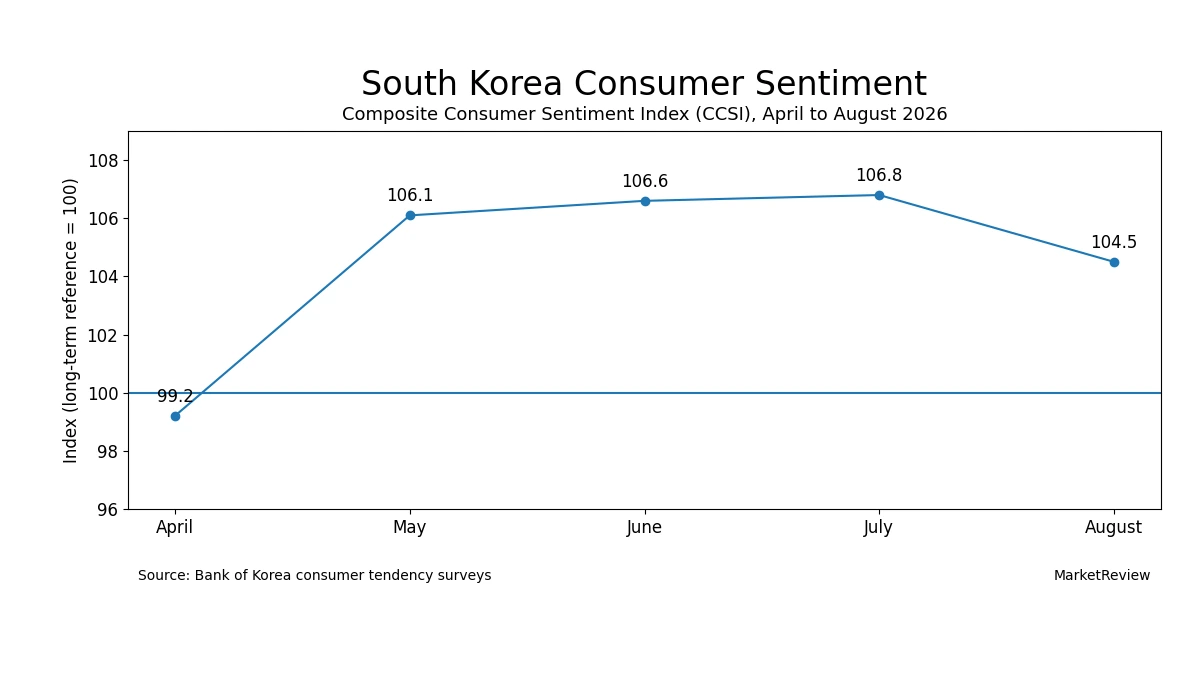
South Korean consumer sentiment fell in August for the first time in four months, interrupting a three-month recovery as stock-market volatility and the accumulated cost of higher prices weighed on households. The Bank of Korea’s Composite Consumer Sentiment Index, or CCSI, dropped 2.3 points to 104.5 from 106.8 in July.
The decline did not erase the improvement recorded since spring. Sentiment had fallen to 99.2 in April, rebounded to 106.1 in May, then edged up to 106.6 in June and 106.8 in July. August’s reading remained above 100, which means the combined measure was still above the long-term standard used by the survey rather than signaling a broad return to pessimism.
The Bank of Korea released the August survey on Tuesday after polling 2,500 urban households from Aug. 7 to Aug. 14. Responses were received from 2,244 households. The CCSI combines six gauges covering living conditions, household income, spending and assessments of the economy, so the headline number captures a wider range of household views than a single question about whether conditions are good or bad.
Economic assessments weakened across the survey
All six components used to calculate the CCSI declined from July. The current economic conditions index recorded the largest fall, dropping five points to 79, while the outlook for future economic conditions fell three points to 89. Both remained below 100, showing that households were less upbeat about the economy than the survey’s long-run reference even though the broader composite index stayed above that line.
Household finances also softened, though the moves were smaller. The index for current living conditions fell one point to 92, and the outlook for living conditions slipped one point to 97. The household income outlook eased to 100, while the spending outlook declined to 109. Spending therefore remained the strongest of the six headline components, but the synchronized drop suggests that consumers became more cautious across several parts of their financial outlook rather than reacting to one isolated concern.
The current household savings index fell three points to 94, its lowest level since May 2025. Bank of Korea officials said the measure includes stocks and investment funds as well as bank deposits, which helps explain why the correction in domestic equities affected households’ view of their savings. That channel matters because a fall in perceived financial wealth can make consumers less willing to commit to optional purchases even before income or employment changes.
Employment expectations weakened as well. The employment opportunity outlook fell three points to 86, with Bank of Korea officials pointing to softer hiring conditions in manufacturing and construction and greater concern among younger workers. The wage outlook declined one point to 123. Those readings do not forecast payrolls directly, but they show that consumers were less confident about job availability even as they continued to expect wages to rise relative to the survey benchmark.
The survey therefore presents a different perspective from some of South Korea’s stronger top-line economic indicators. When the Bank of Korea raised its policy rate in July, it said growth had strengthened, led by exports and investment. August’s confidence data show that favorable production or trade conditions do not immediately remove pressure felt by households, especially when asset prices are volatile and the cost of everyday goods remains elevated.
Inflation slowed, but households still felt the price burden
Official inflation data help explain that gap. South Korea’s consumer price index rose 2.8% from a year earlier in July, down from 3.2% in June, while prices fell 0.2% from the previous month. The index excluding food and energy increased 2.6% from a year earlier, according to the Ministry of Data and Statistics’ July price report.
Consumers did not interpret the slower annual rate as a return to low prices. Their estimate of inflation over the previous year held at 3.0% in the August survey. Expected inflation for the next year remained at 2.7%, while three-year and five-year expectations were unchanged at 2.6%. The stability of those measures indicates that the fall in headline confidence was not driven by a fresh surge in expected inflation, but price pressure was still firmly present in household decision-making.
The price-level outlook index stayed at 149, far above the neutral reference of 100. Petroleum products were cited by 50.2% of respondents as a likely source of inflation over the next year, followed by agricultural, livestock and fishery products at 42.0% and public utility charges at 33.3%. The share naming food-related products rose sharply from July, while the proportion pointing to petroleum declined.
July’s official data also show why the consumer experience can differ from the headline inflation rate. Transport prices were 7.7% higher than a year earlier, restaurant and hotel prices rose 2.8%, and recreation and culture costs increased 5.5%. A slower rate of inflation means prices are rising less quickly; it does not reverse the increases that households have already absorbed. That distinction is consistent with the one-point declines in both current and expected living conditions.
Rate and housing expectations remained elevated
Interest-rate expectations stayed high after the Bank of Korea’s July tightening. The interest-rate outlook index slipped one point to 125, a level that still indicates a stronger expectation of higher rates than lower rates relative to the survey benchmark. On July 16, the central bank raised its base rate by 25 basis points to 2.75%, citing stronger growth, inflation expected to remain above target for some time and continuing financial-stability risks.
Housing expectations cooled slightly after rising for four consecutive months. The housing-price outlook declined two points to 125 from 127 in July. The index had climbed from 104 in April to 112 in May and 120 in June before reaching 127 in July, so the August move marked a pause rather than a reversal of the earlier rise. Bank of Korea officials said government tax and housing-supply measures contributed to the moderation in expectations.
Other balance-sheet measures moved less. The current household debt index was unchanged at 100, while the debt outlook fell one point to 97. Combined with the lower savings assessment and the still-high interest-rate index, those readings suggest that households were paying close attention to financing costs without reporting a sharp deterioration in their current debt position.
For policymakers, the August survey is a mixed signal rather than a simple case for easier or tighter policy. Consumer confidence cooled, yet it remained above its long-term reference. Inflation expectations were steady, but they stayed above the Bank of Korea’s 2% target, and the central bank had already identified growth, inflation and financial stability as reasons for July’s rate increase. One monthly sentiment report is unlikely to settle that balance on its own.
The next scheduled consumer survey release is due Sept. 23 at 6 a.m. local time. It will provide the first official reading on whether sentiment stabilized after the August pullback.
More News
Latest News
View all news- Prologis Q3 Core FFO Rises to $1.60 a Share as Leasing Demand Holds Firm
- U.S. Natural Gas Storage Rises 67 Bcf to 3,567 Bcf, EIA Reports
- U.S. Business Inventories Increase 0.4% in August as Sales Climb 1.1%
- Philadelphia Fed Manufacturing Index Falls to 20.9 as Factory Growth Moderates
- New York Manufacturing Index Jumps to 25.5, Highest Since December 2021