Switzerland and ASEAN Explore Deeper Economic Cooperation and EFTA Links in Manila
ASEAN Secretary-General Kao Kim Hourn and Swiss State Secretary Helene Budliger Artieda discussed new areas for collaboration as ASEAN and EFTA work toward implementing their 2024 economic cooperation framework.
Our editorial standards
MarketReview publishes clear, independently produced financial information using reliable sources and transparent editorial standards.
Read our Editorial Policy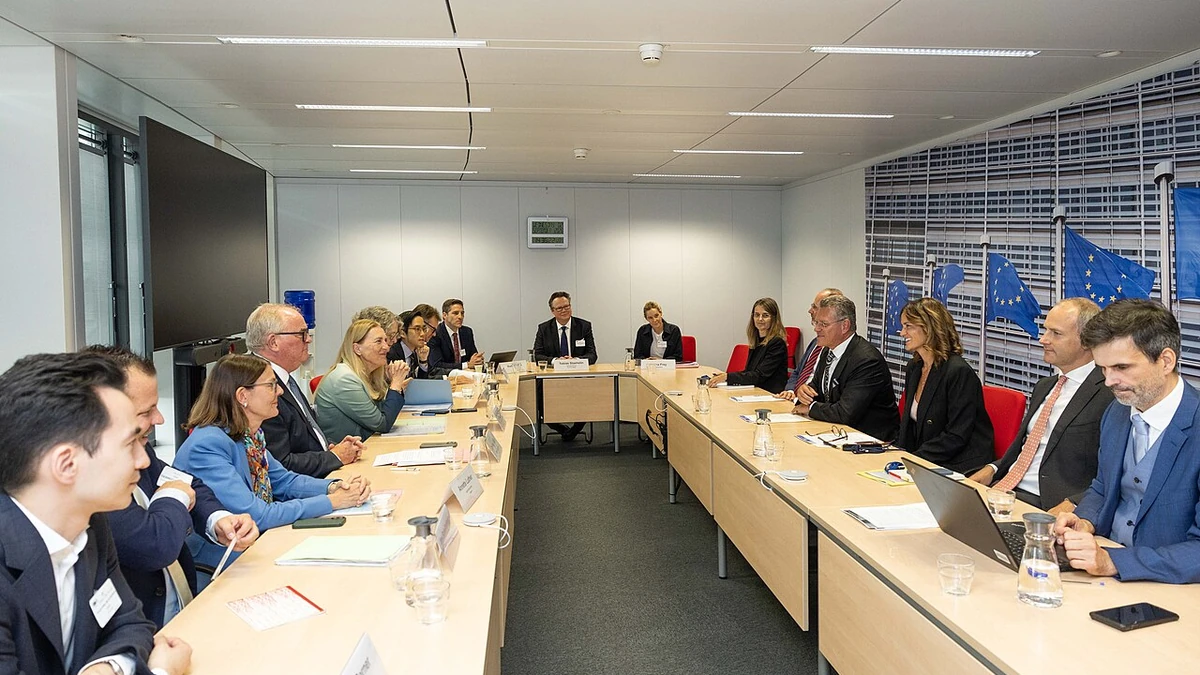
Switzerland and ASEAN are looking at ways to deepen economic cooperation as the Southeast Asian bloc advances a broader trade-policy track with the European Free Trade Association. ASEAN Secretary-General Kao Kim Hourn met Swiss State Secretary Helene Budliger Artieda in Manila on September 20, with the discussion covering potential ASEAN-Switzerland collaboration and ASEAN’s cooperation with EFTA.
The meeting took place during the 58th ASEAN Economic Ministers’ Meeting and related sessions in the Philippine capital. The wider ministerial program has focused on regional trade, investment, trade facilitation and ASEAN’s economic relationships with external partners. ASEAN economic ministers also said the regional economy expanded 4.9% in 2025 and is projected to grow 4.5% in 2026, against a projected global growth rate of 3.0%.
In its account of the Manila meeting, the ASEAN Secretariat said Kao and Budliger Artieda discussed possible cooperation between ASEAN and Switzerland as well as ASEAN’s work with EFTA. The statement did not announce a new trade negotiation, a timetable for an agreement or a signed initiative. Instead, the talks fit into an existing framework that both sides have been building over the past two years.
That distinction is important for understanding the significance of the meeting. ASEAN and EFTA already have an economic cooperation declaration, while Switzerland has maintained its own sectoral dialogue partnership with ASEAN since 2016. The Manila discussion therefore points to implementation and expansion of existing channels rather than the launch of a new ASEAN-wide free trade negotiation.
Manila meeting brings the ASEAN-EFTA work plan back into focus
ASEAN and the four EFTA states, Iceland, Liechtenstein, Norway and Switzerland, adopted a Joint Declaration on Economic Cooperation in Vientiane, Laos, on September 19, 2024. Budliger Artieda took part in that meeting for Switzerland. EFTA described the declaration as a step toward deeper economic dialogue and stronger trade and investment relations between the two regions.
Broad in scope rather than tariff-specific, the declaration calls for cooperation on trade in goods and services, customs procedures and trade facilitation, electronic commerce, investment and intellectual property. It also provides room for work on competition policy, public procurement, innovation and emerging technologies, sustainable development, inclusive growth and human-resource development. Another objective is to increase the participation of micro, small and medium-sized businesses in economic cooperation.
Turning those broad areas into a practical work program is the next stage. At EFTA’s ministerial meeting in Reykjavik on June 22, 2026, the four member states said they wanted to strengthen engagement with partners beyond existing trade agreements and specifically highlighted finalizing the work plan under the ASEAN-EFTA Joint Declaration on Economic Cooperation. That June statement makes the EFTA reference in the Manila discussion more concrete: the current institutional task is to move from the 2024 declaration toward a defined program of cooperation.
Official statements released so far do not say that the Manila meeting completed that work plan or created new market-access commitments. They also do not identify individual projects agreed on September 20. For now, the official record shows high-level economic engagement around a framework that is still being put into practice.
EFTA already has a growing network of Southeast Asian trade agreements
Alongside the ASEAN-level declaration, EFTA has a much more developed set of relationships with individual Southeast Asian economies. EFTA has long-standing free trade arrangements with Singapore and the Philippines, while its comprehensive economic partnership agreement with Indonesia has been in force since 2021. Those agreements give the four EFTA states preferential access in major ASEAN markets without requiring a single region-to-region free trade agreement.
EFTA has continued expanding that network. EFTA and Malaysia signed an Economic Partnership Agreement in June 2025, although ratification remains pending. EFTA and Thailand signed a free trade agreement in January 2025, with entry into force also still pending. In July 2026, EFTA and Vietnam announced the conclusion of negotiations on a comprehensive free trade agreement after talks that had stretched over more than a decade.
That patchwork helps explain why ASEAN-EFTA cooperation can be economically relevant even without an ASEAN-wide FTA. The regional declaration can support dialogue on issues that cut across national agreements, including trade facilitation, digital commerce, investment practices, sustainable trade and smaller-business participation. At the same time, country-level agreements remain the vehicles for binding tariff and market-access commitments where they exist.
Trade between the two regions has also grown materially over time. EFTA reported that merchandise trade with ASEAN rose from EUR 10.9 billion in 2010 to EUR 34.4 billion in 2023, an increase of 216.9% in nominal terms. The figures are historical rather than a measure of the current 2026 level, but they show why the four-country bloc has kept Southeast Asia high on its external trade agenda.
Host country Philippines is itself part of that network. The EFTA-Philippines free trade agreement was signed in 2016 and entered into force for the Philippines, Norway, Liechtenstein and Switzerland in June 2018, with Iceland following in 2020. The agreement covers goods and services, investment, intellectual property, government procurement, competition and trade and sustainable development.
Switzerland’s ASEAN relationship extends beyond trade agreements
Switzerland’s engagement with ASEAN is broader than its role inside EFTA. The country became an ASEAN Sectoral Dialogue Partner in 2016, creating a formal channel for high-level exchanges and technical cooperation. Swiss government material describes the partnership as covering areas including prosperity, sustainability and digitalization, alongside peace and security.
Economic ties have become more visible as Southeast Asia has grown in importance to Swiss trade policy. The Swiss government said in July 2025 that annual trade with ASEAN countries was around CHF 25 billion. Switzerland has also used EFTA to pursue preferential trade arrangements across the region while maintaining direct bilateral economic relationships with individual ASEAN members.
For ASEAN, engagement with Switzerland and EFTA comes during a broader push to reinforce external economic ties while upgrading its own internal trade architecture. The 58th AEM meeting in Manila addressed the ASEAN Trade in Goods Agreement, trade facilitation measures and investment cooperation, while also providing a venue for consultations with outside partners. That setting gives the Kao-Budliger Artieda meeting a practical trade-policy context rather than making it an isolated diplomatic call.
A concrete marker for the next phase is the ASEAN-EFTA work plan identified by EFTA ministers in June. A completed plan could translate the 2024 declaration’s broad agenda into specific dialogues, projects or cooperation priorities, but neither ASEAN nor Switzerland announced such a completion in Manila. As of September 20, the confirmed development is narrower: the two sides used the ASEAN economic ministers’ meetings to discuss further collaboration and to keep the EFTA channel on the agenda.
More News
Latest News
View all news- Australia Raises Pension Payments and Deeming Rates From Sept. 20
- REPT BATTERO and Germany’s Haller Group Sign European Battery Partnership
- BNY’s $1 Billion Series F Preferred Redemption Takes Effect
- Chiltern Railways Transfers Into Public Ownership as UK Rail Restructuring Advances
- TWC Enterprises’ New TSX Buyback Authorization Takes Effect for Up to 1.21 Million Shares