
Teledyne to Buy Varex Imaging for $1.1 Billion as Varex Shares Jump 48%
Teledyne is paying a 52% premium for the X-ray imaging specialist as it expands its fast-growing Digital Imaging business.
Our editorial standards
MarketReview publishes clear, independently produced financial information using reliable sources and transparent editorial standards.
Read our Editorial Policy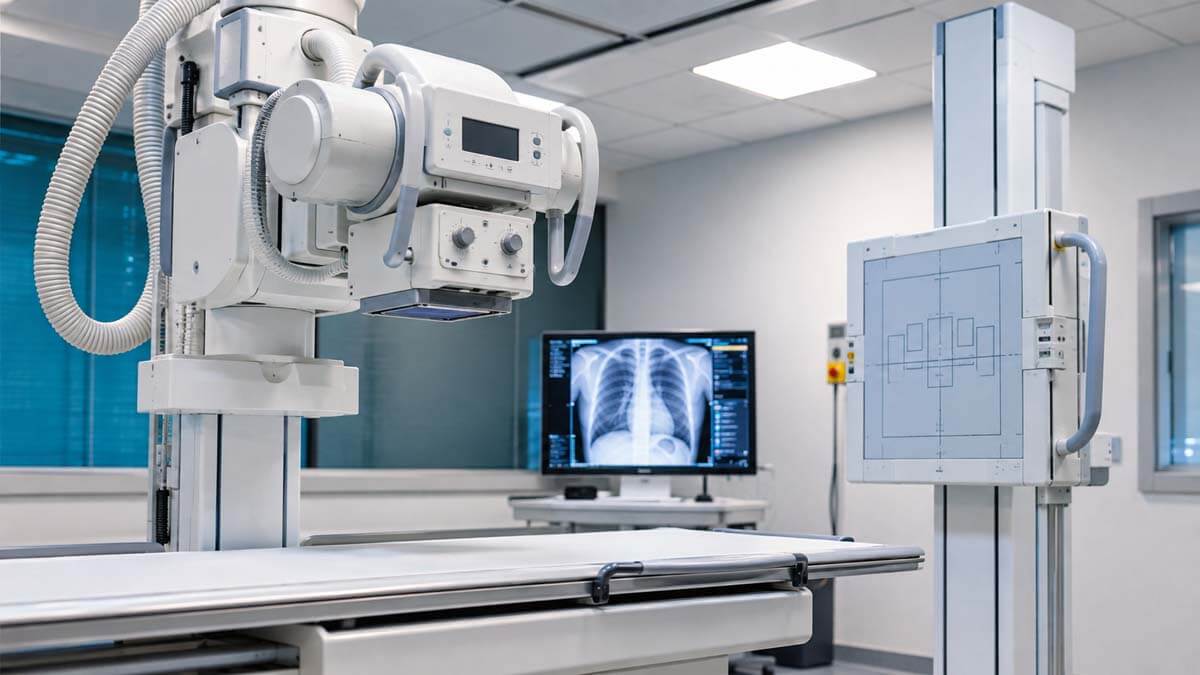
Teledyne Technologies has agreed to acquire Varex Imaging for about $1.1 billion in cash, a move that would broaden Teledyne’s position in medical and industrial X-ray technology and give Varex shareholders a substantial premium after several years of uneven operating performance. The purchase would deepen an imaging business that already generates more than half of Teledyne’s quarterly sales rather than take the company into an unfamiliar market.
Teledyne will pay $18.90 for each outstanding Varex share, about 52% above Varex’s Friday closing price. The stated purchase value includes Varex’s equity awards and debt. Both boards have unanimously approved the acquisition, which is expected to close in early 2027, subject to Varex shareholder approval, regulatory clearances and other customary conditions.
Varex shares jumped roughly 48% to $18.43 in Monday afternoon trading, quickly moving close to the offer price, while Teledyne shares edged higher. At that level, Varex was trading about 47 cents below the $18.90 cash offer, leaving a spread of roughly 2.5%. The narrow gap indicates that investors were assigning a relatively high probability to completion, although the remaining discount still reflects the time to closing and the risk that shareholder, regulatory or other conditions could delay or derail the deal.
Varex broadens Teledyne’s X-ray capabilities
Teledyne already sells imaging sensors, detectors, cameras and related electronics across aerospace, defense, industrial, scientific and medical markets. Varex operates closer to the core of X-ray generation and detection, manufacturing X-ray tubes, digital detectors, image-processing components and complete systems used by medical-equipment makers as well as industrial and security customers.
The Salt Lake City company serves applications including computed tomography, radiography, fluoroscopy, cargo inspection and industrial testing. Varex says its history in imaging stretches back more than 70 years and that it employs roughly 2,450 people across North America, Europe and Asia.
Teledyne Executive Chairman Robert Mehrabian has emphasized that the two portfolios are more complementary than duplicative. Teledyne already makes X-ray detectors, but it does not produce detectors designed for high-radiation environments such as oncology. Varex also offers photon-counting detectors for healthcare and industrial inspection, an area where Teledyne does not currently have an equivalent product, and it manufactures X-ray tubes used in radiography, fluoroscopy and CT systems.
Those product gaps help explain why buying Varex can expand Teledyne’s addressable market without forcing it to combine two nearly identical businesses. Photon-counting technology is one of the more important additions because traditional CT detectors generally convert incoming X-ray energy into light and then into an electrical signal, while photon-counting detectors are designed to count individual X-ray photons and measure their energy more directly. That can allow imaging systems to produce richer spectral information and improve the differentiation of materials. Varex has been investing in photon-counting platforms for next-generation CT applications, and management said earlier this year that demand for those detectors was contributing to business momentum.
Varex also gives Teledyne more exposure to healthcare without moving far from the sensing and imaging technologies it already understands. Teledyne’s existing imaging operations span defense, space, industrial automation, scientific research, marine systems and other specialized markets, while Varex’s largest business is medical imaging. In its fiscal second quarter, Varex generated $156 million of its $216 million in revenue from its Medical segment, with the remaining $60 million coming from Industrial.
Teledyne has room on the balance sheet
The timing fits Teledyne’s recent financial trajectory. Less than three weeks before announcing the Varex agreement, the company reported the strongest quarterly orders, sales and operating profit in its history. Second-quarter revenue rose 9.8% to $1.66 billion, non-GAAP diluted earnings increased 20.8% to $6.28 a share, operating cash flow reached $315.2 million and free cash flow was $284.7 million.
Management had already pointed to the balance sheet as a reason Teledyne could keep looking for acquisitions. Its consolidated leverage ratio fell to 1.1 times at the end of the second quarter after the company repaid $450 million of debt near the beginning of the period. Mehrabian said at the time that the stronger balance sheet gave Teledyne capacity to continue reviewing opportunities, and the Varex purchase puts that capacity to use in a business closely related to its existing operations.
Digital Imaging generated $868.7 million in second-quarter sales, more than half of Teledyne’s $1.66 billion of total revenue. Adding Varex would make that segment larger while extending the range of products it can sell, particularly in X-ray tubes, high-radiation detectors, photon-counting technology and medical imaging.
The strategy is consistent with Teledyne’s long-running use of acquisitions to build specialized technology businesses. Recent purchases have included DD-Scientific, which makes electrochemical gas sensors, and TransponderTech, a maritime communications and navigation technology business acquired from Saab. Teledyne’s largest transformational imaging purchase remains FLIR Systems, which materially expanded its presence in thermal imaging and sensing. Varex is much smaller, but the underlying logic is similar: add a technically specialized business that serves markets Teledyne already knows, then integrate those capabilities into a broader portfolio of sensors and imaging systems.
Varex brings medical demand but uneven profitability
For Varex shareholders, the 52% premium arrives at a time when the company has been showing relatively stable demand without producing especially strong earnings. Fiscal second-quarter revenue was $216 million, up 1% from a year earlier, with management pointing to demand across global CT systems, cargo inspection and photon-counting detectors.
Profitability was weaker. Varex reported a GAAP net loss of 19 cents a share, while non-GAAP earnings fell to 21 cents a share from 31 cents a year earlier. Non-GAAP gross margin declined to 34% from 36%, and operating cash flow was negative $2 million. Management nevertheless expected revenue growth to improve in the second half of fiscal 2026, with prior full-year guidance calling for $860 million to $880 million in revenue and non-GAAP earnings of 80 cents to $1.00 a share.
The company also refinanced its balance sheet in March. It replaced $368 million of 7.875% senior secured notes due in 2027 with a new credit agreement consisting of a $350 million secured term loan, a $100 million revolving facility and a $40 million delayed-draw term facility, all maturing in 2031.
That financial profile helps explain what Teledyne is buying. Varex is not a rapidly growing, high-margin software company. It is an established medical and industrial technology supplier with longstanding customer relationships, manufacturing operations and specialized products that Teledyne believes would be difficult or unnecessary to reproduce internally. The return on the purchase will depend less on headline revenue acceleration than on whether Teledyne can make the combined technology base more valuable through broader customer access, product development and operating execution.
The companies also participate at different points inside an X-ray system. A medical or industrial setup needs a source to generate X-rays, detectors to capture them, electronics to process the signals and software to turn those signals into usable images or measurements. Varex brings substantial expertise on the source side through its tube business as well as detector and processing technology. Teledyne contributes its own detector capabilities, imaging electronics and experience across other parts of the electromagnetic spectrum.
That acquisition could allow Teledyne to offer equipment manufacturers a wider set of components without trying to become a producer of complete medical scanners. Varex primarily supplies original equipment manufacturers that incorporate its tubes, detectors and software into their own systems, while Teledyne also sells highly engineered components and subsystems that other companies integrate into larger products.
The overlap in customer type could make integration more straightforward than it would be for businesses with very different routes to market. It may also create cross-selling opportunities, although the companies have not publicly quantified expected revenue synergies or cost savings in the materials released for the acquisition.
Integration will still carry risk. Varex has manufacturing sites across several countries, meaningful medical-market exposure and products subject to regulatory, supply-chain and customer requirements that differ from parts of Teledyne’s existing portfolio. Teledyne’s balance-sheet position provides flexibility, but paying about $1.1 billion still requires management to earn an adequate return from the acquired assets.
The market is already pricing in a high chance of completion
For Varex investors, most of the takeover premium appeared in the share price within hours of the announcement. At roughly $18.43 on Monday afternoon, Varex was trading only about 2.5% below the $18.90 cash consideration.
That spread measures something different from the 52% premium quoted when the acquisition was announced. The 52% figure compares Teledyne’s offer with Varex’s unaffected Friday closing price. The post-announcement spread represents the additional return available to an investor buying Varex after the rally if the company is ultimately purchased at $18.90 a share.
A small spread can reflect confidence that a deal will close, but it does not eliminate risk. Investors buying near the offer price still have to wait until the expected early-2027 completion and accept the possibility of delays, regulatory complications, a failed shareholder vote or other conditions that could prevent closing.
Both boards have approved the acquisition, but Varex shareholders still need to vote and the companies must obtain the required regulatory clearances. Teledyne has emphasized the limited overlap between the product portfolios, which may reduce some obvious competitive concerns, although regulators will make their own assessment of the relevant imaging markets.
For Teledyne, the bigger test will come after closing. The company is committing roughly $1.1 billion to expand a Digital Imaging segment that already generates more than half of its quarterly sales. Varex would add X-ray tubes, oncology-capable detectors, photon-counting technology and a larger medical-imaging presence to a business that Teledyne has spent years building through internal development and acquisitions.
The immediate milestones are Varex shareholder approval and regulatory review. If those conditions are satisfied, the companies are targeting completion in early 2027.
Sources
Teledyne Technologies: Second-quarter 2026 earnings release and Digital Imaging segment results.
Varex Imaging: Company information and fiscal second-quarter results.
More from Investing


Latest News
View all news- FTC, USDA Launch Joint Inquiry Into Agricultural Equipment Market Practices
- VAALCO Completes Gabon Phase 3 Drilling as ETSEM-3H Starts at About 2,000 BOPD
- U.S. Crude Inventories Fall 3.2 Million Barrels in Latest EIA Report
- UK Trade Remedies Authority Proposes Five-Year Anti-Dumping Duty on Chinese Rutile Titanium Dioxide
- OCC Launches Direct Payments-Fraud Reporting Tool for Community Banks
