
Uber Invests in Zipline as It Targets One Million Drone Deliveries a Day
Uber is making an undisclosed strategic investment in Zipline as the companies plan a U.S. drone-delivery rollout targeting one million deliveries a day by the end of 2029.
Our editorial standards
MarketReview publishes clear, independently produced financial information using reliable sources and transparent editorial standards.
Read our Editorial Policy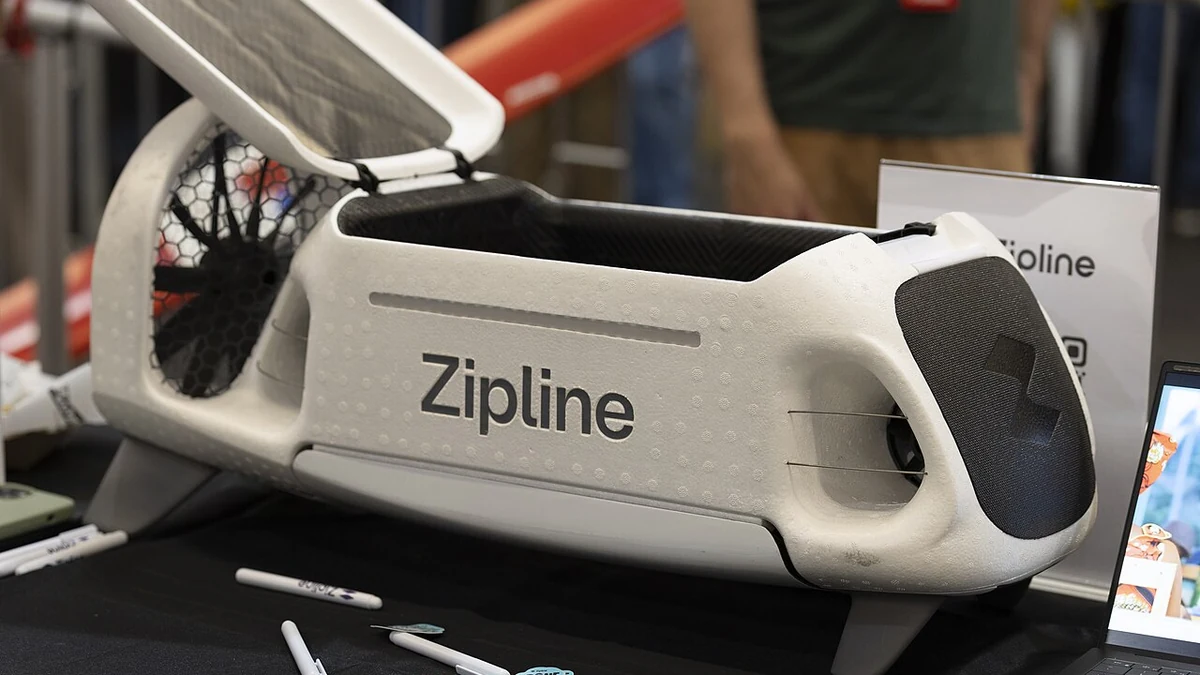
Uber Technologies is investing in drone-delivery company Zipline and plans to bring Zipline’s autonomous aircraft onto Uber Eats, with the companies setting a target of one million drone deliveries a day by the end of 2029.
The size of Uber’s investment was not disclosed. That leaves investors without enough information to determine the stake Uber is buying, the valuation implied by Uber’s investment or how material the cash commitment is for Uber. Reuters reported that Uber declined to provide financial details of the investment.
The operating commitment is more concrete. Uber said in its partnership announcement that the first deployments will begin later in 2026 and that the service is intended to expand across dozens of U.S. cities. Zipline said the rollout will start in markets where it already operates, including Dallas and Houston, before following the company into additional locations.
The one-million-a-day target implies a very large scale-up
The 2029 goal is far beyond Zipline’s present operating volume. Uber says Zipline has completed more than 2.7 million deliveries, carried more than 20 million items and flown more than 135 million autonomous miles. It also describes the current network as making a delivery somewhere in the world every 20 seconds.
Using that one-delivery-every-20-seconds figure as an around-the-clock network average works out to roughly 4,320 deliveries a day. A target of one million a day would be about 230 times that rate. At one million deliveries per day, Zipline would also equal its entire disclosed cumulative history of 2.7 million deliveries in less than three days. Those comparisons do not establish how quickly the network will grow, but they show how much manufacturing capacity, operating infrastructure and customer demand must be added if the companies are to reach the target.
Zipline’s own announcement says the partnership will first go live in Dallas and Houston and expand as Zipline adds service elsewhere. The company says its U.S. system is designed to deliver orders in five to 10 minutes. Uber’s release does not specify how many cities will be operating by any particular intermediate date, how many aircraft will be needed or what portion of the one-million-a-day goal is expected to come specifically from Uber Eats.
The target therefore remains an operating ambition rather than contracted volume. It is also broader than a single restaurant-delivery use case. Uber says its delivery network increasingly combines human couriers, sidewalk robots and drones, while Zipline already works across healthcare, food and retail logistics. The companies have not disclosed minimum delivery commitments, exclusivity terms, per-delivery economics or a revenue-sharing formula.
Uber is buying exposure, not building the drone fleet itself
The Zipline deal fits Uber’s broader approach to autonomy: use outside technology providers and integrate them into a platform that already aggregates consumer demand and merchants. Uber made its first investment in drone delivery in September 2025 through a partnership with Flytrex. The new Zipline agreement adds another aerial-delivery provider rather than replacing couriers or putting Uber in the business of designing and manufacturing its own aircraft.
That distinction matters financially. The disclosed structure lets Uber pursue autonomous delivery without announcing the capital spending that would come with building a proprietary national drone fleet. At the same time, the undisclosed investment means investors cannot yet judge how much capital Uber is putting at risk in Zipline or whether Uber received preferred terms, board rights or other protections. There is also no disclosed ownership percentage that would allow the market to value Uber’s exposure as Zipline’s private valuation changes.
Zipline was valued at $7.6 billion in a funding round announced in January, when it raised $600 million, Reuters reported at the time. Uber has not said whether its new investment uses that valuation, a higher or lower one, or a different security structure. Without those terms, the strategic rationale can be evaluated more readily than the investment return.
Uber does have substantial financial capacity to make strategic investments. It ended the second quarter with $5.4 billion of unrestricted cash, cash equivalents and short-term investments and generated $2.8 billion of free cash flow during the quarter. Delivery gross bookings reached $27.46 billion in the quarter, up 26% from a year earlier, while Delivery revenue rose 28% to $5.25 billion and segment operating income increased 38% to $1.06 billion. The Zipline partnership is therefore being layered onto a delivery business that is already large and profitable on Uber’s segment measure, rather than being used to create a new delivery business from scratch.
Regulation and deployment will determine how national the rollout becomes
Reaching one million daily deliveries is not only a demand question. Commercial drone delivery beyond a pilot’s visual line of sight remains regulated by the Federal Aviation Administration. The FAA says Part 135 is currently the regulatory path for drone operators carrying another party’s property for compensation beyond visual line of sight, and it has separately proposed a broader framework intended to normalize such operations.
Zipline has already received FAA authorization for beyond-visual-line-of-sight package delivery, giving it a base from which to expand. A national rollout still requires operating approvals, launch and receiving infrastructure, aircraft production, local market deployment and enough participating merchants and customers. Uber and Zipline have not published a city-by-city schedule beyond naming Dallas and Houston among the first markets.
The investment gives Uber a financial interest in one of the larger existing drone-delivery networks while keeping its operating model partner-led. The headline target is also unusually demanding: one million deliveries a day by the end of 2029 would represent an annualized pace of about 365 million deliveries. For investors, the key evidence will come from how quickly the companies move beyond the first markets, whether delivery economics are disclosed and whether Zipline can scale aircraft and operations fast enough to turn the 2029 target into recurring volume rather than a long-range aspiration.
More from Investing
Latest News
View all news- FTC, USDA Launch Joint Inquiry Into Agricultural Equipment Market Practices
- VAALCO Completes Gabon Phase 3 Drilling as ETSEM-3H Starts at About 2,000 BOPD
- U.S. Crude Inventories Fall 3.2 Million Barrels in Latest EIA Report
- UK Trade Remedies Authority Proposes Five-Year Anti-Dumping Duty on Chinese Rutile Titanium Dioxide
- OCC Launches Direct Payments-Fraud Reporting Tool for Community Banks
