U.S. Median Employee Tenure Rises to 4.1 Years
Workers had stayed with their current employer for a median 4.1 years in January, up from 3.9 years in 2024, as the share with a year or less of tenure declined.
Our editorial standards
MarketReview publishes clear, independently produced financial information using reliable sources and transparent editorial standards.
Read our Editorial Policy
U.S. workers had been with their current employer for a median 4.1 years in January 2026, up from 3.9 years two years earlier, according to new federal data released Thursday. The increase reverses the decline recorded in 2024, when median tenure had fallen to its lowest level since 2002.
The headline number does not mean workers across the economy suddenly became much more likely to stay in the same job. Tenure varies sharply by age, industry and sector, and the Bureau of Labor Statistics cautions that the median can move with changes in the age profile of workers as well as with hiring and separations. The 2026 results nevertheless point to a modest shift toward longer stays with current employers compared with the prior survey.
Tenure returns to 4.1 years after the 2024 dip
The Bureau of Labor Statistics said the median tenure for wage and salary workers rose by 0.2 year from January 2024. The measure is the point at which half of workers have been with their employer longer and half for a shorter period. It stood at 4.1 years in both 2020 and 2022 before dropping to 3.9 years in 2024.
The latest survey also shows a stronger rebound for women. Median tenure for men increased to 4.3 years from 4.2 years in 2024, while the median for women rose to 4.0 years from 3.6 years. That reduced the gap between the two groups to 0.3 year from 0.6 year in the previous survey.
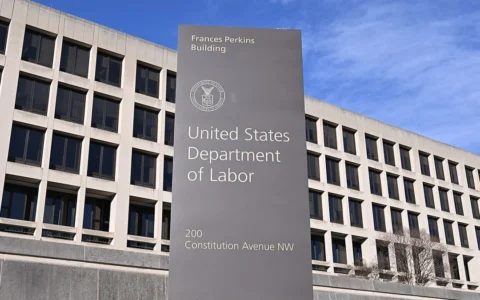
The data come from a supplement to the Current Population Survey conducted in January. The U.S. Department of Labor’s Chief Evaluation Office sponsored the tenure survey, which has generally been conducted every two years since 1996. The CPS itself is a monthly survey of roughly 60,000 eligible households and covers the civilian noninstitutional population age 16 and older.
Because the tenure figures are a snapshot, they capture the cumulative effect of many labor-market forces rather than a single month’s hiring or quitting activity. A slower pace of voluntary job changes can push tenure higher, but so can shifts in the composition of the workforce. BLS specifically notes that changes in workers’ ages and in the number of hires and separations can affect the median.
Age and sector still produce large differences
Age remains one of the clearest dividing lines. Workers ages 25 to 34 had median tenure of 3.0 years in January, compared with 9.6 years for workers ages 55 to 64. Among people ages 60 to 64, 52.6% had been with their current employer for at least 10 years, compared with 20.3% of workers ages 35 to 39.
The sector gap was also large, although it narrowed from 2024. Public-sector employees had a median tenure of 5.6 years in January 2026, compared with 3.9 years for private-sector workers. Two years earlier, those medians were 6.2 years and 3.5 years, respectively. That means the overall rise in tenure occurred even as the public-sector median declined.
Within government, federal employees had the longest median tenure at 7.0 years, while state and local government workers were both at 5.4 years. BLS said one factor behind the public-private difference is age because government workers tend to be older on average than private-sector employees.
Private-industry figures varied considerably. Financial activities had a median tenure of 5.0 years. Mining, quarrying and oil and gas extraction, manufacturing, and information each registered 4.9 years. Leisure and hospitality was at the other end of the range at 2.4 years, consistent with a workforce that tends to have shorter job stays and a younger age profile.
Occupation shows a similar pattern. Workers in management, professional and related occupations had median tenure of 4.9 years, with management occupations at 6.1 years. Service occupations were at 2.9 years, including 2.2 years for food preparation and serving-related jobs and 2.8 years for personal care and service occupations.
Fewer workers are in their first year with an employer
Another important change was the decline in the share of workers who had been with their current employer for a year or less. That group accounted for 20.6% of wage and salary workers in January 2026, down from 22.2% in January 2024. BLS says the group includes new hires, people who lost a job and found another during the prior year, and workers who voluntarily changed employers.
The age split is especially stark. About 74.1% of workers ages 16 to 19 had tenure of 12 months or less, compared with 9.2% of workers ages 55 to 64. Among workers age 25 and over, 31.1% of men and 29.0% of women had been with their employer for at least 10 years.
The latest tenure data also fit with a broader cooling in voluntary turnover from the unusually active labor market earlier in the decade, although the measures cover different periods and should not be treated as interchangeable. BLS data show the annual average quits rate fell from 2.8% in 2022 to 2.0% in 2025. In July 2026, the most recent monthly Job Openings and Labor Turnover Survey available before Thursday’s tenure release, the quits rate was 1.9%, with 3.1 million quits.
That backdrop can help explain why longer tenure is plausible, but the tenure survey itself does not assign a single cause to the increase from 2024. Its January snapshot reflects worker demographics, the pace of hiring, voluntary moves and employer-initiated separations accumulated over time. The 4.1-year median therefore describes how long workers had stayed with their employers, not whether job stability improved for every group.
The next near-term read on worker movement will come from the August Job Openings and Labor Turnover Survey, which BLS is scheduled to release on September 29. That report will provide updated figures on hires, quits and layoffs, giving a more current view of labor-market churn than the January tenure snapshot.
More News


Latest News
View all news- TD SYNNEX Revenue Jumps 38% to $21.6 Billion in Record Fiscal Q3
- Sky Quarry Restarts Nevada’s Eagle Springs Refinery After Receiving Air Permit
- Darden Sales Rise 5.1% to $3.2 Billion as Restaurant Group Reaffirms Outlook
- Vertiv Agrees to Buy King Environmental Services to Expand AI Data-Center Cooling Support
- IBM Connects Digital Asset Haven to Swift Ledger for Tokenized Deposits