
Woodside Retires 2030 Scope 3 Targets as Underlying Profit Rises 7%
Woodside kept its 2030 Scope 1 and 2 emissions target, raised its interim dividend and put Beaumont New Ammonia under strategic review.
Our editorial standards
MarketReview publishes clear, independently produced financial information using reliable sources and transparent editorial standards.
Read our Editorial Policy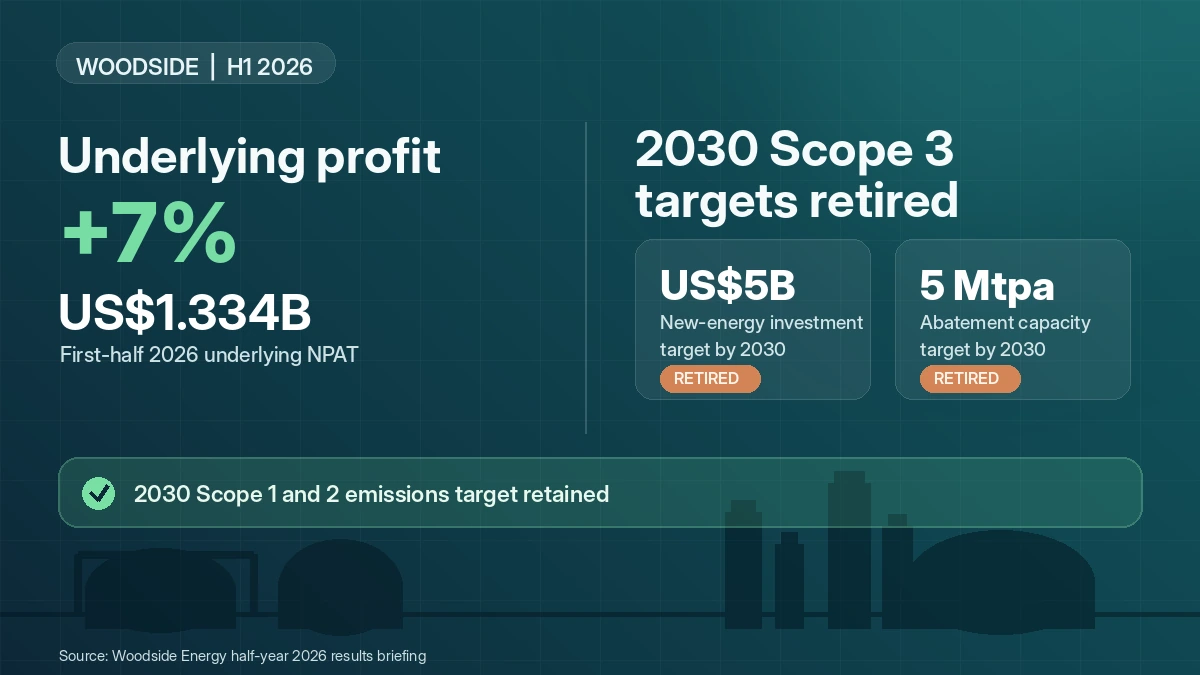
Woodside Energy said Tuesday it is retiring two 2030 targets tied to its Scope 3 strategy, ending a commitment to invest US$5 billion in new energy products and lower-carbon services and a related goal to reach final investment decisions on projects with 5 million tonnes a year of emissions-abatement capacity. The decision came alongside half-year results showing underlying net profit after tax rose 7% to US$1.334 billion for the six months ended June 30.
The company did not abandon all of its climate goals. It affirmed a separate target to reduce net equity Scope 1 and 2 greenhouse gas emissions by 30% from its starting base by 2030, and it continues to describe net zero by 2050 or sooner as an aspiration. Woodside also placed Beaumont New Ammonia under strategic review and set a structural cost-saving target of US$350 million a year from 2028.
Two 2030 Scope 3 targets are being retired
Woodside detailed the change in its half-year results briefing. One retired target called for US$5 billion of investment in new energy products and lower-carbon services by 2030. The other covered final investment decisions on projects with total emissions-abatement capacity of 5 million tonnes of carbon dioxide equivalent a year by the same deadline.
Those commitments were part of Woodside’s approach to Scope 3 emissions, a category that includes indirect emissions outside the company’s operational boundary, such as emissions from customers using products it sells. They were investment and project-capacity targets, not a pledge to cut Woodside’s total Scope 3 emissions by a fixed percentage. The retained Scope 1 and 2 target addresses emissions from Woodside’s operations and purchased electricity on a net equity basis, and it permits the use of carbon credits as offsets.
Earlier disclosures had already made the Scope 3 targets conditional on commercial feasibility, regulatory approvals, third-party action and individual project economics. Woodside’s 2024 climate update also said the targets were not guidance. Retiring them nevertheless removes two numerical 2030 markers from the company’s climate strategy, and Woodside did not announce replacement Scope 3 spending or abatement-capacity targets.
Management’s revised framework puts all capital proposals through one allocation process. New-energy investment will be guided by customer demand, commercial markets and returns, while climate targets will reflect the pace of the global energy transition. Woodside has said markets for hydrogen, ammonia and carbon capture have developed more slowly than anticipated and remain dependent on policy support and broader value-chain development.
Higher prices offset a drop in production
Reported net profit after tax rose 27% to US$1.672 billion from US$1.316 billion a year earlier. The underlying measure increased to US$1.334 billion from US$1.247 billion after Woodside adjusted for deferred-tax benefits and impairments. Operating revenue climbed 13% to US$7.446 billion, while earnings before interest, tax, depreciation and amortization, excluding impairment, edged up 1% to US$4.647 billion.
A stronger realized price did much of the work. Woodside received an average US$74 per barrel of oil equivalent, 20% more than in the first half of 2025, as global supply disruptions supported commodity prices and the trading business redirected cargoes to higher-priced markets. Total production fell 13% to 86.5 million barrels of oil equivalent, reflecting cyclone interruptions, the planned Pluto LNG turnaround and the earlier divestment of the Greater Angostura assets.
The cash-flow picture was mixed. Net cash from operating activities declined 10% to US$3.013 billion, but free cash flow rose to US$352 million from US$136 million. Capital expenditure fell 36% to US$1.637 billion during the half. Woodside declared a fully franked interim dividend of 57 US cents a share, up from 53 cents and equal to an 80% payout of underlying profit.
Full-year operating guidance was unchanged. Woodside continues to expect production of 174 million to 185 million barrels of oil equivalent in 2026 and capital expenditure of US$4.0 billion to US$4.5 billion. Those ranges keep the near-term financial focus on executing the company’s LNG and oil growth program rather than replacing the retired Scope 3 targets with a new fixed spending commitment.
Beaumont review puts new-energy spending under scrutiny
Beaumont New Ammonia is the most immediate test of the revised approach. The 1.1 million-tonne-a-year plant in Texas began producing ammonia in December 2025, and Woodside assumed operational control in March after performance testing and handover from OCI Global. Woodside’s published materials did not specify a timetable or possible outcomes for the strategic review.
The facility produced 279,000 tonnes in the first half, with reliability of 87.6% including commissioning. Output averaged 69% of capacity in the second quarter because of feedstock constraints linked to delays at third-party suppliers, and Woodside expects those constraints to continue into 2027. Lower-carbon ammonia production is still targeted for 2027, subject to the commissioning of Linde’s hydrogen facilities, the start-up of ExxonMobil’s carbon-capture infrastructure and the relevant permitting.
Beaumont had been central to the old Scope 3 program. Woodside agreed to acquire the project for US$2.35 billion in 2024 and described it as its largest new-energy investment. By the end of that year, the company had counted 80% of the acquisition price toward the US$5 billion investment target, with the remaining payment due at project completion.
Elsewhere in the lower-carbon portfolio, Woodside recognized a US$43 million pre-tax impairment on the H2OK project after deciding to retire the remaining assets, reducing their carrying value to nil. Together, the H2OK charge and the Beaumont review illustrate a stricter approach to project capital, even though Woodside has not ruled out future investment in new energy products or lower-carbon services.
Core growth projects remain on their previously stated schedules. Scarborough was 98% complete at June 30 and was targeting its first LNG cargo in the fourth quarter of 2026; Trion was 64% complete and targeting first oil in 2028; Louisiana LNG was 28% complete and targeting first LNG in 2029. Woodside has not set a deadline for the Beaumont review. Its next scheduled operating update is the third-quarter report on October 21, followed by capital markets days in Australia on November 5 and the United States on November 12.
More from Investing


Latest News
View all news- U.S. Producer Prices Surge 1.3% in September, Biggest Monthly Increase Since 2022
- U.S. Retail Sales Rise 0.8% in September to $745 Billion
- U.S. Weekly Jobless Claims Edge Up to 199,000 as Layoffs Remain Low
- U.S. Natural Gas Storage Rises 67 Bcf to 3,567 Bcf, EIA Reports
- U.S. Business Inventories Increase 0.4% in August as Sales Climb 1.1%
