
FTC Finalizes Conditions on Ascension’s $3.9 Billion AmSurg Acquisition
The FTC made permanent a remedy requiring seven surgery-center divestitures and a decade of prior-notice obligations in five metropolitan areas.
Our editorial standards
MarketReview publishes clear, independently produced financial information using reliable sources and transparent editorial standards.
Read our Editorial Policy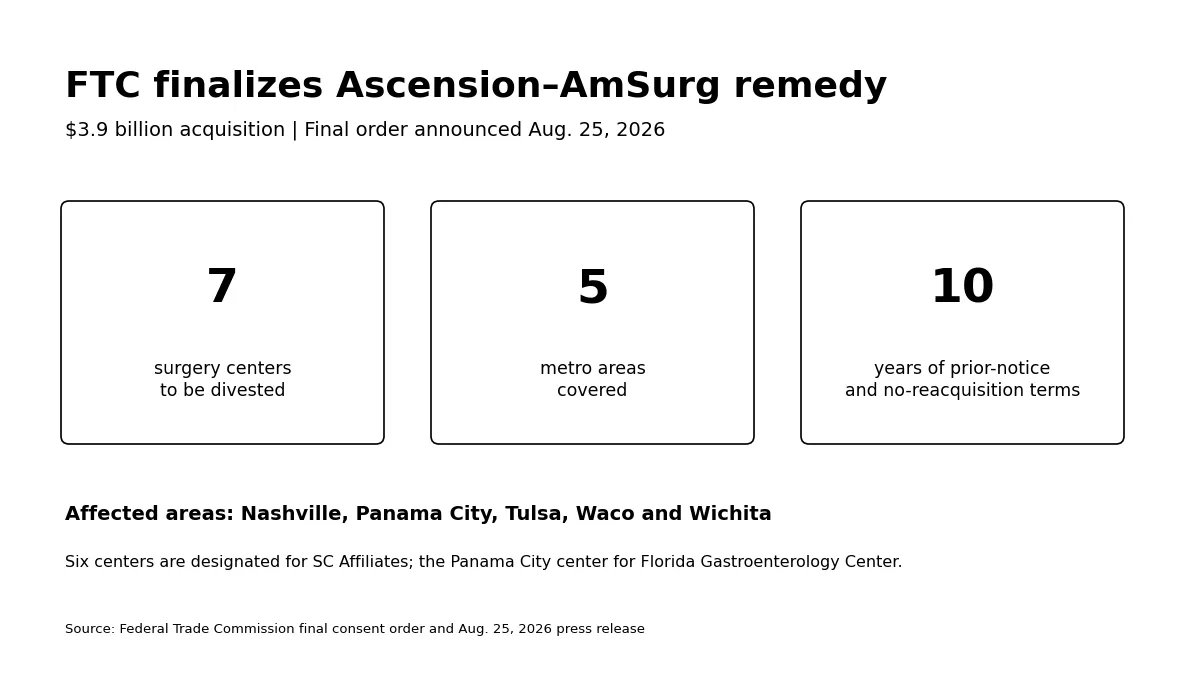
The Federal Trade Commission has finalized the consent order governing Ascension Health Alliance’s $3.9 billion acquisition of AmSurg, making permanent a set of divestiture and oversight requirements aimed at preserving competition in outpatient surgery markets across five metropolitan areas. The acquisition itself was completed in June after the agency accepted the proposed settlement, so the August action closes the FTC’s public-comment stage rather than marking a new deal closing.
Under the final order, Ascension must divest seven AmSurg ambulatory surgery centers in the Nashville, Panama City, Tulsa, Waco and Wichita areas. Six centers are designated for sale to SC Affiliates, while the Panama City facility is to go to Florida Gastroenterology Center. The commission voted 2-0 to approve the order.
The FTC announced the final consent order on August 25 after considering public comments on the settlement first proposed in June. The agency alleged that combining Ascension and AmSurg without the remedy would reduce competition for certain outpatient procedures performed by gastroenterologists, ophthalmologists and orthopedists, creating a risk of higher prices as well as weaker incentives for quality and innovation.
Seven surgery centers are carved out of the combined network
The required divestitures cover every AmSurg facility identified by the FTC in the local markets where the two providers overlapped in ways the agency considered competitively significant. In Nashville, the remedy applies to two endoscopy locations and an additional Hermitage endoscopy center. Tulsa accounts for two centers, while Waco and Wichita each account for one. A separate gastroenterology center in Panama City is also covered.
The final decision identifies the Waco Gastroenterology Endoscopy Center, Tulsa Endoscopy Center, Eye Surgery Center of Tulsa, Surgery Center of Kansas, Associated Endoscopy in Hermitage, and two St. Thomas endoscopy locations in Nashville among the facilities assigned to SC Affiliates. The Northwest Florida Gastroenterology Center in Panama City is to be transferred to a physician group that previously held a minority interest in the facility and will take full ownership.
The order is designed to transfer more than physical sites. It covers the ownership interests, operating rights, leases, contracts, intellectual property, business information and transferable permits tied to the affected centers. Ascension and AmSurg must also provide support needed to keep the divested businesses operating, including administrative, billing, information-technology, credentialing and supply-chain assistance when requested by the buyers.
Transition services can continue for up to 12 months after a divestiture, with an additional six months available for certain payer-contract transitions. The FTC also appointed an independent monitor to oversee compliance with the divestiture and transition obligations. If the required assets are not transferred in the manner set out by the order, the commission retains authority to appoint a divestiture trustee.
The final order adds 10 years of acquisition oversight
The remedy extends well beyond the immediate sale of the seven centers. For 10 years, Ascension and the other respondents must give the FTC advance notice before acquiring an interest in ambulatory surgery centers that provide the relevant services in the five affected areas. That requirement applies even to some acquisitions that might otherwise fall below the federal premerger reporting thresholds.
For covered purchases, the order generally requires notice at least 30 days before closing and gives the FTC the ability to request additional information. Ascension is also barred for 10 years from reacquiring any of the divested AmSurg centers. Annual compliance reports are required during that period, and the final order itself is scheduled to terminate 10 years after issuance.
The commission’s competition theory was local rather than nationwide. Its analysis said Ascension and AmSurg were close alternatives for health plans and patients in the affected markets, with evidence of patient substitution between their facilities. The relevant services differed by area: gastroenterology procedures were central in Nashville, Panama City and Waco; Tulsa involved both gastroenterology and ophthalmology; and Wichita focused on outpatient orthopedic services.
Those distinctions matter because ambulatory surgery competition is often shaped by local physician networks, insurer contracting and the practical distance patients are willing to travel for a procedure. The FTC did not seek to unwind the entire $3.9 billion acquisition. Instead, it required targeted asset sales in the markets where it alleged the acquisition would remove a meaningful competitive option.
The respondents entered the consent process for settlement purposes and did not admit that the law had been violated as alleged. The final order resolves the FTC’s administrative challenge while preserving the agency’s ability to enforce the remedy and monitor future acquisition activity in the specified markets.
Ascension has already folded AmSurg into its outpatient strategy
Ascension completed the AmSurg acquisition on June 4, two days after the FTC announced the proposed consent agreement. In its closing announcement, the nonprofit health system said the purchase expanded its network to about 300 ambulatory surgery centers nationwide and added AmSurg’s footprint across more than 250 centers in 34 states.
AmSurg specializes in outpatient surgery centers and commonly operates them through partnerships with physician groups. Its network includes gastroenterology, ophthalmology, orthopedics and multispecialty care, the same broad areas that made the local overlap review important to the FTC. Ascension has described the acquisition as part of a broader shift toward delivering more care outside traditional hospitals.
For Ascension, the strategic rationale is scale in lower-acuity settings. The health system has been expanding ambulatory care while reserving hospitals for more complex acute treatment. Adding AmSurg gave it a national surgery-center platform, physician partnerships and operating infrastructure that would have taken years to build organically.
The final consent order does not reverse that strategy. It narrows the combined footprint in five local markets and creates a decade of regulatory visibility around further surgery-center acquisitions there. That leaves Ascension with the large majority of the AmSurg network it acquired, but with specific limits intended to prevent the company from rebuilding the competitive overlaps the FTC required it to eliminate.
The FTC’s case docket lists the final decision and order as issued on August 24, with the agency announcing the action publicly the following day. The next practical milestones are compliance with the divestiture, transition and reporting provisions, all of which remain subject to monitoring under the final order.
More from Investing


Latest News
View all news- Trump Says Russia and Ukraine Agreed to Halt Energy Strikes, but Kyiv Cannot Confirm
- UK Announces New Flood and Drought Taskforce to Strengthen Infrastructure Resilience
- Texas Extends Newborn Health Insurance Coverage Window to 61 Days Under New Rules
- Singapore Announces Haze-Related Healthcare Subsidies Starting October 12
- New Zealand’s ACT Party Proposes NZ$12.4 Billion Cut to 2031 Debt Forecast
