
New Zealand Mortgage Commitments Fall to NZ$7.85 Billion in July as Investor Lending Retreats
New Zealand mortgage commitments fell 7.0% in July, with investor lending down 22.6% from a year earlier and its share of new commitments slipping to 18.9%.
Our editorial standards
MarketReview publishes clear, independently produced financial information using reliable sources and transparent editorial standards.
Read our Editorial Policy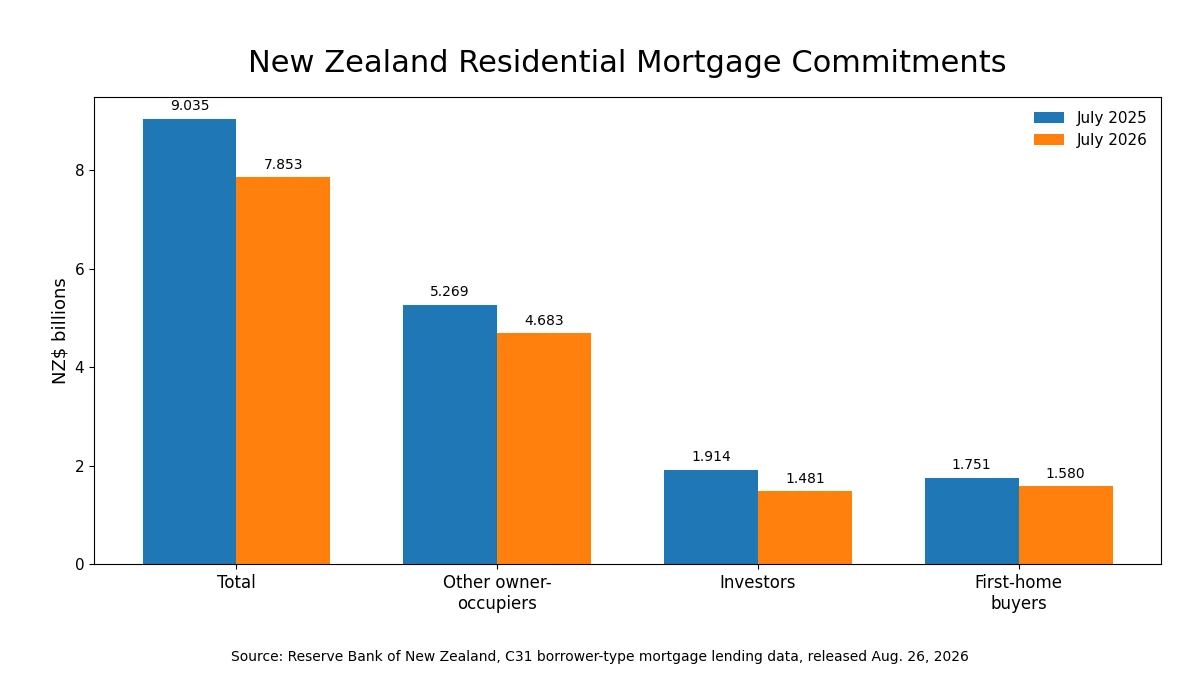
New Zealand’s new residential mortgage commitments fell to NZ$7.853 billion in July, down 7.0% from June and 13.1% from a year earlier, according to Reserve Bank of New Zealand data released Wednesday. Investor borrowing showed the sharpest annual pullback among the three main borrower groups, falling 22.6% from July 2025 and slipping to a smaller share of total commitments.
The monthly decline took total commitments down from NZ$8.445 billion in June and NZ$9.035 billion in July 2025. The Reserve Bank counts a mortgage commitment when a lender has made a finalised offer to provide a mortgage loan or increase an existing mortgage, evidenced by loan documents supplied to the borrower, so the series measures committed credit rather than mortgage balances outstanding.
The latest borrower-type figures put investor lending at NZ$1.481 billion in July, down from NZ$1.645 billion in June and NZ$1.914 billion a year earlier. Investors accounted for 18.9% of new commitments, compared with 19.5% in June and 21.2% in July 2025.
Investor lending leads the borrower pullback
The decline in investor lending was larger than the drop among first-home buyers and other owner-occupiers. First-home-buyer commitments eased to NZ$1.580 billion from NZ$1.601 billion in June, while other owner-occupier lending fell to NZ$4.683 billion from NZ$5.104 billion. On an annual basis, the Reserve Bank said first-home-buyer lending was down 9.8% and other owner-occupier lending was down 11.1%.
The borrower mix shifted even though lending fell across all three major categories. First-home buyers took 20.1% of the value of new mortgage commitments in July, up from 19.0% in June and 19.4% a year earlier. Other owner-occupiers accounted for 59.6%, down from 60.4% in June but above the 58.3% share recorded in July 2025.
The Reserve Bank’s new residential mortgage lending by borrower type table also showed NZ$109 million of commitments classified as being for business purposes, up from NZ$95 million in June. That category is much smaller than household owner-occupier and investor lending and consists of borrowing structured as residential mortgage loans but intended for business purposes.
The slowdown was visible in both the value and the number of commitments. Banks reported 21,268 new mortgage commitments in July, 4.9% fewer than in June and 7.2% fewer than in July 2025. The average new loan value across all purpose types fell 2.2% from June to NZ$369,256 and was 6.3% lower than a year earlier, indicating that the decline in total committed lending reflected both fewer commitments and a smaller average amount.
Property purchases take a larger share as refinancing falls
Mortgage commitments for property purchases totaled NZ$4.505 billion in July, down from NZ$4.724 billion in June and NZ$5.146 billion in July 2025. Even so, purchases represented 57.4% of the value of all new commitments, up from 55.9% in June, because other categories contracted more sharply.
The clearest example was borrowers changing loan providers. Commitments for that purpose dropped to NZ$1.933 billion from NZ$2.298 billion in June, a decline of about 15.9%, and were down from NZ$2.600 billion a year earlier. The Reserve Bank also said the number of new commitments for a change in loan provider was 21.1% lower than in July 2025.
Top-ups were comparatively steady at NZ$973 million, against NZ$992 million in June, and their share of the value of new commitments increased to 12.4% from 11.7%. The remaining “other” commitments, a category that can include bridging finance and some loans secured against previously unencumbered property, rose slightly to NZ$442 million from NZ$432 million.
Average loan sizes also eased in two of the largest purpose categories. The average new commitment for a property purchase fell 1.1% from June to NZ$597,259, while the average for borrowers changing loan providers declined 1.4% to NZ$640,818. The figures reinforce the distinction between the amount of credit being committed and the number of borrowers entering or rearranging mortgage finance.
Risk measures remain below current policy speed limits
The July data were released less than two weeks after the Reserve Bank’s Financial Policy Committee kept New Zealand’s loan-to-value ratio restrictions unchanged. The current settings allow banks to make up to 25% of new owner-occupier lending at LVRs above 80% and up to 10% of new investor lending at LVRs above 70%. The central bank said on August 14 that housing risks were contained, national house prices had been broadly flat in recent years, mortgage lending growth was modest and the share of higher-risk lending remained manageable.
Separate debt-to-income data released Wednesday show that 14.1% of new commitments to investors had a DTI ratio above 7 in July, down slightly from 14.2% in June. The policy speed limit allows banks to make 20% of new investor lending above a DTI of 7. The published aggregate share is therefore below that threshold, although the national aggregate does not by itself establish whether every individual bank was within its own regulatory limit.
The same DTI release showed that 53.2% of investor commitments had a DTI above 5, compared with 34.1% for first-home buyers and 28.9% for other owner-occupiers without investment-property collateral. That does not mean those loans breach the DTI rules, because the investor policy threshold is above 7 rather than above 5, but it illustrates why the Reserve Bank applies different borrower thresholds when it monitors higher-leverage mortgage lending.
Monetary policy is another part of the backdrop to housing credit. The Reserve Bank increased the Official Cash Rate by 25 basis points to 2.50% on July 8, saying inflation remained above target and that some further reduction in monetary stimulus was likely to be required. The July mortgage data span the month in which that increase occurred, but the statistical release does not identify the OCR move as the cause of the decline in commitments.
The next monthly mortgage-commitment release is scheduled for September 24. Before then, the Reserve Bank is due to publish its next Monetary Policy Statement and OCR decision on September 2, giving borrowers and lenders another update on the interest-rate setting that influences mortgage pricing and credit demand.
More from Banking


Latest News
View all news- U.S. Producer Prices Surge 1.3% in September, Biggest Monthly Increase Since 2022
- U.S. Retail Sales Rise 0.8% in September to $745 Billion
- U.S. Weekly Jobless Claims Edge Up to 199,000 as Layoffs Remain Low
- Prologis Q3 Core FFO Rises to $1.60 a Share as Leasing Demand Holds Firm
- U.S. Natural Gas Storage Rises 67 Bcf to 3,567 Bcf, EIA Reports
