Rocket Lab Launches 96th Electron Mission, Deploys Synspective’s 12th StriX Satellite
The mission placed the radar-imaging spacecraft into a 572-kilometer orbit, extending a launch partnership that still has 15 dedicated Electron missions on the manifest.
Our editorial standards
MarketReview publishes clear, independently produced financial information using reliable sources and transparent editorial standards.
Read our Editorial Policy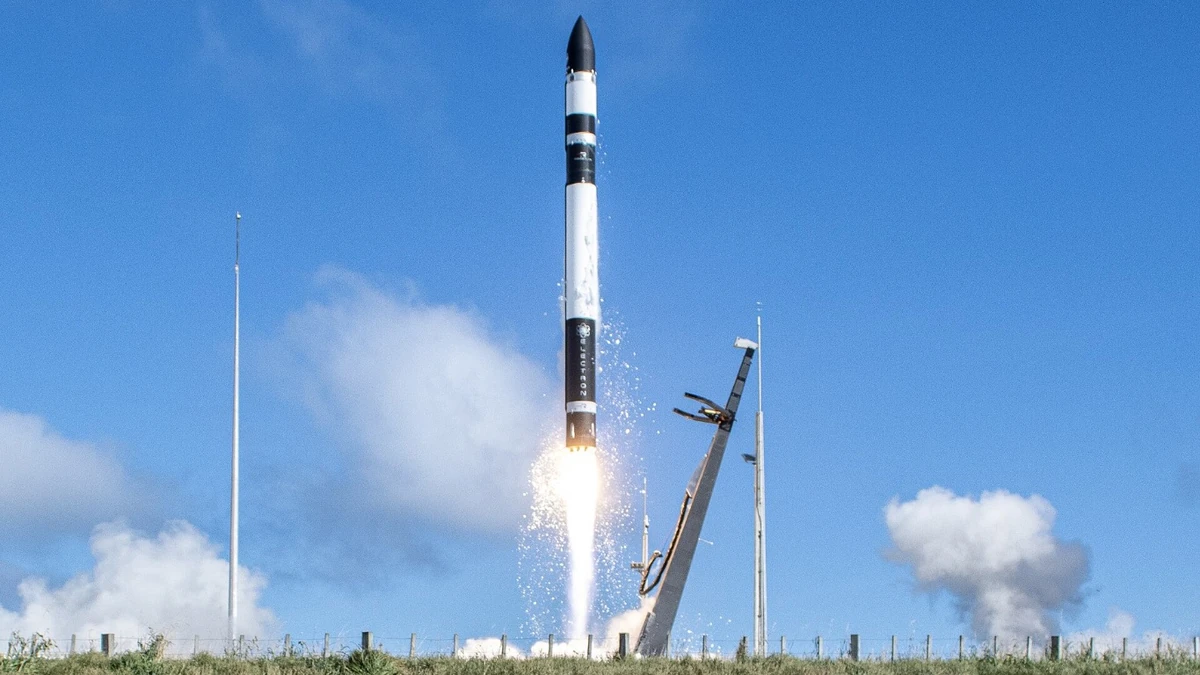
Rocket Lab launched its 96th Electron mission on September 19, deploying Synspective’s 12th StriX synthetic aperture radar satellite into low Earth orbit from Launch Complex 1 on New Zealand’s Māhia Peninsula.
The mission, named “Owl By The Dozen,” lifted off at 3:22 p.m. New Zealand Standard Time, or 03:22 UTC, and placed the spacecraft into a 572-kilometer orbit. Rocket Lab said the flight was its 17th Electron launch of 2026 and extended its record of successful missions for Synspective, a Japan-based operator building a commercial radar-imaging constellation.
In its mission update, Rocket Lab said Electron’s Kick Stage delivered StriX to the planned orbit with the accuracy needed for the satellite to begin its next phase of on-orbit work. Synspective separately confirmed the deployment and said the spacecraft will now undergo testing and commissioning over the coming months before entering service.
Electron’s launch cadence is becoming part of the customer proposition
The September 19 mission capped a rapid stretch of Electron activity. Rocket Lab’s 94th Electron flight launched another Synspective satellite on September 2, its 95th mission flew for a confidential customer on September 11, and the 96th followed eight days later. That sequence took Rocket Lab from its 15th Electron mission of the year to its 17th in a little more than two weeks.
For constellation operators, launch frequency is not only a measure of rocket production. A dedicated small launch can give a customer more control over timing and orbital placement than waiting for room on a larger rideshare mission. Rocket Lab’s mission page for “Owl By The Dozen” listed a single StriX satellite as the payload and targeted a 572-kilometer orbit at 38 degrees inclination, rather than grouping the spacecraft with unrelated payloads headed to different destinations.
That model has become central to the Rocket Lab-Synspective relationship. Rocket Lab first launched a StriX spacecraft in 2020 and has handled every Synspective launch since then. In September 2025, the companies announced another 10-launch agreement that increased the number of then-upcoming dedicated Electron missions to 21. The latest mission update says 15 additional dedicated Electron launches for Synspective are now manifested through the end of the decade.
Those future flights give Rocket Lab a long-running customer on its Electron schedule and give Synspective a repeated path to orbit as it adds satellites. The economics of the September 19 flight were not disclosed in the mission announcement, so the launch should not be treated as a stand-alone revenue event with a known value. Its importance is clearer in the context of a multi-year service relationship that has already produced a dozen dedicated missions.
Why another StriX satellite matters for Synspective
Synspective is building its StriX network around synthetic aperture radar, or SAR, a technology that sends microwave signals toward Earth and measures the reflected energy to create images of terrain and structures. Unlike conventional optical imagery, radar can collect useful observations at night and through clouds, which makes it suitable for applications where waiting for clear daylight conditions is impractical.
The company says its planned constellation is intended to support disaster response, national defense, environmental monitoring and infrastructure-related uses. Its long-term goal is a network of about 30 SAR satellites by the end of the 2020s, with more spacecraft improving how frequently the system can revisit areas of interest. Synspective’s product materials also describe a mix of sun-synchronous and inclined orbits, allowing the operator to tailor coverage rather than place every satellite into the same orbital pattern.
The newly deployed spacecraft does not become a fully operational data source immediately. In its launch confirmation, Synspective said it will spend the coming months testing and commissioning the satellite to verify its observation capabilities before service begins. That process is an important distinction because successful orbital deployment confirms the launch objective, not the completion of all satellite validation work.
Synspective has also been broadening how it plans to reach orbit. One day before the Electron launch, the company announced an agreement with Mitsubishi Heavy Industries for two StriX satellites to fly on Japan’s H3 rocket in the second half of 2027. The new H3 agreement does not erase the scale of the Rocket Lab relationship, but it shows Synspective is adding another launch route as it works toward a much larger constellation.
The company has been developing the commercial side of that network at the same time. In February, Synspective announced a framework agreement with Airbus Defence and Space that gives Airbus access to capacity from the StriX constellation. Synspective said the arrangement is aimed at expanding access to radar data for security, disaster management and other monitoring needs. More satellites increase the capacity available for those kinds of services, provided each spacecraft completes commissioning and performs as planned.
The mission lands against a much larger Rocket Lab backlog
For Rocket Lab investors, the flight is one execution point inside a launch business that has been expanding alongside the company’s space-systems operations. Rocket Lab reported second-quarter 2026 revenue of $234 million and total backlog of $2.36 billion. Its June 30 quarterly filing broke that backlog into about $1.42 billion for space systems and $940.2 million for launch services.
The company also said in August that it had secured more than $437 million in new launch contracts across Electron, HASTE and Neutron during the second quarter and the period after quarter-end, taking its total launch backlog to more than 90 missions. Those figures cover multiple vehicles and customers, so they should not be read as a measure of the Synspective contract alone. They do, however, put the repeated StriX launches in the context of a broader effort to keep launch capacity booked across several programs.
Electron remains Rocket Lab’s operational small-launch vehicle while the larger Neutron rocket is still under development. That makes cadence, reliability and repeat business on Electron relevant to current execution rather than only to a future product roadmap. The company’s September launches also show how a high flight rate can convert a contracted manifest into completed missions over short intervals.
For Synspective, the next immediate step is on orbit rather than at the launch pad. The 12th StriX satellite must complete testing and commissioning before it can join the company’s active observation services. Beyond that, Rocket Lab says 15 more dedicated Electron missions remain on the manifest through the end of the decade, leaving the partnership with substantial work still ahead even after flight number 96.
More News



Latest News
View all news- Sequoia ETF Registration Amendment Takes Effect Ahead of $3.6 Billion Fund’s October Conversion
- Akari Therapeutics Showcases New ADC Payload Approach at Global XDC Conference
- Berkshire Names Howard Buffett Chairman as Warren Buffett Becomes Chairman Emeritus
- CoreWeave Prices Upsized $3.7 Billion Convertible Notes Offering
- MISTRAS Agrees to $866 Million H.I.G. Capital Takeover at $20.35 a Share