U.S. and China Open New York Economic Talks on Trade, AI and Critical Minerals
Treasury Secretary Scott Bessent, U.S. Trade Representative Jamieson Greer and Chinese Vice Premier He Lifeng are meeting ahead of the September 24 Trump-Xi summit.
Our editorial standards
MarketReview publishes clear, independently produced financial information using reliable sources and transparent editorial standards.
Read our Editorial Policy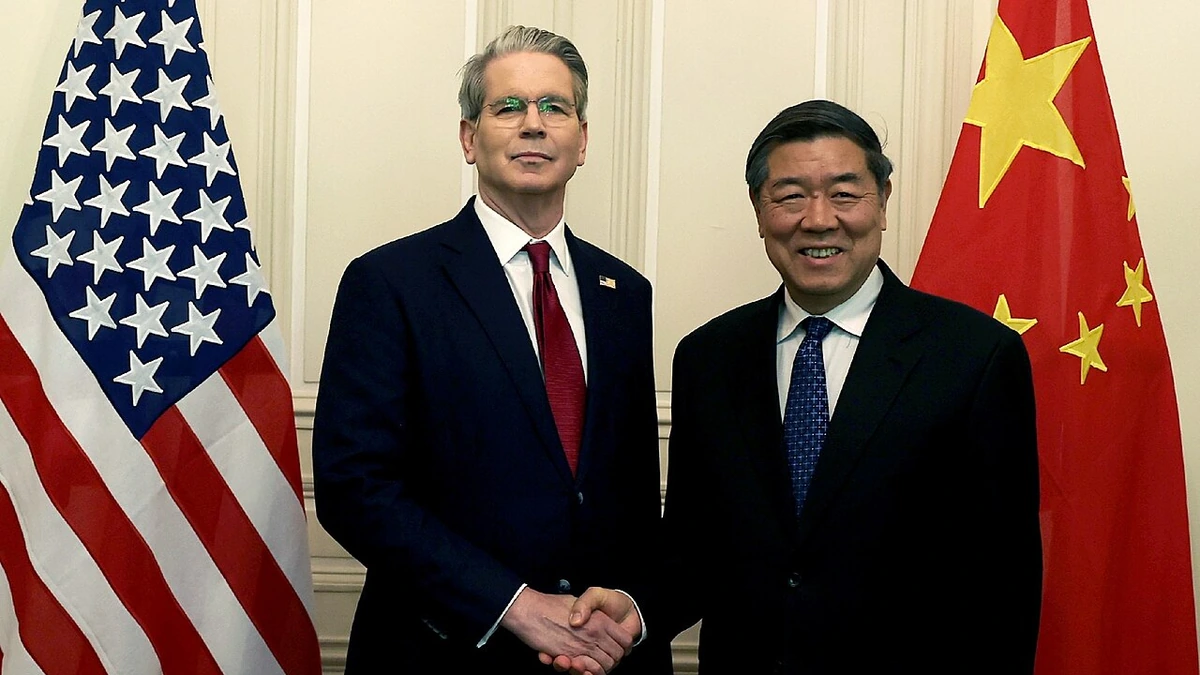
The United States and China opened a new round of economic talks in New York on Sunday, September 20, with trade policy, critical-mineral supplies and artificial intelligence among the issues in focus ahead of a meeting between President Donald Trump and Chinese President Xi Jinping later this week.
U.S. Treasury Secretary Scott Bessent and U.S. Trade Representative Jamieson Greer are meeting Chinese Vice Premier He Lifeng. The Office of the U.S. Trade Representative said before the talks that the U.S. side planned to review implementation of recent commitments, expand trade in non-sensitive goods and seek better market access for American farmers, manufacturers and workers. China’s Commerce Ministry described the visit more broadly as economic and trade consultations on issues of concern to both sides.
Reuters reported that the talks began at JPMorgan Chase’s headquarters in Manhattan at about 10:30 a.m. Eastern Time and were expected to continue through the day. Its reporting identified artificial intelligence, tariffs and critical minerals as key subjects. Neither the USTR announcement nor China’s pre-meeting statement listed every item on that agenda, so the AI and critical-minerals details rest on current reporting rather than a complete official agenda released by both governments.
Trade commitments and market access anchor the official agenda
The New York meeting comes as Washington and Beijing try to manage a series of trade understandings reached over the past year without allowing unresolved disputes to spill into another broad escalation. USTR’s announcement placed implementation at the center of the U.S. approach, an indication that negotiators are not starting from a blank sheet but are reviewing commitments already made by the two governments.
One deadline gives the discussions added weight. A White House executive order issued in November 2025 kept the suspension of heightened U.S. reciprocal tariffs on Chinese imports in place until 12:01 a.m. Eastern Time on November 10, 2026. Separate USTR action also extended 178 exclusions from Section 301 tariffs to the same date. Those measures do not settle the wider trade relationship, but they create a clear policy milestone less than two months after the New York meeting.
Greer’s office said the administration also wants to optimize trade in non-sensitive goods and improve market access. That language fits with a broader framework announced after the May 2026 Trump-Xi meeting in Beijing, when the White House said the two governments had established a U.S.-China Board of Trade for non-sensitive goods and a Board of Investment for investment-related issues. The same White House fact sheet described Chinese commitments involving U.S. agricultural purchases, Boeing aircraft and restored market access for certain American food exports.
Beijing’s public description was deliberately less specific. In a September 19 statement, the Chinese Ministry of Commerce confirmed that He would lead a delegation to the United States from September 19 through September 23 and said the two sides would consult on economic and trade issues of mutual concern under the understandings reached by the countries’ leaders. The ministry did not publicly enumerate the subjects to be negotiated in New York.
Critical minerals remain a test of earlier commitments
Rare earths and other critical minerals are among the areas where the two governments have already recorded commitments but continue to scrutinize implementation. In May, the White House said China had agreed to address U.S. concerns about supply shortages involving rare earths and critical minerals, naming yttrium, scandium, neodymium and indium, and to address restrictions affecting rare-earth production and processing equipment and technologies.
Those materials sit inside supply chains for electronics, energy systems, vehicles and defense equipment, which makes access to them economically important and politically sensitive. Reuters reported Sunday that U.S. officials remain concerned about the flow of Chinese rare-earth magnets and other critical minerals. MarketReview could not independently verify the adequacy of current shipment levels from the official pre-meeting statements, so that characterization remains attributed to the reporting and to U.S. concerns rather than presented as an agreed assessment by both governments.
The dispute is therefore less about whether critical minerals belong in the bilateral economic relationship than about how earlier commitments are being carried out and what additional assurances the two sides may be willing to make. Any progress in New York could help narrow the set of unresolved issues left for Trump and Xi, but there was no announced minerals agreement at the start of the talks.
AI brings a newer security question into the economic dialogue
Artificial intelligence gives this round a different dimension from a conventional tariff negotiation. Reuters reported that negotiators were expected to discuss possible AI guardrails, including issues surrounding open-weight and closed-weight models. Those discussions come as both governments treat advanced computing and AI capabilities as matters of economic competitiveness as well as national security.
The official USTR notice did not spell out an AI agenda, and China’s Commerce Ministry likewise kept its public description broad. That distinction matters because the New York meeting is an economic consultation, not a separately announced bilateral AI accord. Any discussion of model safeguards or other AI rules would still have to be translated into specific commitments before it could be treated as a formal outcome.
The immediate purpose of the talks is also shaped by the calendar. USTR said the meeting would take place ahead of the U.S.-China summit in Washington. Trump is due to host Xi on September 24, giving Bessent, Greer and He only a few days to identify areas where the presidents could confirm progress or decide how to handle remaining disputes.
For now, the New York session is best understood as a working-level bridge between earlier trade commitments and the leaders’ meeting rather than as evidence that the major disagreements have been resolved. The next concrete marker will be the Trump-Xi summit, when any understandings reached by the economic teams may become clearer and the two governments can indicate whether the November trade deadline will be extended, revised or left in place.
More News


Latest News
View all news- Australia Raises Pension Payments and Deeming Rates From Sept. 20
- BNY’s $1 Billion Series F Preferred Redemption Takes Effect
- Chiltern Railways Transfers Into Public Ownership as UK Rail Restructuring Advances
- TWC Enterprises’ New TSX Buyback Authorization Takes Effect for Up to 1.21 Million Shares
- Switzerland and ASEAN Explore Deeper Economic Cooperation and EFTA Links in Manila