
France and Canada Put LNG, Energy and Critical Minerals on Macron-Carney Agenda
Emmanuel Macron and Mark Carney met in Saint-Pierre-et-Miquelon with LNG, energy security and critical minerals at the center of a broader push to deepen Canada-France economic ties.
Our editorial standards
MarketReview publishes clear, independently produced financial information using reliable sources and transparent editorial standards.
Read our Editorial Policy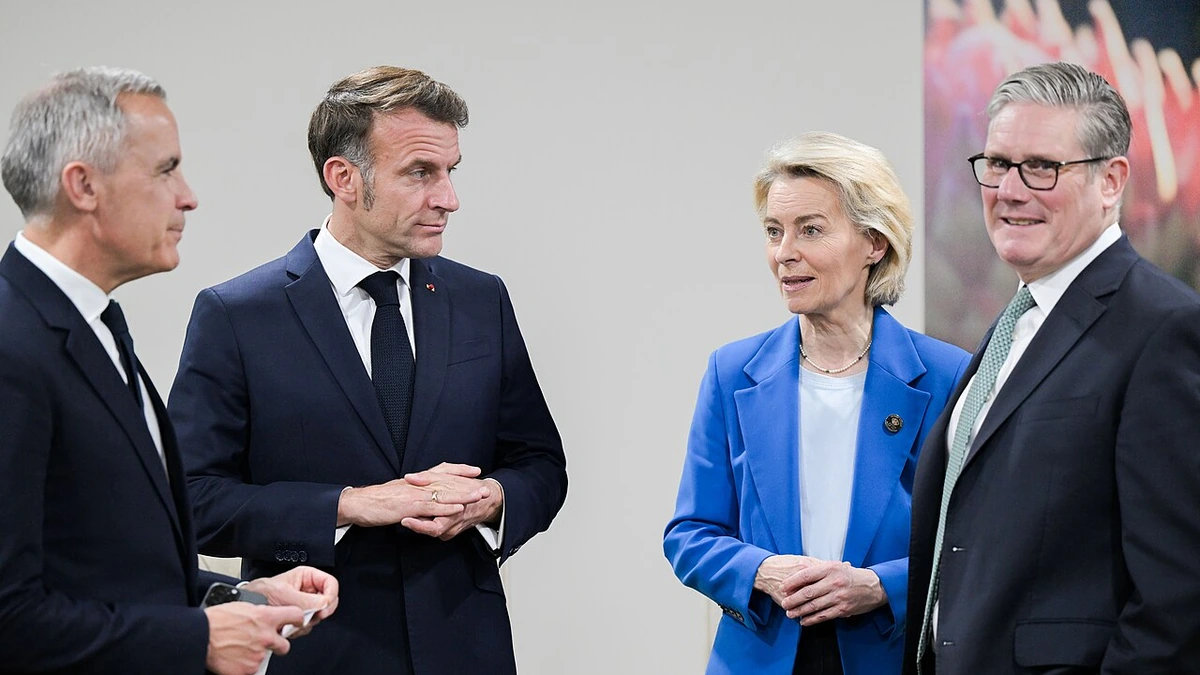
French President Emmanuel Macron and Canadian Prime Minister Mark Carney met in Saint-Pierre-et-Miquelon on Sunday with energy and critical minerals on the bilateral agenda, bringing France’s near-term search for more diversified hydrocarbon supplies together with Canada’s broader effort to expand strategic trade with Europe.
The meeting came as France was looking for ways to strengthen energy security amid disruption risks around the Strait of Hormuz. In a September 18 press conference, Macron said France was working with international partners on oil products and liquefied natural gas, and said his meeting with Carney would be used to strengthen commercial exchanges in petroleum products and LNG.
Canada had already identified energy and critical minerals as core subjects for the visit. The Prime Minister’s Office said when announcing the trip that Carney and Macron would discuss deeper cooperation in aerospace, energy, critical minerals and advanced technologies including quantum, satellites and supercomputing. The two countries also share a maritime border between Newfoundland and Labrador and Saint-Pierre-et-Miquelon, the French overseas collectivity where the leaders met.
LNG moves into the Canada-France conversation
Macron’s LNG comments gave the energy portion of the meeting a more immediate supply-security dimension. France has been seeking to protect energy availability as geopolitical tensions affect global oil and gas flows. In his September 18 remarks, the French president described a broader effort to secure alternative supplies, manage inventories and reduce exposure to more expensive hydrocarbons. He placed Canada alongside other partner countries in that effort, specifically linking Sunday’s meeting to petroleum products and LNG.
The Canadian side has been making a broader case to Europe that Canada’s energy resources can support European security. In an address to the European Parliament on September 17, Carney said Canada could contribute LNG and hydrogen at scale and pointed to the potential role of new and existing port infrastructure in the High North and on Canada’s East Coast. The speech was framed as part of a proposed deeper Canada-Europe partnership rather than as a France-specific supply commitment.
That distinction matters for the Saint-Pierre-et-Miquelon meeting. The official material reviewed for this story did not specify LNG volumes, a named Canadian export project, a French buyer, a delivery timetable or a new supply contract. Macron’s statement established France’s interest in expanding trade, while Canada’s public position established its willingness to deepen energy links with Europe. Those are meaningful policy signals, but they are not the same as a completed commercial agreement.
The energy discussion also sits inside a wider bilateral relationship. The Canadian government said merchandise trade between the two countries totaled C$15.2 billion in 2025, including C$5 billion in Canadian exports to France and C$10.2 billion in imports. France is Canada’s third-largest export market in the European Union, according to the Prime Minister’s Office.
Critical minerals extend an agenda already under way
Critical minerals are not a new subject for Macron and Carney. At their June 12 meeting in Paris, the two leaders discussed expanding bilateral trade and investment in energy, critical minerals and advanced technologies. Their September meeting therefore builds on an existing economic agenda rather than opening a separate track from scratch.
Canada has been positioning its mineral resources as part of Europe’s effort to reduce concentrated supply risks. In his European Parliament address, Carney said Canada has deposits of more than 34 critical minerals and is among the leading producers of 10 minerals he described as especially important to the global energy transition. He argued that deeper cooperation could pair European demand for reliable supplies with Canada’s interest in expanding advanced processing and complete value chains.
France has been pushing the same diversification issue through the Group of Seven. A G7 statement issued during France’s presidency in June warned about concentrated critical-mineral markets and the use of export restrictions and other non-market measures. The statement called for more diversified and resilient supply chains. That gives the Macron-Carney talks a direct connection to a policy priority France has already been advancing with other major economies.
For investors and companies, the practical questions are likely to be less about the size of Canada’s geological endowment than about which projects can move into production, how processing capacity is developed, and whether long-term buyers and financing can be secured. None of those project-level outcomes was established in the official pre-meeting material. The bilateral discussion does, however, put political support behind closer links between Canadian resources and French or wider European demand.
Energy and minerals sit inside a broader strategic partnership
The Saint-Pierre-et-Miquelon visit was designed to cover more than commodities. Canada’s announcement also pointed to aerospace and advanced technologies, while both governments have recently emphasized defence, artificial intelligence, quantum technologies and supply-chain resilience. That broader agenda reflects an effort by Canada and Europe to reduce strategic dependencies without treating economic security as simple self-sufficiency.
Macron’s September 18 remarks on France’s energy-security response make LNG and petroleum products unusually prominent in the immediate conversation. Carney’s recent European speeches, by contrast, place energy and critical minerals inside a larger proposal for deeper Canada-Europe cooperation on strategic capabilities. The two perspectives overlap, but they operate on different timelines: France is addressing a near-term supply concern while Canada is also seeking longer-term markets, investment and industrial partnerships.
The leaders’ schedule included a working lunch followed by a joint statement in Saint-Pierre-et-Miquelon. At the time the official sources for this story were checked, neither government had announced a new LNG supply contract or a new bilateral critical-minerals agreement tied to the meeting. The verified development is that the two governments have elevated those sectors in their bilateral discussions, with Macron explicitly identifying LNG and petroleum trade as part of France’s current energy-security effort.
More News

Latest News
View all news- Australia Raises Pension Payments and Deeming Rates From Sept. 20
- BNY’s $1 Billion Series F Preferred Redemption Takes Effect
- Chiltern Railways Transfers Into Public Ownership as UK Rail Restructuring Advances
- TWC Enterprises’ New TSX Buyback Authorization Takes Effect for Up to 1.21 Million Shares
- Switzerland and ASEAN Explore Deeper Economic Cooperation and EFTA Links in Manila
