GS Group Breaks Ground on 15 Trillion Won AI Data Center in South Korea
The first 1.2 gigawatts of the planned Donghae campus are scheduled to come online in stages from 2028, with a proposed second phase that would double capacity.
Our editorial standards
MarketReview publishes clear, independently produced financial information using reliable sources and transparent editorial standards.
Read our Editorial Policy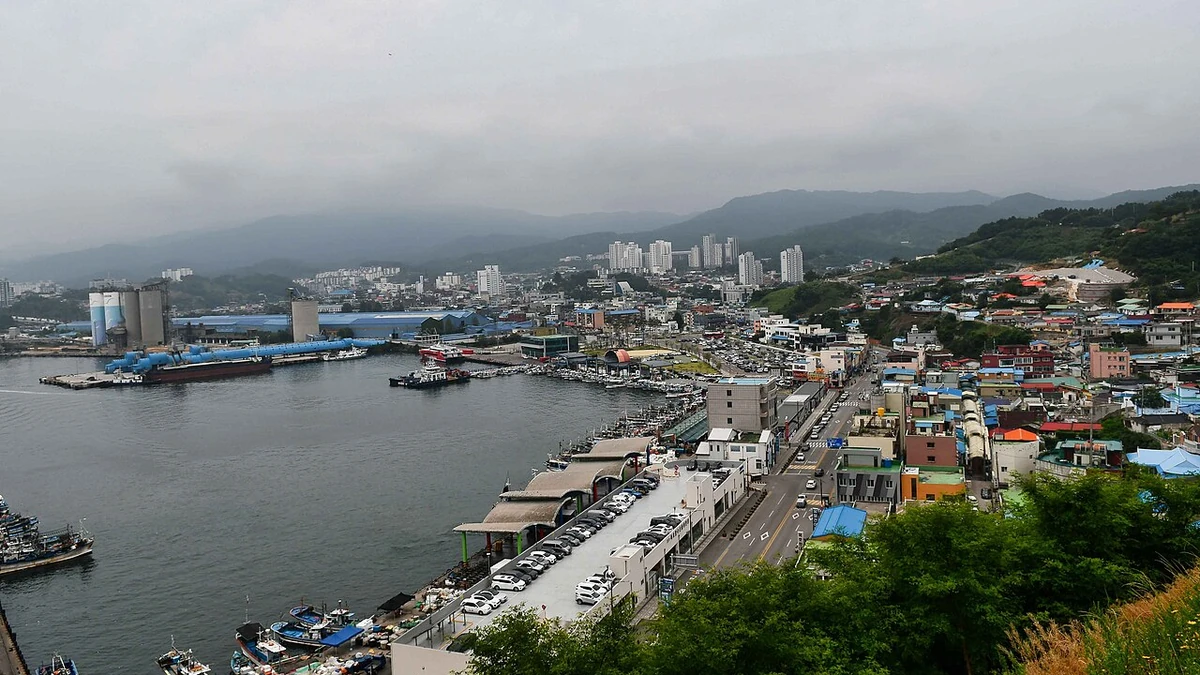
GS Group broke ground Saturday on an artificial intelligence data center in Donghae, South Korea, where it plans to invest 15 trillion won in the first half of a 2.4-gigawatt campus. The conglomerate expects to bring the initial 1.2 gigawatts of capacity into operation in stages, beginning in 2028.
South Korean President Lee Jae Myung attended the ceremony at the Bukpyeong Second General Industrial Complex in Gangwon Province alongside GS Group Chairman Huh Tae-soo and government officials. The project is the first gigawatt-scale AI data center to break ground under the government’s three major infrastructure initiatives unveiled in June.
For GS, whose businesses already span electricity generation, energy and construction, the development represents an expansion into a market where access to reliable power is as important as the availability of computing hardware. The investment also takes large-scale data center construction beyond the Seoul metropolitan area, where competition for electricity supply has complicated development.
Investment in Donghae Will Extend Beyond the First Phase
The planned 15 trillion won investment covers the initial 1.2-gigawatt development rather than the entire proposed campus. GS confirmed the first-phase investment plan in a November 11 announcement detailing its cooperation with steelmaker POSCO. A further 1.2 gigawatts of capacity is planned.
According to Yonhap News Agency, GS estimates that building the infrastructure for both phases would require around 30 trillion won. The broader project could reach 120 trillion won if the cost of graphics processing units (GPUs) and memory is included. The higher figure is a potential estimate of the investment associated with the completed development, not the amount GS has committed to spend on the construction that began Saturday.
The distinction matters for GS’s financial exposure. Facility construction requires spending before operating revenue begins, and computing equipment adds a separate layer of expenditure. Who supplies and ultimately pays for that equipment will depend on the commercial arrangements for the facilities.
GS outlined its initial financing approach in a September disclosure, according to Korean financial publication EToday. The plan calls for project financing and equity capital, with equity expected to account for roughly 20% of the first-phase investment. The proposed ratio could change as the development progresses. It should not be interpreted as evidence that the necessary loans have been secured or that the full equity contribution has already been made.
Phased construction gives the developer some flexibility in matching expenditure to demand. ChosunBiz reported that the first 100-megawatt facility is scheduled for completion in the second quarter of 2028, with the remainder of the initial phase targeted for 2029. The first building permit was obtained in October, according to GS.
Power Supply and Industrial Partnerships Shape the Project
Donghae’s location on the east coast is central to the development strategy. In its groundbreaking announcement, the Ministry of Science and ICT said GS had selected the industrial site partly because of the region’s electricity generation infrastructure. GS is also considering the use of seawater for cooling, although it has not established that approach as the final design for the campus.
Cooling is an economic consideration as well as an engineering one. AI servers generate considerable heat, and the electricity required to remove it adds to a facility’s operating costs. At the scale envisaged in Donghae, the design of the cooling and power systems could affect both the cost of running the facilities and the amount of computing equipment they can accommodate.
GS established a dedicated business, GS AI Infra, to develop its data center operations. The group can draw on GS Engineering & Construction for facility design and building work, and on GS Caltex for liquid-cooling expertise. Those existing capabilities give the conglomerate a route into AI infrastructure without having to develop every component of the business from scratch.
Its partnership with POSCO, announced earlier this month, is intended to address some of the constraints that accompany large construction programs. POSCO plans to contribute specialist steel products suitable for electrical systems and data center structures. The two groups also want suppliers involved earlier in the design process so that materials can be selected and ordered around the construction schedule rather than after the design has been completed.
The agreement could eventually support projects outside South Korea, but it is a memorandum of understanding rather than a disclosed order for a fixed quantity of materials. The announcement did not disclose an overseas project award or a contract value.
South Korea Seeks to Expand AI Infrastructure Outside Seoul
South Korea is preparing regulatory measures to encourage data center construction outside the capital region. The Ministry of Science and ICT has outlined proposed implementing rules for a special law promoting the AI data center industry, due to take effect in March 2027. They include a streamlined permitting process and an exemption from power-grid impact assessments for qualifying facilities outside the metropolitan area, with a proposed threshold of 50 megawatts.
The proposed exemption is far below the planned capacity of GS’s first development phase. It is therefore not a blanket waiver for the Donghae campus, and the availability of suitable grid connections will remain important to the project’s execution.
Local officials and GS are also working on ways to connect the development to the regional economy. Yonhap reported that the first phase could require roughly 1,000 direct and indirect workers during operations, according to estimates associated with the project. Demand for labor during construction will be different from the staffing needs of a completed facility, so the two should not be treated as equivalent measures of permanent employment.
Saturday’s ceremony marks progress on construction, but the development’s commercial performance will depend on the terms under which computing capacity is sold or leased. The announcements reviewed for this story did not identify tenants or give a revenue forecast for the campus. The next major physical milestone is the planned completion of the first 100-megawatt facility in 2028, ahead of the wider first-phase rollout.
More from Investing
Latest News
View all news- Black Friday Online Spending Hits Record $13.1 Billion, Up 11.1% From Last Year
- United Fidelity Bank Branches Begin Operating Under First Citizens After Failure of $5.9 Billion Lender
- Small Business Saturday Puts Independent Retailers in Focus During Holiday Shopping Season
- Italy Publishes Industrial Investment and Infrastructure Funding Decree
- India Uncovers ₹88 Crore GST Refund Fraud in Tobacco Sector, Restricts Cigarettes Worth Over ₹150 Crore