United Fidelity Bank Branches Begin Operating Under First Citizens After Failure of $5.9 Billion Lender
The FDIC expects the closure to cost its insurance fund $1.83 billion, with 22 branches scheduled to reopen under First Citizens by Monday.
Our editorial standards
MarketReview publishes clear, independently produced financial information using reliable sources and transparent editorial standards.
Read our Editorial Policy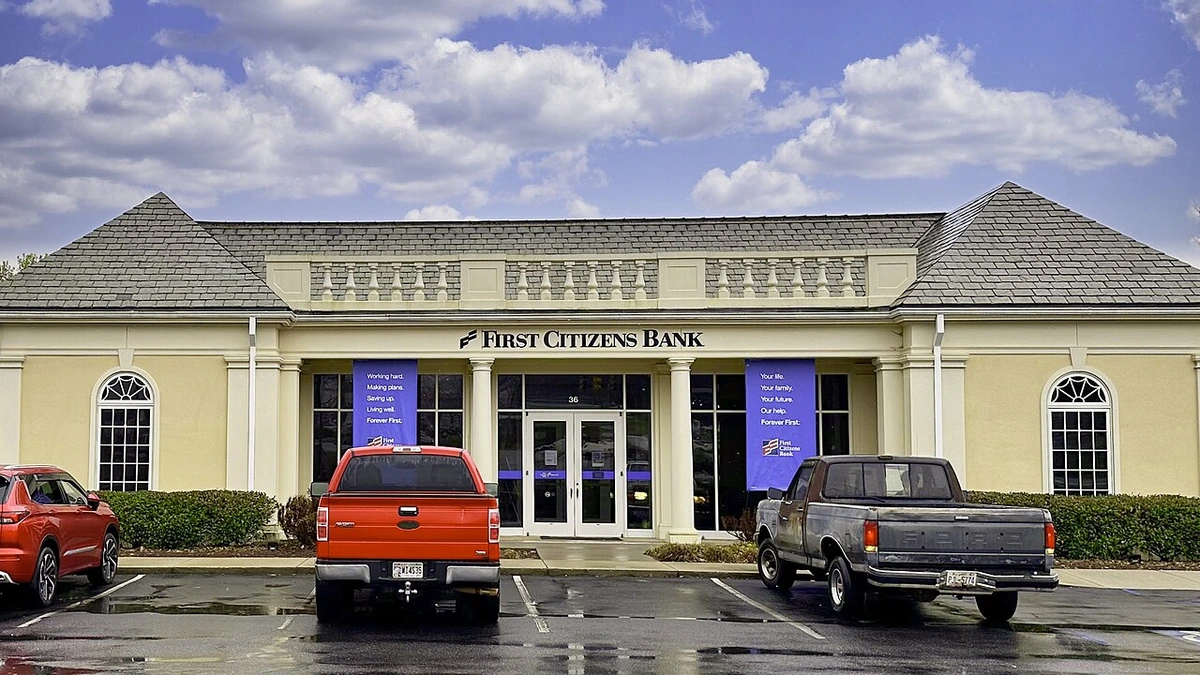
United Fidelity Bank’s branches are beginning to operate under First Citizens Bank on Saturday, November 28, after federal regulators shut the Evansville, Indiana, lender on Friday. United Fidelity had approximately $5.9 billion in assets at the end of September, and the Federal Deposit Insurance Corporation (FDIC) expects its failure to cost the deposit insurance fund $1.83 billion.
The closure affects 22 banking locations across four states and the U.S. Virgin Islands. Branches that normally open on Saturdays are scheduled to resume business this weekend, with the remaining offices due to reopen on Monday. First Citizens is taking over most of the failed bank’s deposits and assets through a purchase arranged by the FDIC.
Existing accounts remain accessible during the handover
Customers whose deposits are transferred do not have to open new accounts to recover their money. In its announcement of the closure, the FDIC said depositors would retain their funds and existing deposit insurance coverage under the new owner. Debit cards, ATMs and checks remain available for accessing funds over the weekend.
For borrowers, the change of bank ownership does not suspend the obligation to repay a loan. The FDIC instructed United Fidelity’s loan customers to keep making payments as before. Customers should also continue using their existing banking locations rather than assuming they can immediately conduct business at any First Citizens branch.
The change in ownership precedes a conversion of the acquired bank’s operating systems. First Citizens has not announced a date for that conversion, so the reopening of the branches should not be confused with the completion of the work needed to connect customer accounts to its existing network.
Of the 22 locations covered by the agreement, 20 are in Indiana, Illinois, Colorado and Florida. The other two operate in the U.S. Virgin Islands under the Bank of St. Croix name. The transfer therefore reaches beyond United Fidelity’s Indiana home market and includes a geographically dispersed group of banking offices.
First Citizens wins the bidding with a $2.6 billion asset discount
United Fidelity reported about $5.4 billion in deposits as of September 30. First Citizens, a subsidiary of Nasdaq-listed First Citizens BancShares (FCNCA), expects to acquire $5.9 billion in assets and take on $4.5 billion in deposits, with loans of $3.1 billion included in the asset pool.
Those figures are preliminary. In its acquisition announcement, First Citizens said the balances remain subject to adjustment to reflect United Fidelity’s financial position at closing and subsequent settlement with the FDIC. Certain brokered deposits and other excluded accounts are outside the scope of the assumption agreement.
The roughly $900 million difference between the failed bank’s reported deposits and the amount First Citizens expects to assume is not, by itself, evidence of depositor losses. Neither headline balance identifies the ultimate disposition of every excluded account. The FDIC’s assurance about customer funds should be read alongside the specific exclusions disclosed by the acquiring bank.
First Citizens was selected through competitive bidding. Its winning offer included a discount of approximately $2.6 billion on assets and no premium on deposits. The discount is an element of the purchase terms, not a separate estimate of the FDIC’s losses. Nor is the $5.9 billion asset figure the cash price paid to acquire the failed lender.
The purchase extends beyond bank branches and lending portfolios. United Fidelity’s subsidiaries are included, among them Pedcor Homes Corporation, which develops and manages real estate. First Citizens described the structure as a whole-bank purchase out of receivership rather than an ordinary merger between two operating banks.
Regulatory concerns preceded the closure
The Office of the Comptroller of the Currency (OCC), which closed United Fidelity and appointed the FDIC as receiver, determined that the lender was no longer in a condition to operate safely and was likely to be unable to meet its financial obligations or depositors’ demands.
Federal supervisors had raised concerns about the bank well before Friday’s intervention. In November 2023, the OCC announced a consent order against United Fidelity covering deficiencies in governance and risk oversight, lending standards, liquidity management and the management of exposure to changing interest rates.
The Federal Reserve subsequently announced a written enforcement agreement in June 2024 with Fidelity Federal Bancorp, Pedcor Financial Bancorp and Pedcor Financial LLC. Those earlier supervisory actions provide context for the closure, although Friday’s announcements did not quantify how much each of the previously identified problems contributed to the eventual loss.
United Fidelity itself had previously been an acquirer of failed banks. FDIC records identify it as the institution that took over Highland Community Bank in Chicago in 2015 and First City Bank of Florida in 2020. It is now the institution being resolved through an FDIC-arranged sale.
The FDIC estimates a $1.83 billion cost
The projected loss to the Deposit Insurance Fund amounts to roughly 31% of United Fidelity’s September asset balance. It is an estimate of the cost of resolving the failure, not a measure of how much cash customers have lost. The fund is financed principally by assessments on insured banks and interest earned on its investments in government securities.
Federal deposit insurance generally protects up to $250,000 for each depositor at an insured bank within each ownership category. A sale that transfers deposits to another institution can preserve balances beyond that statutory insurance amount without changing the standard insurance limit applicable to the banking system.
The FDIC has a dedicated telephone line for United Fidelity customers at 1-866-431-1725. It is scheduled to operate until 5 p.m. Central time on Saturday and from noon to 4 p.m. on Sunday. The next stage of the branch reopening is Monday, November 30, when all locations are scheduled to return to regular business hours.
More from Banking


Latest News
View all news- Black Friday Online Spending Hits Record $13.1 Billion, Up 11.1% From Last Year
- Small Business Saturday Puts Independent Retailers in Focus During Holiday Shopping Season
- Italy Publishes Industrial Investment and Infrastructure Funding Decree
- India Uncovers ₹88 Crore GST Refund Fraud in Tobacco Sector, Restricts Cigarettes Worth Over ₹150 Crore
- GS Group Breaks Ground on 15 Trillion Won AI Data Center in South Korea