FDIC Publishes Proposed Custodial Deposit Rules Affecting Smaller U.S. Banks
The FDIC is proposing implementation details for a custodial-deposit exemption capped at 20% of eligible banks’ liabilities, with comments due in January.
Our editorial standards
MarketReview publishes clear, independently produced financial information using reliable sources and transparent editorial standards.
Read our Editorial Policy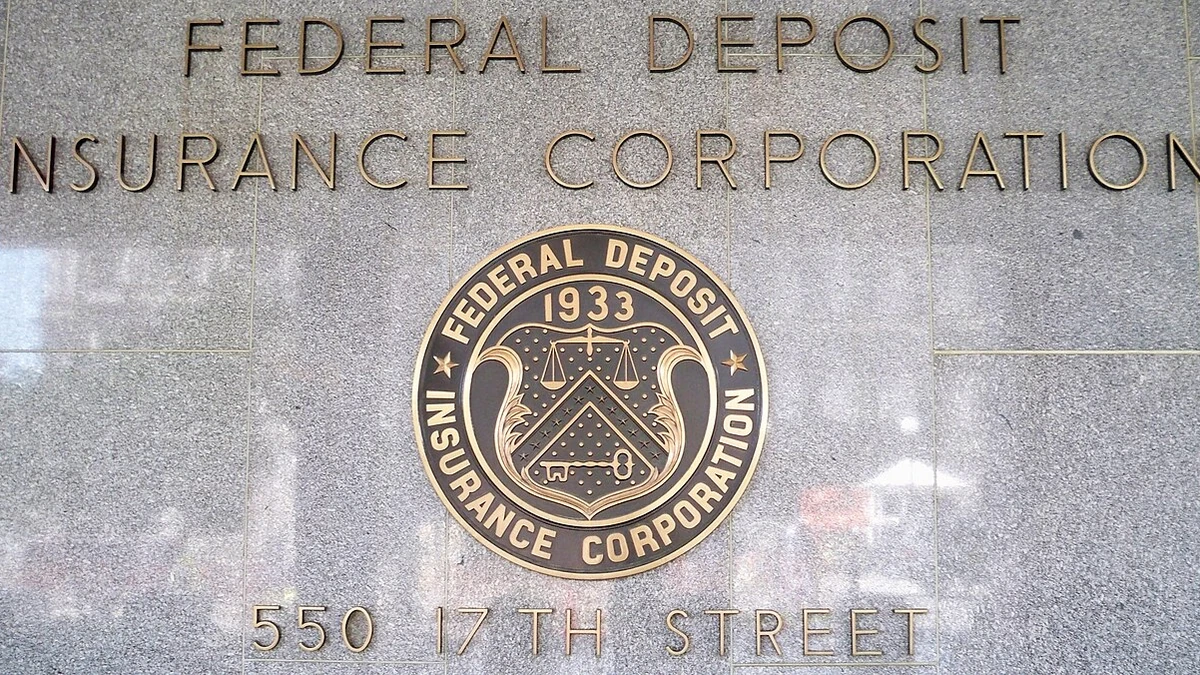
The Federal Deposit Insurance Corporation published proposed rules Friday that would spell out how eligible smaller U.S. banks can exclude certain custodial deposits from their brokered-deposit totals. The exclusion is capped at 20% of a bank’s total liabilities and generally applies to institutions with less than $10 billion in assets that meet supervisory and capital requirements.
The proposal, published in the Federal Register on November 20, would implement provisions of the 21st Century ROAD to Housing Act. The FDIC board approved the notice on November 17, and public comments are due January 19, 2027.
There is an important distinction between the legislation and the new regulatory proposal. Congress’s limited exception for qualifying custodial deposits took effect on July 11, 2026. The FDIC is now proposing definitions and procedures to explain how banks and third parties can use it. The agency is not proposing a blanket exemption for every deposit held through a custodian.
Brokered-deposit classification matters because federal law restricts banks that are not well capitalized from accepting deposits placed through brokers. Depending on their capital position, those banks may need an FDIC waiver or may be prohibited from accepting such funding. Brokered deposits can also influence an institution’s deposit insurance assessments. The new exception therefore has potential consequences for how some community banks report and fund their operations, although the financial benefit will depend on the deposits they actually hold.
Which banks qualify for the 20% exclusion
Under the proposed framework, an eligible institution must meet an asset-size test and additional supervisory conditions. A bank with less than $10 billion in assets can qualify if its most recent supervisory examination assigned a composite CAMELS rating of 1, 2 or 3 and it is well capitalized. The alternative route is to have obtained an FDIC waiver under the existing brokered-deposit rules. The asset threshold still applies.
The FDIC proposes a four-quarter approach to determining whether the bank meets the size limit. An institution that reported assets below $10 billion in any of the preceding four quarters would satisfy the test. A bank reporting $10 billion or more for four consecutive quarters would no longer qualify. That approach would reduce the risk of a sudden loss of eligibility when a smaller institution briefly moves above the threshold as its balance sheet changes.
The limit is measured against total liabilities, not total deposits or total assets. Only qualifying custodial deposits up to the equivalent of 20% of those liabilities would be excluded from brokered-deposit treatment under this specific exception. Any qualifying custodial deposits above the cap would continue to be treated as brokered funds. Deposits qualifying for another existing exclusion would be assessed under that separate provision, rather than automatically counted toward the new cap.
The law also places interest-rate restrictions on certain custodial deposits accepted when an eligible bank is not well capitalized. The proposed amendments would incorporate those statutory restrictions into FDIC regulations. The result is a targeted exception with conditions, not permission for financially weaker banks to collect unlimited deposits through intermediaries.
The deposit arrangements and notices covered by the proposal
For the exclusion to apply, the funds generally must be placed for the purpose of providing or maintaining deposit insurance for their beneficial owners. The placement must be made through a qualifying entity acting in a formal custodial or fiduciary capacity. The FDIC identifies several types of qualifying entities, including insured banks acting as custodians, bank-controlled trust entities, state-chartered trust companies, and certain plan administrators or investment advisers acting for a plan.
The proposal draws a distinction between a qualifying custodial arrangement and an arrangement in which a bank pays a third party to bring it deposits. A deposit would not qualify if an insured bank paid fees under an agreement in return for its placement. The agency would nevertheless distinguish deposit-placement fees from payments for other services, such as recordkeeping, and from interest paid on deposits. It is seeking comments on whether that treatment accurately reflects existing compensation arrangements.
The FDIC also proposes to evaluate the deposit-insurance purpose at the level of the placement program. Under its proposed interpretation, the program would need to keep each beneficial owner’s funds at or below the standard maximum deposit insurance amount at each receiving bank. A program deliberately placing amounts beyond that limit would not meet this particular purpose test. This distinction could affect how custodians structure programs that distribute client funds across multiple insured institutions.
A new notice process would provide a way to document qualifying arrangements. An eligible bank, qualifying entity or another participant in the placement arrangement could file a written notice identifying the parties, describing how deposits are placed, confirming the per-owner insurance-limit condition and explaining agreements involving compensation paid by receiving banks. The notice would take effect when submitted, with annual certification and updates if the information changes.
Under the proposal, the FDIC would publish a list of submitted notices within 30 days of receipt. The agency could request additional information and could revoke a notice if an arrangement did not satisfy the conditions, after giving the filer an opportunity to respond or correct the problem. These are proposed administrative requirements; their final form remains subject to public comment and subsequent agency action.
How many banks could be affected and what comes next
FDIC figures show why the proposal is relevant to smaller institutions, but they do not establish that every eligible bank would obtain relief. As of June 30, 2026, the agency insured 4,247 banks and other insured depository institutions. Of those, 4,085 reported assets below $10 billion, and the FDIC estimated that approximately 4,031 institutions could meet the proposed eligibility definition.
Among potentially eligible institutions, 1,629 reported positive amounts of non-reciprocal brokered deposits. The regulator uses that group as an indication of how many banks might be immediately affected if the rule were finalized in its proposed form. It cautions that its available data cannot show how many actually hold deposits that would qualify for the custodial exception. The 1,629 figure is therefore a possible exposure measure, not a count of banks confirmed to benefit.
A shift from brokered to non-brokered classification could reduce deposit insurance assessments for some banks because the FDIC’s assessment system takes certain concentrations of brokered funding into account. The agency expects any resulting reduction in assessment revenue to be small overall and says it cannot identify which individual institutions would receive lower assessments. The rule could improve the treatment of qualifying funding without necessarily changing the amount of money deposited at any particular bank.
The proposed notice process would have costs as well. The FDIC estimates about four hours of labor for an initial filing and one hour for annual certification, representing approximately $450 initially and $112 each year at the hourly rate used in its analysis. Those estimates are limited to the filing and certification work and do not capture every potential cost of gathering records or coordinating among intermediaries.
Reporting requirements are another area still under consideration. The FDIC is evaluating two possible Call Report items: one identifying total qualifying custodial deposits and another identifying qualifying deposits that remain classified as brokered because they exceed the 20% limit. Any such reporting changes would be addressed separately in coordination with the Federal Financial Institutions Examination Council. Existing supplemental Call Report instructions already recognize that banks may rely on the statutory exception while the implementing rule is being developed.
Questions open for comment include how to distinguish permitted service payments from deposit-placement fees, whether the proposed notices provide adequate transparency and how the four-quarter asset test should work. Comments referencing RIN 3064-AG38 must reach the FDIC by January 19, 2027. The agency will consider the submissions before deciding the final wording of its implementing regulations.
More from Banking



Latest News
View all news- FirstEnergy Raises Five-Year Capital Investment Plan to $38 Billion
- GAO Flags AI-Driven Cybersecurity Risks Across Financial Services and Critical Infrastructure
- MasTec Agrees to Acquire Murphy Corporation for About $1.25 Billion
- U.S. Industry Productivity Growth Remains Uneven, New BLS Data for 2025 Show
- Moog Reports Record $4.52 Billion Fiscal 2026 Revenue, Up 17%