
General Mills Reaffirms FY2027 Outlook as Q1 Organic Sales Stay Flat
Reported sales fell 3% to $4.39 billion as the U.S. yogurt divestiture reduced revenue, while adjusted operating profit declined 11% in constant currency.
Our editorial standards
MarketReview publishes clear, independently produced financial information using reliable sources and transparent editorial standards.
Read our Editorial Policy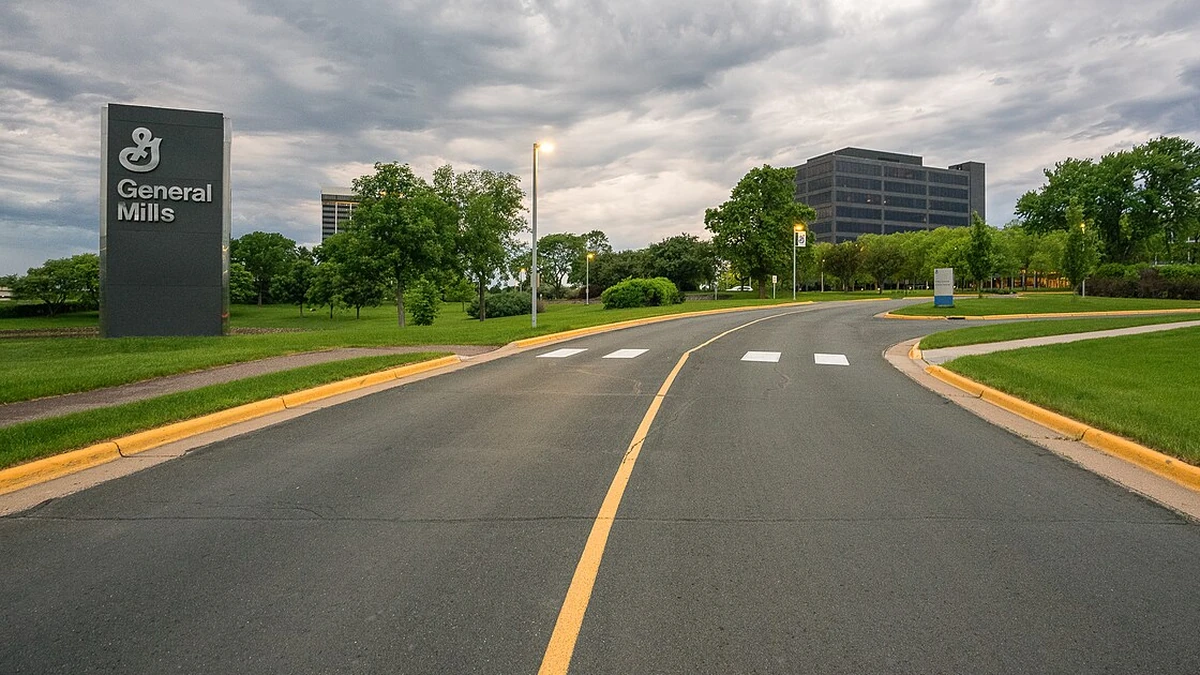
General Mills reaffirmed its fiscal 2027 outlook after first-quarter organic net sales were essentially flat, as pricing and mix offset part of the pressure from lower volume. Reported net sales fell 3% to $4.39 billion, largely reflecting the effect of the company’s U.S. yogurt divestiture.
Profit measures were weaker. Adjusted operating profit fell 11% in constant currency, and adjusted diluted earnings per share declined 13% in constant currency to $0.75. Reported operating profit was $634 million, down 63%, but that comparison was heavily affected by a roughly $1 billion gain recorded a year earlier from the yogurt divestiture.
General Mills said in its first-quarter fiscal 2027 results that gross margin was unchanged at 33.9% of net sales. Adjusted gross margin fell 90 basis points to 33.3% as higher input costs outweighed favorable net price realization and mix. The company’s quarter ended August 30, 2026.
Divestitures weigh on reported sales while organic demand stabilizes
The difference between reported and organic sales was central to the quarter. Total reported volume reduced sales growth by 4 percentage points, while price and mix added 1 point. Acquisitions and divestitures reduced reported growth by 3 points. On an organic basis, volume was down 1 point and organic net sales were flat.
North America Retail remained the largest source of pressure. Segment net sales fell 7% to $2.45 billion, including a four-point drag from the U.S. yogurt divestiture. Organic net sales were down 3%. General Mills said Big G Cereal and Canada posted double-digit reported declines, U.S. Snacks was down in the mid-single digits, and U.S. Meals & Baking Solutions was flat. Segment operating profit fell 15% to $479 million, reflecting lower volume and higher input costs, partly offset by favorable price and mix and lower selling, general and administrative expenses.
The North America Pet business was steadier at the top line but also faced profit pressure. Sales of $613 million were essentially unchanged from a year earlier, and organic sales were flat. Cat food sales increased by double digits and pet treats grew at a low-single-digit rate, while dog food declined at a high-single-digit rate. Operating profit fell 12% to about $100 million as higher input costs, lower volume and higher expenses more than offset favorable price and mix.
Other parts of the portfolio performed better. North America Foodservice sales increased 1% to $523 million, with organic sales up 4%, and segment operating profit rose 12% to $79 million. International sales increased 4% to $794 million, including a one-point benefit from foreign exchange. International organic sales also rose 4%, led by distributor markets, India and China, while operating profit increased 14% as reported and 15% in constant currency.
Profit comparisons remain distorted by last year’s yogurt sale
The large decline in reported operating profit does not reflect only the underlying operating trend. In the first quarter of fiscal 2026, General Mills recorded a $1.05 billion pretax gain from the sale of its U.S. yogurt business. There was no comparable gain this quarter, making the year-over-year reported decline much larger than the change in adjusted profit.
Net earnings attributable to General Mills were $397 million, down 67% from $1.20 billion a year earlier. Diluted EPS was $0.74, compared with $2.22 in the prior-year quarter. The adjusted figures strip out items the company considers to affect comparability, leaving adjusted diluted EPS of $0.75 for the latest quarter.
The company also completed the sale of its Brazil business to 3corações on September 2, after the quarter ended. General Mills had already classified that business as held for sale and recorded an additional $24 million non-cash pretax valuation loss in the first quarter. The company expects customary post-closing sale-price adjustments to be recorded in the second quarter.
Cash generation was lower in the quarter. Cash provided by operating activities totaled $298 million, compared with $397 million a year earlier. Capital investment fell to $90 million from $110 million. General Mills paid $330 million in dividends and did not repurchase shares during the quarter, compared with $500 million of share repurchases in the year-earlier period.
FY2027 guidance still assumes a difficult consumer backdrop
General Mills maintained its full-year fiscal 2027 targets. Organic net sales are expected to range from a decline of 1.5% to growth of 0.5%. Adjusted operating profit is expected to decline 13% to 8% in constant currency, and adjusted diluted EPS is expected to be between $3.00 and $3.20. Free cash flow conversion is projected at approximately 95% of adjusted after-tax earnings.
The company continues to expect at least $750 million in savings from its Holistic Margin Management productivity program, its global transformation initiative and other cost-saving actions during the fiscal year. Those savings are intended to offset input-cost inflation and spending behind the brands. General Mills also expects roughly nine percentage points of pressure on operating profit and 11 points on EPS from the comparison with fiscal 2026’s 53rd week, the normalization of corporate incentive expense and the effect of divestitures.
Management’s sales plan is shifting away from the base price investments that were completed in fiscal 2026 and toward product innovation and renovation. The company highlighted products built around consumer priorities such as protein and fiber, stronger flavors and indulgence, along with continued demand tied to pet humanization. It expects category growth to remain below its long-term historical rate because of a challenging consumer environment.
The reaffirmed outlook therefore rests on a mix of steadier organic demand, cost savings and continued brand investment rather than a sharp rebound in reported sales. General Mills now expects the combined effect of divestitures, foreign exchange and the comparison with last year’s 53rd week to reduce fiscal 2027 reported net sales growth by about 4%. The next quarter will provide a clearer test of whether the sequential improvement the company cited in retail trends can translate into stronger organic growth without further pressure on margins.
More from Investing

Latest News
View all news- Fed’s Barr Says Further Rate Adjustments Likely as Inflation Risks Rise
- Cracker Barrel Ends Fiscal 2026 With Lower Sales, Sets 2027 Outlook
- Bullish and Marex Partner to Expand Institutional Digital-Asset Access
- Beneficient Unveils Strategy to Challenge Former CEO-Linked Debt and Equity Claims
- Espey Fiscal 2026 Profit Rises as Sales Reach $46.1 Million
