$753 Million Los Angeles Port Bridge Project Begins as 16-Month Closure Takes Effect
The Vincent Thomas Bridge is shut through early 2028 for a complete deck replacement, sending commuters and freight trucks onto alternate routes around the Port of Los Angeles.
Our editorial standards
MarketReview publishes clear, independently produced financial information using reliable sources and transparent editorial standards.
Read our Editorial Policy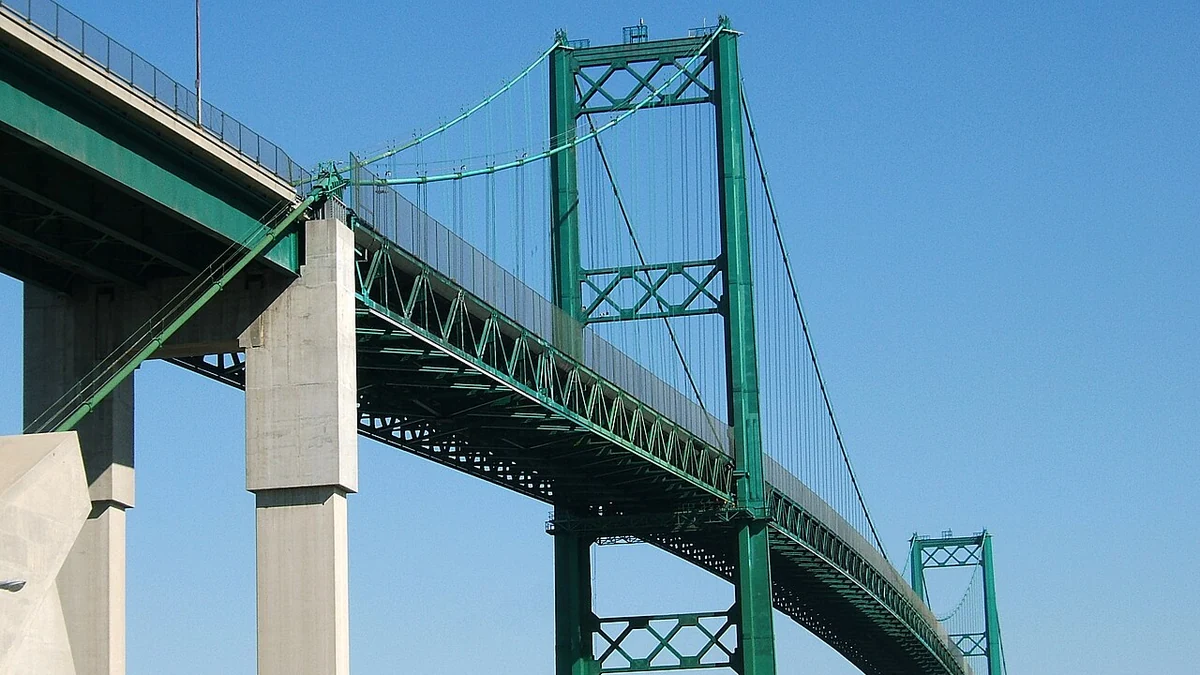
The Vincent Thomas Bridge at the Port of Los Angeles closed to traffic on Saturday, November 7, as a $752.8 million project to replace its deteriorating concrete deck entered its main construction phase. The full shutdown began at 12:01 a.m. local time and is planned to last about 16 months, cutting off a major road connection between San Pedro and Terminal Island.
Both directions of State Route 47 across the bridge are closed between Harbor Boulevard and Ferry Street. Caltrans has set March 1, 2028, as its target for reopening to motorists, although that remains a construction schedule rather than a guarantee. The closure shifts a substantial volume of commuter and freight traffic onto other roads serving the Los Angeles and Long Beach port complex.
The Port of Los Angeles describes the work as a $753 million project, while the latest Caltrans closure notice gives a more precise figure of $752.8 million. Some Caltrans project materials use the rounded figure of $750 million. All three descriptions refer to the Vincent Thomas Bridge deck replacement, not separate bridge projects.
Why the Bridge Needs a New Deck
Opened in 1963, the suspension bridge has spent more than six decades carrying traffic through a marine environment. Caltrans says the bridge itself remains structurally sound, but the concrete roadway has suffered fatigue under repeated heavy loads and deteriorated with age and exposure to the harbor environment. Without a comprehensive replacement, the agency says more localized deck failures and emergency repairs would become increasingly likely.
Crews are replacing the full concrete roadway rather than performing a series of smaller patches. The approved scope also includes a new center median barrier, railings, fencing, lighting and signage, along with upgraded seismic sensors. This is a rehabilitation of an existing transport link, not a plan to add lanes or build a second bridge. The roadway is expected to retain two travel lanes in each direction when it reopens.
Caltrans selected a single-stage, full-closure approach after reviewing construction alternatives and public feedback. Its project guidance says a complete shutdown offered advantages for safety, efficiency and cost compared with keeping parts of the bridge open through a longer construction program. The 16-month schedule is based on work being carried out around the clock.
Preparatory activity started before the full closure. Temporary platforms, stairways and structural bracing have been installed to support the deck replacement, with nearby road improvements intended to absorb some of the diverted traffic. The main construction contractor is Skanska-CEC Joint Venture, which worked with Caltrans during planning and preconstruction.
The timetable has already been adjusted once: Caltrans moved the closure back by six days to November 7 to complete coordination before the main work began. Officials said the change would not alter the intended early-March reopening window. The agency’s construction plan also includes a final stage after traffic returns, when temporary work facilities are removed and remaining equipment and utilities are installed.
Detours Put Pressure on Harbor-Area Roads
The size of the road closure is unusual for a corridor this busy. According to Caltrans, the Vincent Thomas Bridge carries an average of about 53,000 vehicles a day, with heavy trucks accounting for nearly 9% of that traffic. Drivers who previously crossed directly from San Pedro to Terminal Island must now approach the port complex from other directions.
The primary detours use Interstate 110, Interstate 710, State Route 103 and Harry Bridges Boulevard. On-ramps and highway connections leading into the closed section are also affected, so the change involves more than simply turning vehicles away at the bridge entrances. Drivers are being advised to check current road conditions and allow extra travel time rather than assume normal trip durations on alternative routes.
Caltrans and local agencies have prepared the surrounding road network with resurfacing, revised striping, traffic cameras and temporary signals. Traffic-control officers are to be deployed as needed at 18 key intersections, and local police plan expanded enforcement of commercial-truck restrictions. These measures are intended to keep redirected vehicles moving without pushing avoidable congestion into nearby residential streets.
Those safeguards cannot eliminate the strain of redirecting traffic for more than a year. The main uncertainty is how congestion will develop at different times of day as commuter trips, terminal appointments and other deliveries share the available approaches. Caltrans has not provided a single reliable additional-travel-time figure applicable to every driver, and conditions are likely to vary by route.
Port Terminals Stay Open as Truck Access Changes
The Port of Los Angeles says its marine terminals will remain open during the bridge project and does not expect the shutdown to directly reduce cargo-terminal capacity or productivity. The port also expects rail freight operations to continue without an interruption attributable to the bridge closure. The immediate operational challenge is road access for people and trucks moving around the port complex.
The port estimates that only about 8% of drayage truck traffic in the broader port complex uses the Vincent Thomas Bridge. That figure is different from Caltrans’ estimate that heavy trucks make up nearly 9% of all vehicles traveling on the bridge. The two percentages describe different traffic populations and should not be read as competing estimates of the same measure.
Shipping company Maersk warned customers in a November 4 advisory that port facilities were expected to remain operational but that truck arrivals and commuter travel could become less predictable. It identified landside access to APM Terminals’ Pier 400 facility as one area where drivers may need to use different approaches. The warning does not amount to a forecast that vessels will stop calling at the port or that terminals will close.
A separate State Route 47 interchange improvement program is also underway nearby. The Port of Los Angeles lists that work independently from the bridge deck replacement, a distinction that matters when comparing budgets and the effects of overlapping construction. The bridge closure is the more direct constraint on the San Pedro-to-Terminal Island crossing.
Caltrans’ target reopening date of March 1, 2028, would restore the bridge before the Los Angeles Olympic Games later that year. The agency’s staged plan allows some final removal of temporary construction features and installation work after motorists return. For now, the central milestone is the 16-month period in which the bridge itself remains unavailable to road traffic.
More News

Latest News
View all news- Berkshire Hathaway Reports Lower Q3 Operating Earnings, $9.6 Billion in Share Buybacks
- Powerhouse Parramatta Opens as A$915 Million Cultural Project Reaches Milestone
- Bank of Japan Releases Governor Ueda’s Analysis of Japan’s Current Account Surplus
- U.S. Consumer Sentiment Rises to 51.0 in November as Inflation Expectations Ease
- USDA Finalizes WIC Rule Allowing Online Grocery Orders and Digital Payments