
L3Harris-Built Optics Launch Aboard NASA’s Roman Space Telescope
L3Harris supplied Roman’s 2.4-meter Optical Telescope Assembly and radiation-hardened electronics, with NASA now beginning a three-month commissioning journey toward the Sun-Earth L2 point.
Our editorial standards
MarketReview publishes clear, independently produced financial information using reliable sources and transparent editorial standards.
Read our Editorial Policy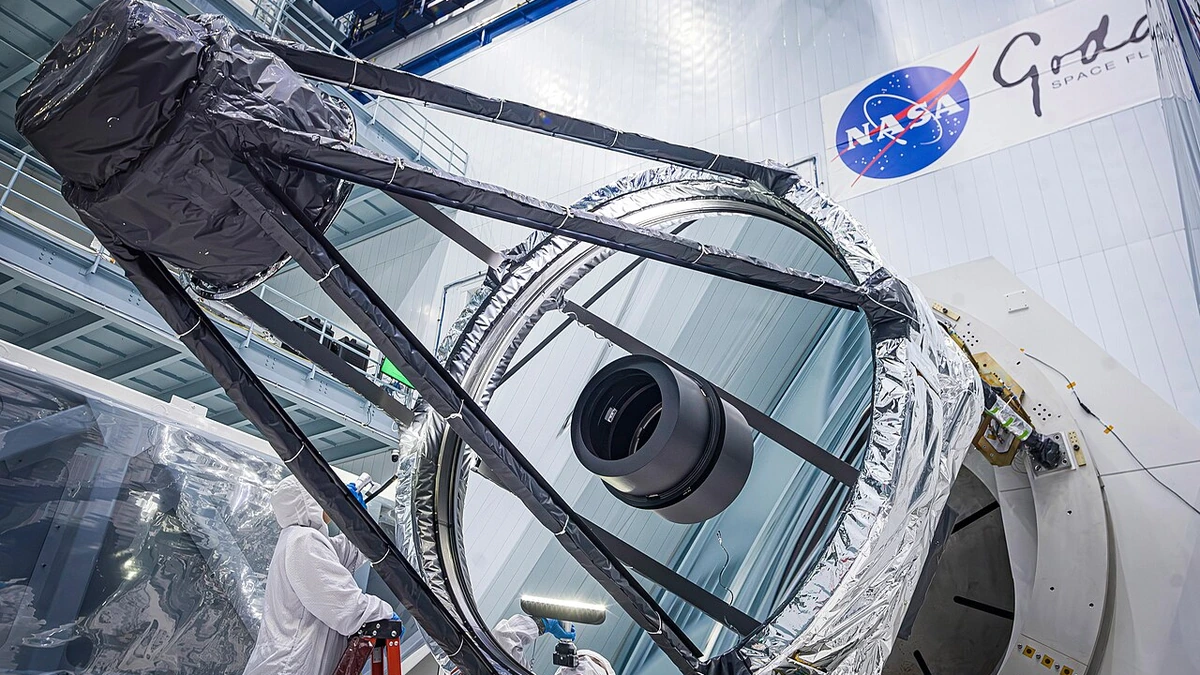
L3Harris Technologies hardware is now in space aboard NASA’s Nancy Grace Roman Space Telescope after the observatory launched Sunday morning from Florida. A SpaceX Falcon Heavy lifted off from Launch Complex 39A at NASA’s Kennedy Space Center at 7:26 a.m. EDT on Aug. 30, carrying a telescope that includes an L3Harris-built 2.4-meter Optical Telescope Assembly and radiation-hardened electronics.
The launch moves a long-running civil-space program from engineering and integration into flight, giving L3Harris another NASA mission in which its optical hardware is central to the spacecraft’s scientific performance. The company did not disclose a new contract value, incremental revenue contribution or change to financial guidance with Sunday’s announcement, so the immediate investor significance is primarily technical execution and mission heritage rather than a newly quantified financial award.
L3Harris optics move from clean-room integration to flight
L3Harris said the successful launch caps more than a decade of engineering and collaboration with NASA’s Goddard Space Flight Center. The Optical Telescope Assembly functions as Roman’s optical eye, collecting and directing light toward the observatory’s instruments. Its main mirror is 7.9 feet, or 2.4 meters, across, the same diameter as Hubble’s primary mirror.
The assembly contains the primary mirror, nine additional mirrors, supporting structures and electronics. NASA said when the telescope was delivered to Goddard in November 2024 that L3Harris designed and built the assembly in Rochester, New York, using key optics that had been made available to NASA by the National Reconnaissance Office. L3Harris reshaped the primary mirror and built on that inherited hardware to meet Roman’s infrared-observation requirements.
Those optics had to survive both launch loads and the thermal conditions expected in deep space. L3Harris said during the 2024 delivery milestone that it tested the telescope’s mirrors down to minus 82 degrees Fahrenheit to verify optical alignment under extreme conditions. Before delivery, the completed telescope also underwent a month-long thermal-vacuum test as teams checked its performance under the cold, low-pressure conditions it will experience away from Earth.
The telescope itself should not be confused with Roman’s two science instruments. Light collected by the L3Harris-built assembly is routed to the Wide Field Instrument, a 300-megapixel infrared camera, and the Coronagraph Instrument, a technology demonstration designed to suppress starlight so astronomers can image faint planets and surrounding material. The optical assembly is therefore foundational to the mission, but it is one part of a broader observatory built by NASA and multiple industrial and scientific partners.
Roman begins a three-month commissioning journey
NASA said Roman separated from the Falcon Heavy about 31 minutes after liftoff, with telemetry reaching the ground team seven minutes after launch. The observatory is now traveling toward an orbit around the second Sun-Earth Lagrange point, or L2, roughly one million miles from Earth. NASA described the trip and initial checkout as an approximately three-month commissioning period.
Early post-launch steps were completed on Sunday. NASA confirmed deployment of Roman’s solar panels and lower instrument sun shade about one hour and 23 minutes after liftoff. The agency said the high-gain antenna and deployable aperture cover are scheduled to follow in the coming days, along with a mid-course correction and power-on of the Coronagraph Instrument. The Wide Field Instrument is expected to activate a few weeks into the voyage.
Once commissioning is complete, Roman is intended to pair Hubble-class sharpness with a field of view about 100 times larger. NASA says the observatory is designed to survey the universe about 1,000 times faster than Hubble, allowing it to map billions of galaxies, investigate dark matter and dark energy, and build a large statistical census of planets beyond the solar system. The spacecraft is also expected to transmit about 1.4 terabytes of data per day, which NASA says will be the highest data rate yet for one of its astrophysics missions.
L3Harris highlighted three planned survey programs in its launch announcement. Among them, Roman is expected to peer through the Milky Way’s dense central region, scan roughly 12% of the sky in less than 18 months to study cosmic expansion, and observe supernovae whose light has traveled for billions of years. Those goals depend on a chain of systems performing together, from the telescope’s mirrors and pointing stability to detectors, communications links and ground processing.
The milestone adds flight heritage, not a new financial forecast
For L3Harris, Roman sits inside a much larger Space & Mission Systems portfolio that includes civil, defense and classified programs. In the company’s second-quarter 2026 results, Space & Mission Systems generated $2.966 billion of revenue, up 7% from a year earlier, while segment operating margin was 9.8%, down from 10.4%. Year-to-date segment revenue reached $5.956 billion, a 15% increase, and L3Harris raised its 2026 revenue outlook for the segment to about $11.7 billion.
The company also reported a record $42 billion total backlog at the end of the second quarter. Roman’s launch release did not identify how much of that backlog is tied to the telescope, nor did it attach any new revenue or margin target to the mission. That distinction matters because a successful launch can strengthen a supplier’s technical record without automatically changing near-term earnings expectations.
What Sunday’s flight does establish is that L3Harris’s Roman optics have moved beyond ground testing and survived the launch phase of the mission. The next test is on-orbit performance. NASA plans to spend the commissioning period deploying hardware, calibrating instruments and verifying the observatory’s pointing and optical behavior before science operations begin. The agency currently expects to release Roman’s first images in early 2027, providing the next concrete measure of how the telescope and its instruments are performing in space.
More News



Latest News
View all news- OCC Report Finds Restrictive Banking Policies at Nine Major U.S. Banks
- Morgan Stanley Reports $20.3 Billion in Quarterly Revenue as Wealth Assets Grow
- U.S. Treasury Removes Venezuelan Official Jorge Rodríguez From Sanctions List
- Federal Reserve Researchers Examine Liquidity Risks as Retail Investors Enter Private Credit
- CMS Says Duplicate Health Insurance Subsidy Checks Could Save $1.5 Billion Annually
