Bristol Myers Squibb, BioNTech Report 36.7% Response Rate in Phase 2 Pumitamig Lung Cancer Trial
The early ROSETTA Lung-107 data also showed median progression-free survival of 6.9 months, but the single-arm study cannot establish a benefit over existing therapy.
Our editorial standards
MarketReview publishes clear, independently produced financial information using reliable sources and transparent editorial standards.
Read our Editorial Policy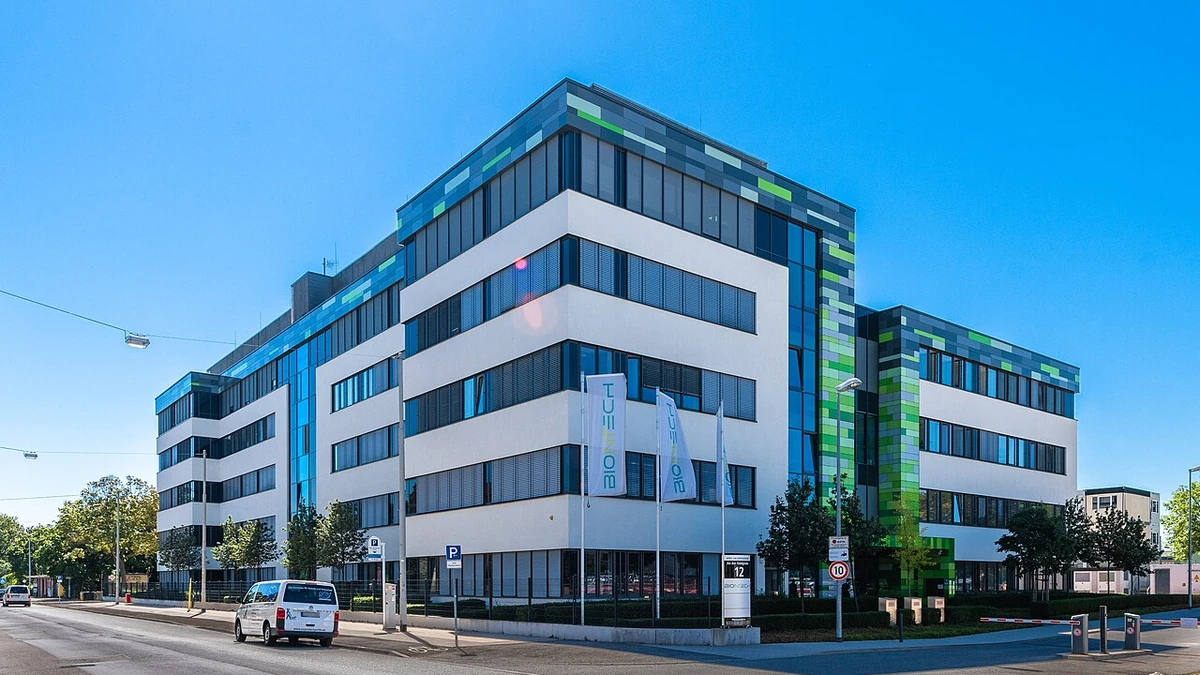
BioNTech and Bristol Myers Squibb reported a 36.7% confirmed tumor response rate for their experimental drug pumitamig, used with the chemotherapy docetaxel, in a Phase 2 study of patients with advanced lung cancer whose disease had progressed after an initial course of immunotherapy and chemotherapy. The companies also reported an early median progression-free survival of 6.9 months, extending the clinical evidence for the drug into a difficult second-line treatment setting.
The results, presented October 25 at the European Society for Medical Oncology Congress in Madrid, come from the global ROSETTA Lung-107 trial in metastatic non-small cell lung cancer. They give the two companies another reason to study pumitamig, but not a direct comparison showing that it works better than existing treatment. The trial has no randomized control group, and follow-up remains short.
The response rate rests on 30 evaluable patients
At a July 10, 2026, data cutoff, 50 patients had been treated and 33 remained on treatment, according to the companies’ October 25 clinical update. Only 30 were included in the efficacy-evaluable group used to calculate the 36.7% confirmed objective response rate. The study had enrolled 59 patients overall, so its various reported measures use different populations rather than a single denominator.
The confirmed response rate measures patients whose tumors met the criteria for a verified reduction in size. A separate disease control rate of 90.0% includes patients with stable disease as well as those with a response. That distinction matters: disease control does not mean that nine in 10 patients experienced tumor shrinkage.
The response signal appeared across the two major non-small cell lung cancer histologies. The reported confirmed response rate was 57.1% in squamous tumors and 30.4% in non-squamous tumors. Rates also varied across PD-L1 expression categories: 42.9% in patients with expression below 1%, 33.3% in the 1% to 49% group, and 40.0% among those at 50% or higher. These are descriptive subgroup findings from a small early dataset, not evidence that one group benefits more than another.
Median time to response was 1.4 months. For the full treated group of 50 patients, the companies estimated median progression-free survival at 6.9 months, with a 95% confidence interval running from 4.2 months to a median upper bound that had not been reached. The estimated six-month progression-free survival rate was 63.3%. Progression-free survival reflects the period before the cancer worsens or the patient dies; it is not the same measure as overall survival.
The maturity of those estimates is a central limitation. Median follow-up was only 12.2 weeks, a much shorter observation period than the reported 6.9-month progression-free survival median. The results therefore require further follow-up to establish how durable the responses are and how the survival estimates change. The announcement did not provide a mature overall-survival result or a reported median duration of response.
BioNTech and Bristol Myers Squibb cited historical median progression-free survival of roughly 3.6 to 3.9 months for docetaxel in patients who had already received immunotherapy and chemotherapy. That is context, not a trial comparator. Patient selection, assessment schedules and other differences can affect outcomes across separate studies, so the historical figures cannot establish a treatment advantage for pumitamig plus docetaxel.
Safety findings also need longer observation
Pumitamig, also known as BNT327 or BMS-986545, is designed to act on two targets: PD-L1, a protein involved in suppressing immune responses against tumors, and VEGF-A, which supports the formation of blood vessels. The approach seeks to address immune escape and tumor blood-vessel activity with one bispecific medicine. That mechanism is the basis for further testing rather than proof of a clinical benefit.
The Phase 2 study administered pumitamig with docetaxel every three weeks. Its initial safety stage tested pumitamig doses of 1,400 mg or 2,000 mg, while the subsequent expansion stage used 1,400 mg alongside docetaxel at 75 mg per square meter of body surface area. The selected dose reflects the internal review of early safety information and evidence from the wider lung cancer program.
Among 50 patients assessed for safety, 52.0% had an adverse event attributed to pumitamig, and 18.0% experienced a treatment-related event of grade 3 or higher. Four patients, or 8.0%, discontinued pumitamig because of treatment-related adverse events. The companies characterized the overall safety profile as manageable and said no new safety signals had appeared, but those assessments remain provisional in a relatively small group.
Immune-related adverse events occurred in 22.0% of patients, including grade 3 or higher events in 10.0%. VEGF-related events were reported in 26.0%, with two patients experiencing grade 3 events. Bleeding was reported in eight patients, or 16.0%, and all the reported bleeding events were grade 1 or 2. The companies reported no pumitamig-related deaths or dose-limiting toxicities in the dataset.
These categories of adverse events may overlap and should not be added together. The trial also excluded patients with certain prior anti-VEGF treatments and those at substantial risk of bleeding, according to its eligibility rules. Safety findings in this selected population cannot automatically be extended to every patient who might eventually be considered for treatment. Longer observation and larger comparative studies will be necessary to assess the benefit-risk profile.
The findings add evidence to a multibillion-dollar drug partnership
For the companies, the study represents more than another conference presentation. Under their June 2025 co-development and commercialization agreement, Bristol Myers Squibb committed to a $1.5 billion upfront payment to BioNTech and $2 billion in non-contingent anniversary payments through 2028. BioNTech can also become eligible for as much as $7.6 billion in additional development, regulatory and commercial milestone payments. Those potential milestones depend on future achievements rather than being guaranteed proceeds.
The partners agreed to share joint development and manufacturing costs equally, subject to exceptions, as well as split global profits and losses. That structure gives both businesses an economic interest in whether the drug advances successfully through larger studies and, ultimately, gains regulatory approval. The latest early-stage results do not themselves trigger a stated payment or establish that a commercial launch will happen.
ROSETTA Lung-107 is the third global Phase 2 dataset the companies have highlighted for pumitamig in lung cancer, alongside prior work in first-line non-small cell lung cancer and extensive-stage small cell lung cancer. Those trials involve different groups of patients and treatment approaches. Their findings cannot simply be pooled to predict how pumitamig will perform after first-line treatment has failed.
The wider program is already more advanced in other settings. The October 25 announcement listed seven ongoing global Phase 3 trials with potential to support registration across cancer types, including four lung cancer studies. The second-line ROSETTA Lung-107 results are not themselves a Phase 3 comparison, and the partners have not set out a confirmed regulatory submission timetable for this particular use.
The question for the second-line setting is whether an appropriately controlled study can reproduce the tumor response and progression-free survival signals without an unacceptable rise in serious adverse events. The companies said the ROSETTA Lung-107 data would inform further development in this population; the trial continues to follow patients for progression and survival outcomes.
More News


Latest News
View all news- New Zealand National Party Unveils 26-Point First-100-Days Agenda Covering Taxes, Loans and KiwiSaver
- FAA’s JFK Flight Limits Enter New Two-Year Extension Through October 2028
- Eli Lilly Releases New Olomorasib Lung Cancer Data Ahead of 2027 Phase 3 Results
- Canada Announces Abu Dhabi Crown Prince Visit Focused on Investment and Economic Ties
- Austria Sets 2027 Motorway Toll Vignette Increase at 2%, Below Inflation