
Bank of America Launches $250 Billion U.S. Infrastructure Finance Initiative
The $250 billion target counts eligible lending, investing, capital-markets and advisory activity through July 4, 2027, rather than a single pool of Bank of America capital.
Our editorial standards
MarketReview publishes clear, independently produced financial information using reliable sources and transparent editorial standards.
Read our Editorial Policy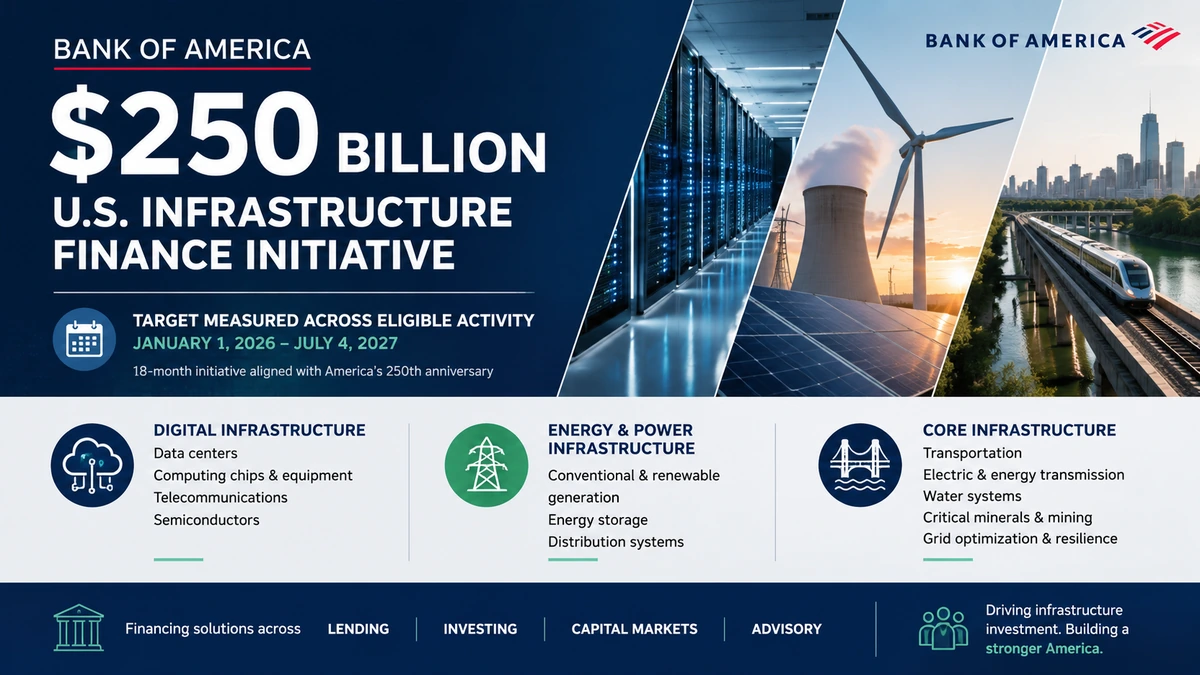
Bank of America has launched a $250 billion U.S. infrastructure finance initiative aimed at digital infrastructure, power generation and other large projects tied to rising demand for computing capacity and broader modernization of the country’s physical systems.
The headline figure is not a newly created $250 billion fund. Bank of America says the total will be measured through eligible activity across primary-market lending, investing, capital markets and advisory work. In other words, the initiative can include financing that comes directly from the bank as well as capital raised or arranged through public and private markets.
There is another important timing detail. Although Bank of America announced the initiative on August 12, the measurement period began on January 1, 2026 and runs through July 4, 2027. Eligible activity from earlier this year can therefore count toward the target. The bank describes the program as an 18-month initiative tied to the United States’ 250th anniversary.
What counts toward the $250 billion target
Bank of America’s Critical Infrastructure Finance Initiative spans three broad groups: digital infrastructure; energy and power infrastructure; and core infrastructure. The bank did not provide a dollar allocation for any one category, so the $250 billion should not be read as a commitment to spend a fixed amount on data centers, power plants or any other individual asset type.
Digital infrastructure includes data centers, computing hardware, chips and equipment, telecommunications and semiconductors. The energy and power category covers conventional and renewable generation, energy storage and other distribution systems. Core infrastructure includes transportation, electric and energy transmission, grid optimization, water systems, critical minerals, mining and related assets.
The range matters because large infrastructure projects rarely depend on one form of financing. A data-center operator, for example, might need corporate borrowing, project-level debt, bond financing, equity capital or strategic advice. A power developer serving the same project could require a separate financing structure. Bank of America says the initiative will operate across both corporate and asset levels and across public and private markets.
The bank’s methodology also means the $250 billion figure represents eligible financial activity rather than a simple measure of how much cash Bank of America itself will put on its balance sheet. Progress will be counted through eligible lending, investing, capital-markets and advisory activity, using an approach consistent with the methodology for the bank’s separate $1.5 trillion sustainable-finance goal.
Bank of America said the effort will be led by its Global Capital Solutions and Global Infrastructure & Sustainable Finance teams, with support across all eight of the company’s lines of business. The broad internal footprint reflects the range of financing needed for projects that can combine banking, securities issuance, private capital, investment and advisory work.
AI data centers are turning power into an infrastructure constraint
The initiative arrives as artificial intelligence is changing the scale of U.S. infrastructure requirements. The immediate need is not limited to servers and data-center buildings. Large computing facilities require dependable electricity, transmission capacity, cooling systems and supply chains for chips and other equipment. That ties digital infrastructure investment directly to power generation and the grid.
The U.S. Energy Information Administration said in its Annual Energy Outlook 2026 that data-center load is emerging as the dominant driver of long-term U.S. electricity-demand growth. Across EIA’s cases, national electricity demand is projected to grow by an average 0.9% to 1.6% a year through 2050 after increasing 2.1% annually over the previous five years.
Meeting that demand would require a substantial buildout of generating capacity. EIA projects installed U.S. electric-generating capacity to increase by 50% to 90% by 2050 across its cases, with natural gas, solar and wind accounting for most generation in many scenarios. The agency cautions that its outlook is a set of alternative cases rather than a single prediction, but the direction of the infrastructure challenge is clear across the scenarios.
EIA has also estimated that electricity used by data-center servers will continue to rise across the commercial building stock. In its 2026 analysis, server consumption reaches between 446 billion and 818 billion kilowatthours by 2050 depending on the case. Servers alone were estimated to account for 7% of commercial-sector electricity consumption in 2025, before adding the cooling and ventilation loads needed to keep the equipment operating.
That connection helps explain why Bank of America’s initiative places data centers and computing infrastructure in one category while separately capturing conventional and renewable power generation, storage, transmission and grid optimization. The financing opportunity is not just the data-center building. It extends to the energy system and physical networks required to support the computing load.
Infrastructure finance is moving across public and private markets
For banks, the scale of the buildout creates opportunities beyond conventional corporate loans. Bank of America specifically includes primary-market lending, investing, capital-markets activity and advisory work in the initiative. Those channels can bring together bank balance sheets, bond investors, equity investors and private capital for projects that may be too large or too complex to finance through a single source.
The structure also makes the initiative broader than an AI financing program. Computing demand is one catalyst, but the eligible categories extend to transportation, water systems, critical minerals, mining and other infrastructure. Bank of America is effectively placing those assets in the same financing framework as data centers and power because they compete for, and in many cases depend on, large pools of long-duration capital.
Bank of America said the initiative is intended to help create tens of thousands of jobs across construction, manufacturing, technology and long-term operations. That figure is the bank’s stated objective rather than a forecast backed by a project-by-project employment schedule. The company did not disclose individual projects, counterparties or a pipeline showing how much of the $250 billion target has already been counted.
Those missing details will matter when progress is assessed. Because the measurement window began on January 1, some eligible 2026 activity may already fall within the program, but the announcement does not specify their value or how much remains to be completed. It also does not set out a public interim reporting schedule.
The clearest benchmark for the initiative is therefore the bank’s own eligibility methodology and the July 4, 2027 end date. By then, Bank of America says it intends to have mobilized and deployed $250 billion across qualifying U.S. infrastructure activity, with data centers, computing equipment, energy generation and the networks that connect them forming a central part of the financing opportunity.
More from Banking


Latest News
View all news- USDA Releases October Crop Supply and Demand Estimates for Global Grain Markets
- U.S. Consumer Sentiment Falls to 46.3 as Inflation Expectations Rise
- Swiss-Ukraine Reconstruction Agreement Takes Effect, Opening Procurement Route for Swiss Firms
- U.S. Commerce Department Finalizes South Korean Hot-Rolled Steel Subsidy Review
- Treasury Names Judy Shelton Counselor on Currency Policy, With China Focus
