
Carney Says Canada–U.S. Trade Talks Are Progressing, but Auto Tariffs Remain a Sticking Point
Carney says talks with President Trump have advanced after an August breakdown, but Ottawa has not reached an agreement and remains firm on protecting its auto industry.
Our editorial standards
MarketReview publishes clear, independently produced financial information using reliable sources and transparent editorial standards.
Read our Editorial Policy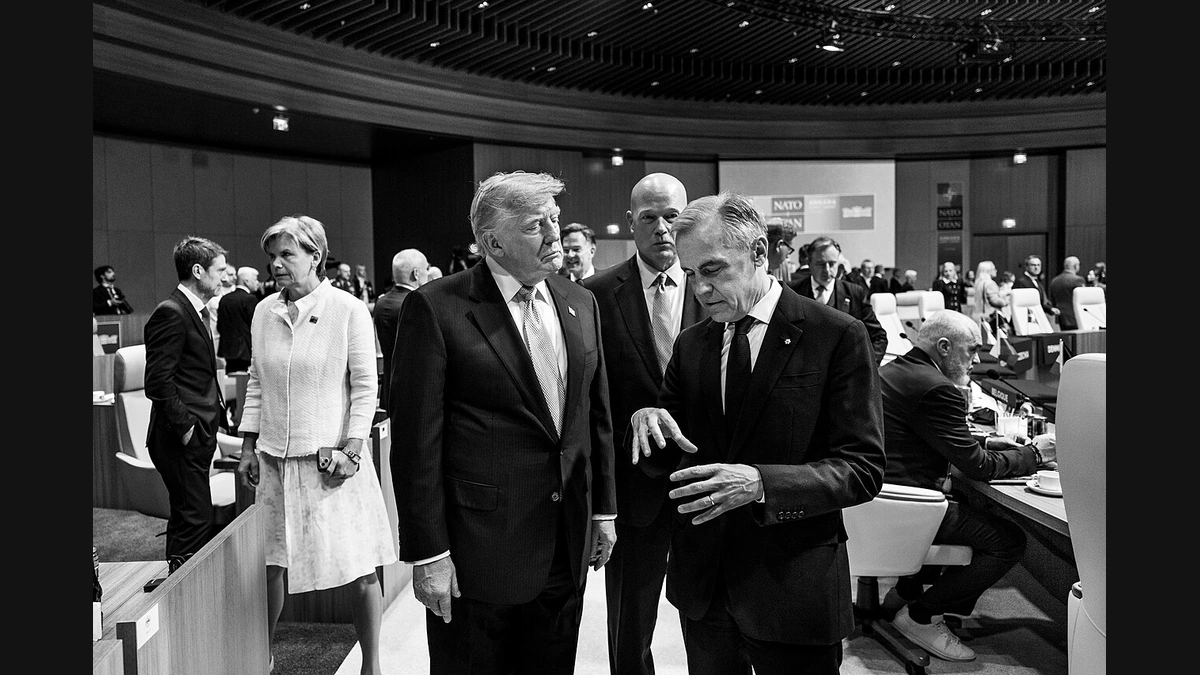
Canadian Prime Minister Mark Carney said Saturday that Canada and the United States were making progress toward a possible trade agreement after he spoke at length with President Donald Trump. He cautioned that the two countries had not reached a deal, and his comments left a major obstacle unresolved: tariffs affecting Canada’s automotive industry.
Carney spoke to reporters in Manila on November 14 while visiting the Philippines for meetings with Southeast Asian leaders. He described the recent conversation with Trump as substantive and said a bilateral agreement remained possible, without announcing terms, a timetable or relief from existing duties. His assessment offers a more encouraging signal than the collapse of formal negotiations in August, but it is not an agreement in principle.
The auto issue sets a practical limit on how far the latest diplomatic opening can be read as a breakthrough. Ottawa has repeatedly argued that an agreement must protect Canadian vehicle manufacturing and its extensive cross-border supply chain. A reduction in some tariffs would not necessarily settle the separate dispute over the treatment of cars and auto parts.
A fresh opening after negotiations broke down in August
Canada suspended trade negotiations with Washington on August 21 after Carney said last-minute changes to the U.S. proposal were unacceptable. His government described the demands as economically damaging and said they called into question whether a reliable agreement was possible. The breakdown came amid another U.S. tariff announcement covering a range of Canadian products, which Ottawa said it would answer with countermeasures.
In an address the following day, Carney outlined what Canada had sought from the negotiations: continued tariff-free access for most businesses under the Canada-United States-Mexico Agreement, lower duties on strategic industries and more predictable trading conditions. He said Ottawa had been prepared to lift its remaining retaliatory tariffs on steel, aluminum and autos if Washington substantially reduced corresponding U.S. tariffs. That was Canada’s account of the August offer, not a set of terms announced for the current talks.
The dispute also extends beyond individual tariff rates. The existing North American trade agreement, known as CUSMA in Canada and USMCA in the United States, governs preferential treatment for qualifying goods. In July, the Office of the U.S. Trade Representative said Washington would not renew that agreement in its existing form following the scheduled joint review. It also explicitly said the agreement remained in force, an important distinction from a withdrawal or termination.
Carney’s latest comments establish that direct discussions have continued after the August rupture. They do not identify which previous demands have been dropped, whether reciprocal tariff relief is on the table, or whether the parties are negotiating a narrow sector-specific arrangement or something broader. The difference matters to manufacturers deciding where to commit capital and how to price exports across the border.
Automotive tariffs remain the central test
Canada’s own retaliatory auto duties show why the dispute cannot be reduced to a single blanket tariff. According to the Department of Finance’s official automobile tariff guidance, Canada has imposed a 25% duty since April 9, 2025, on vehicles imported from the United States that do not meet CUSMA requirements. For compliant vehicles imported from the United States, the Canadian duty applies to the portion of value that is neither Canadian nor Mexican. These are Canadian countermeasures, not the tariff schedule Washington applies to vehicles entering the United States.
The distinction matters because North American auto production depends on parts and finished vehicles moving across the border under rules of origin. A vehicle assembled in one country can contain components manufactured in the other, and the applicable duty may depend on where the value was created. Reaching an agreement on headline tariff rates without clarifying treatment of qualifying vehicles could leave manufacturers facing substantial uncertainty.
The industry’s exposure is evident in the government’s employment and production figures. A November 13 announcement from Innovation, Science and Economic Development Canada said automotive manufacturing supports more than 120,000 direct jobs and contributed C$17.1 billion to Canadian gross domestic product in 2025. The government said Canada produced more than 1.2 million vehicles that year. These figures help explain why Ottawa treats automotive market access as an industrial concern rather than only a matter of customs revenue.
Manufacturing support has become a parallel response to the trade pressures. In October, Canada and Ontario announced C$2.5 billion of additional support over two years for large automotive capital projects, with federal and provincial funding. On November 13, Ottawa separately announced C$313 million toward Honda’s C$867 million plan to retool its Alliston, Ontario, operations, alongside a C$156 million provincial contribution. Neither announcement represents a reduction in U.S. tariffs, but both illustrate the investment decisions occurring while trade conditions remain unsettled.
Carney has said Canada will not accept a trade agreement that undermines its auto sector. That position does not establish what Washington is willing to offer, and no new bilateral arrangement was disclosed Saturday. For vehicle producers, the consequential details will be the treatment of finished cars, qualifying North American content and the longevity of any tariff relief, rather than the announcement of talks alone.
New Asian trade agreements run alongside the U.S. talks
Carney’s remarks came during a visit that also produced announcements about other trade relationships. In a November 14 statement, the Canadian government said it had substantially concluded negotiations for a free trade agreement with the Association of Southeast Asian Nations and completed negotiations on a separate agreement with the Philippines. Both are intended to be signed in 2027; neither should be described as a pact already in force.
The Canadian government estimates that the ASEAN agreement, once implemented, could add nearly C$2 billion to annual economic output and create almost 14,000 jobs. Those are official projections, not benefits already realized. Ottawa also says a Philippines agreement could increase Canadian exports to that market by as much as threefold by 2035. The projections depend on agreements being finalized, signed and brought into effect.
Diversification is an economic priority, but it cannot quickly remove Canada’s exposure to the U.S. market. Global Affairs Canada’s State of Trade 2026 reporting put the U.S. share of Canadian goods exports at 72%% in 2025, even as shipments to other markets increased. The North American automotive supply chain is particularly difficult to redirect because plants, parts suppliers and model production have been organized around cross-border trade for decades.
That helps explain why Ottawa is pursuing both tracks rather than treating new Asian markets as substitutes for negotiations with Washington. The government has a stated ambition to conclude the Asian agreements on a 2027 signing schedule. For the United States, Carney offered no corresponding date and said the outstanding differences, including the future of the auto sector under tariffs, had not yet been resolved.
More News



Latest News
View all news- Nasdaq Expands Public Disclosure of Disciplinary Cases as $10,000 Threshold Is Removed
- Switzerland’s New Payment Standards and QR-Bill Rules Take Effect
- Singapore Issues First International Carbon-Credit Project Authorization Under Rwanda Agreement
- Canada Concludes Philippines Free-Trade Talks and Nears Agreement With ASEAN
- U.S. Producer Prices Rise 6.5% Annually in October, Fastest Pace Since November 2022
