Elevra Lithium Releases PFS for Major North American Lithium Expansion in Quebec
The study outlines a C$366 million staged expansion that would lift average annual post-expansion spodumene concentrate production to 373,000 tonnes while lowering unit costs.
Our editorial standards
MarketReview publishes clear, independently produced financial information using reliable sources and transparent editorial standards.
Read our Editorial Policy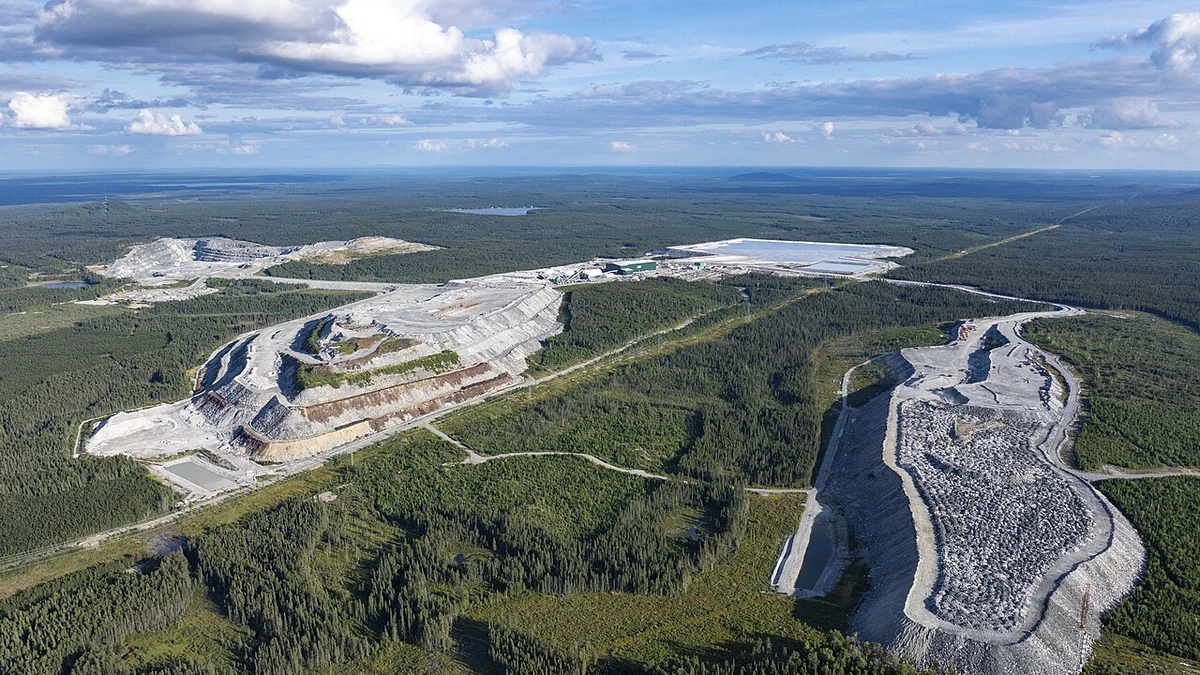
Elevra Lithium has completed a pre-feasibility study for a three-stage expansion of its North American Lithium mine in Quebec, outlining C$366 million of initial capital spending and average annual post-expansion production of 373,000 tonnes of 5.4% lithium oxide spodumene concentrate. The study estimates an expansion-only post-tax net present value of C$943 million at an 8% discount rate, a 49.9% post-tax internal rate of return and a 34-month post-tax payback period.
The PFS gives Elevra a more detailed technical and economic basis for a brownfield growth plan that was previously evaluated at scoping-study level. The company has already begun early execution work, but the new figures remain study estimates rather than guaranteed construction or operating outcomes. Its C$366 million initial capital estimate is classified as AACE Class 4, with a stated target accuracy range of plus or minus 40%.
Elevra published the PFS through its investor announcements channel on September 7. The plan keeps the three-stage sequence announced earlier in 2026, while updating expected production, costs, reserves and project economics.
Higher output is the biggest change from the May study
Production is where the new study differs most clearly from Elevra’s May work. Average annual post-expansion output is now forecast at 373,000 tonnes of spodumene concentrate, nearly double the 199,000-tonne average in the no-expansion base case. The new figure is also about 10% above the 338,000 tonnes estimated in the updated scoping study released in May.
Elevra attributed the increase above the May estimate largely to higher expected mill feed grades associated with ore sorting. Across the full mine life, average annual concentrate production is projected at 348,000 tonnes under the expansion case, compared with 196,000 tonnes under the base case. That distinction matters because 373,000 tonnes is the average after the expanded operation has ramped up, not the average over every year of the mine plan.
Existing Proven and Probable Ore Reserves support the entire production target in the PFS. Elevra reported 47.2 million tonnes of reserves grading 1.12% Li2O, including 0.2 million tonnes Proven and 47.0 million tonnes Probable, supporting a revised 20-year mine life. No Inferred Mineral Resources were included in the production target or economic analysis.
Because North American Lithium is already operating, the proposed scale-up would build on an open pit, concentrator and established infrastructure rather than start with a greenfield mine. Elevra owns 100% of the operation, which sits in Quebec’s Abitibi-Temiscamingue region about 60 kilometers north of Val-d’Or. The site has road and rail access and uses Quebec’s hydroelectric power system.
Recent operating results provide a useful reference point for the size of the proposed increase. In Elevra’s FY26 results filed with the SEC, North American Lithium produced 197,967 dry metric tonnes of spodumene concentrate, with mill utilization averaging 91% and lithium recovery averaging 67%. The PFS therefore describes a post-expansion production level that would be close to twice the mine’s most recent full-year output.
C$366 million initial capital remains fully funded
Elevra kept the initial capital estimate at C$366 million, or about US$271 million using the exchange rate in the study. That total includes C$73 million of contingency. The company allocated C$92 million to Stage 1, C$101 million to Stage 2 and C$173 million to Stage 3.
C$366 million is not the only future spending associated with the expanded operation. The PFS also estimates C$527 million of sustaining expenditure over the expansion case. Its financial model is unlevered and based on the reserves estimated for the study, so financing costs are not part of the project-level return figures.
Funding for the build was arranged before the PFS was released. In May, Elevra completed a A$275 million institutional placement and agreed to a C$145 million convertible-note investment from Canada Growth Fund across two tranches. Elevra has repeatedly described that financing package as sufficient to fully fund the staged NAL expansion under its current plan.
Compared with May, the updated economics show a modest reduction in the value assigned specifically to the expansion. The expansion-only post-tax NPV at an 8% discount rate is now C$943 million, down from C$969 million in the updated scoping study. Elevra said the reduction was driven primarily by a roughly 4% increase in estimated mining costs after more detailed haulage modelling.
For the entire post-expansion operation, the PFS estimates a post-tax NPV of C$3.218 billion. That figure is different from the C$943 million incremental NPV, which isolates the value attributed to expanding the existing operation rather than valuing the entire mine plan. Keeping those two measures separate is important when assessing how much value the study assigns specifically to the additional capital program.
Unit-cost estimates also move lower as throughput rises. Elevra forecasts life-of-mine C1 operating costs of C$876 per tonne of concentrate in the expansion case, versus C$1,048 per tonne in the base case. After the expansion is operating, the study puts C1 costs at about C$851 per tonne and all-in sustaining costs at C$918 per tonne. Those estimates remain sensitive to commodity prices, foreign-exchange rates, head grades and recoveries, all of which the company identifies as important variables in the financial model.
Three stages push first production growth into mid-2027
Rather than wait for a single large plant expansion to be completed, Elevra plans to add capacity in steps. Stage 1 is scheduled to lift process-plant throughput to the currently permitted rate of 4,500 tonnes per day from mid-2027. Elevra expects that work to increase annual spodumene concentrate production by about 15% to 20% from current levels while also reducing unit costs.
Stage 2 is planned for mid-2028 and would expand milling, flotation and filtration capacity to 6,500 tonnes per day. Additional ore would initially be handled with a temporary mobile crushing circuit. Stage 3, targeted for completion in mid-2029, would replace the temporary and existing crushing circuits with a permanent crushing system sized for the expanded mill and add further ore-sorting capacity.
Engineering work has already moved beyond the scoping stage. Sedgman said in August that it was carrying out a comprehensive feasibility study for the expansion and had received the detailed-design mandate for Stage 1, including work across crushing, milling, magnetic separation, flotation, filtration, dewatering and ore sorting. Elevra had also broken ground in June and ordered long-lead equipment as part of its effort to protect the development schedule.
Attention now shifts to the continuing feasibility and detailed-design work rather than another high-level concept study. The PFS narrows the expected economics and production profile, but the accuracy range on capital costs and the sensitivity of returns to lithium prices, exchange rates and operating performance leave meaningful variables to be resolved as engineering and construction progress toward the first planned throughput increase in mid-2027.
More from Investing

Latest News
View all news- China Warns of Countermeasures Over Proposed U.S. Investment Restrictions
- USDA Explains Corn Forecast Error After Review of Kansas and Nebraska Data
- Johnson & Johnson Reports 62% Lower Risk of Prostate Cancer Recurrence or Death in PROTEUS Substudy
- Thailand Reports $690 Million in Advanced Materials Investment Projects as AI and EV Demand Grows
- Egypt Details Startup Action Plan Targeting $5 Billion in Venture Capital and 5,000 Firms