
HomeTrust Bancshares to Acquire Blue Ridge Bankshares in $448 Million All-Stock Deal
HomeTrust says the merger can produce 29.8% run-rate EPS accretion once cost savings are fully phased in, against 8.3% tangible-book-value-per-share dilution and a 3.25-year earnback.
Our editorial standards
MarketReview publishes clear, independently produced financial information using reliable sources and transparent editorial standards.
Read our Editorial Policy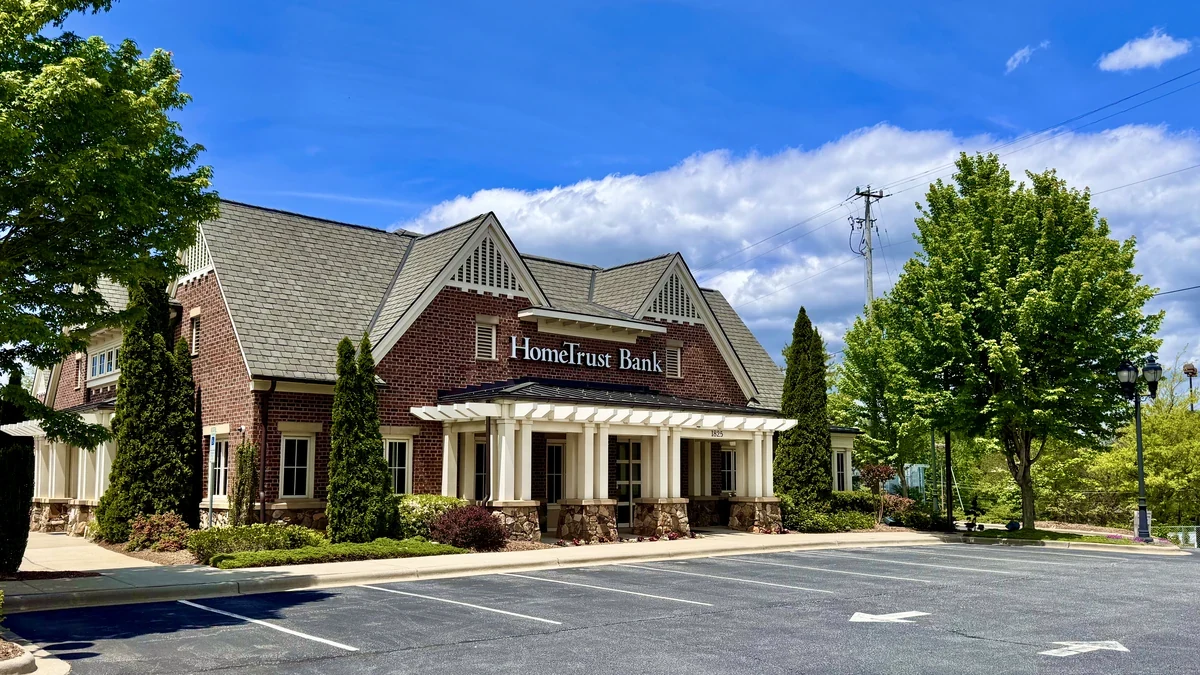
HomeTrust Bancshares has agreed to buy Blue Ridge Bankshares in an all-stock deal valued at about $448.1 million, but the headline deal price is only part of the case HomeTrust is asking its shareholders to accept. Management’s financial model says the acquisition can lift HomeTrust’s earnings per share sharply once planned cost cuts are in place, even though the merger is expected to reduce tangible book value per share at closing.
Blue Ridge shareholders will receive 0.086 HomeTrust shares for each Blue Ridge share. Based on HomeTrust’s five-day volume-weighted average price of $49.82 through August 14, that equates to $4.28 per Blue Ridge share and roughly $448.1 million of aggregate consideration. The companies’ August 17 SEC filing says both boards unanimously approved the merger, which is expected to close early in the first quarter of 2027, subject to shareholder and regulatory approvals.
The central trade-off is unusually explicit. HomeTrust projects 23.2% EPS accretion for 2027 under its modeled phase-in of savings and 29.8% run-rate accretion when the full cost-reduction plan is reflected. Against that, it estimates tangible book value per share will be diluted by 8.3% at closing, with a 3.25-year earnback period. Those are management projections rather than guaranteed outcomes, and they depend heavily on integration, purchase-accounting and cost-saving assumptions.
The 30% EPS case is mostly an integration story
HomeTrust’s investor presentation shows how the earnings case is constructed. The model starts with $61.4 million of 2027 HomeTrust net income to common shareholders based on consensus estimates and $20.6 million of Blue Ridge net income based on management projections. It then adds $36.1 million of after-tax acquisition adjustments to reach pro forma net income of $118.0 million.
The largest pieces of that adjustment are $19.0 million of after-tax cost savings and $21.8 million of purchase-accounting adjustments. Those benefits are partly offset by $4.3 million of new intangible amortization and $0.7 million of financing cost, with a $0.3 million benefit from reversing Blue Ridge’s existing intangible amortization. On a pro forma diluted share count of about 25.0 million, HomeTrust calculates 2027 EPS of $4.72, 23.2% above the $3.83 standalone HomeTrust consensus estimate. If all planned cost savings are treated as fully phased in, the modeled EPS rises to $4.97, or 29.8% accretion.
That distinction matters. The joint release describes approximately 30% EPS accretion once anticipated cost savings are fully achieved, while the presentation shows the reported 2027 estimate at 23.2% and uses the 29.8% figure as a run-rate illustration with the full savings included. HomeTrust says 75% of the planned cost reductions are expected to be phased in during 2027 and 100% thereafter.
The savings assumption is substantial. HomeTrust is modeling reductions equal to more than 45% of Blue Ridge’s noninterest expense, and it says revenue synergies are expected but are not included in the model. That gives the earnings case some protection against relying on new revenue, but it also places more weight on HomeTrust’s ability to remove overlapping costs without losing customers, deposits or productive bankers.
Blue Ridge has already been cutting expenses before the merger. In its revised second-quarter results, the bank reported noninterest expense of $15.9 million, down from $18.7 million in the first quarter and $22.0 million a year earlier. Headcount fell to 269 from 333 a year earlier. Blue Ridge also reported a $1.3 million quarterly net loss after increasing credit-loss reserves for an $11.4 million out-of-market borrower whose business had ceased operations.
That does not invalidate HomeTrust’s savings target, because merger savings can come from duplicated public-company costs, systems, facilities, vendors and management functions that a standalone turnaround cannot remove in the same way. It does mean investors will eventually need to compare the announced target with a Blue Ridge expense base that has already been shrinking. The future Form S-4 and proxy materials should provide more detail on how the companies expect those savings to be achieved.
Why an all-stock deal can still dilute tangible book value
The 8.3% tangible-book-value-per-share dilution is the other side of the merger math. An all-stock acquisition avoids a large cash payment, but it does not prevent book-value dilution when the buyer issues shares to acquire a bank at a premium to its adjusted tangible equity and then records goodwill and other purchase-accounting items.
HomeTrust’s presentation puts Blue Ridge’s common equity at closing at an estimated $285.3 million. After adjustments for projected intangibles, transaction expenses, purchase-accounting marks and deferred taxes, Blue Ridge’s adjusted tangible equity is modeled at $237.6 million. Against the $448.1 million deal value, that leaves an implied premium of $210.5 million. After allocating a net $23.4 million to a core deposit intangible, HomeTrust expects to record about $187.1 million of goodwill.
The presentation quotes the deal at 140% of Blue Ridge tangible book value per share under the stated share-count assumptions. When the full impact of Blue Ridge’s warrants is included, the aggregate deal value is 164% of tangible book value. The warrant treatment is important because holders of about 25% of Blue Ridge’s outstanding warrants have already agreed to convert them into common stock at closing, while the remaining holders can choose the same treatment or roll their warrants into new HomeTrust warrants on equivalent terms.
HomeTrust says the 8.3% tangible-book dilution calculation assumes roughly 25% of the warrants convert into common stock at the exchange ratio and the remaining roughly 75% roll into HomeTrust warrants. Its 3.25-year earnback calculation includes the full impact of warrant dilution. The company also models $32.8 million of pre-tax transaction expenses, equal to 7.3% of the announced deal value.
Several purchase-accounting marks feed the earnings and book-value calculations. HomeTrust assumes a $24.5 million gross credit mark, equal to 1.2% of Blue Ridge’s loan portfolio, and a $51.0 million interest-rate mark on loans, equal to 2.6% of the portfolio, amortized over four years. It also models a core deposit intangible equal to 2.75% of non-time deposits and a $46.4 million mark on available-for-sale securities that would accrete over 4.6 years. Those estimates can change before closing as balance sheets, rates and credit conditions move.
For bank investors, the 3.25-year earnback period is the bridge between the two headline metrics. HomeTrust is effectively arguing that accepting an immediate decline in tangible book value per share is worthwhile if the larger earnings base restores that lost book value in a little more than three years and then continues producing higher per-share earnings. Whether that happens on schedule will depend on how close realized cost savings, credit marks, deposit retention and purchase accounting come to the current model.
Blue Ridge brings scale, but the turnaround is part of the risk
The strategic rationale is broader than the accounting. HomeTrust had $4.4 billion of assets at June 30, while Blue Ridge had about $2.3 billion. The combined company is expected to have more than $7 billion of assets, about $5.7 billion each of loans and deposits, and more than 60 locations across the Southeast. HomeTrust would gain a much larger Virginia presence, including Richmond, Charlottesville and Hampton Roads.
HomeTrust also points to a difference in funding economics that it believes can be improved after the merger. At June 30, HomeTrust’s loan yield was 6.12% and its cost of deposits was 1.73%, compared with a 5.54% loan yield and 2.25% deposit cost at Blue Ridge. The pro forma presentation shows a combined loan yield of 5.92% and deposit cost of 1.91%. HomeTrust says portfolio remixing and its operating infrastructure create room to improve those economics, although the forecast does not guarantee that deposit costs or asset yields will move as planned.
Blue Ridge enters the deal after a difficult restructuring period. The Office of the Comptroller of the Currency terminated its January 2024 cease-and-desist order in November 2025. That order had addressed Bank Secrecy Act and anti-money-laundering compliance as well as capital, liquidity-risk and information-technology control issues. HomeTrust’s deal materials say Blue Ridge raised $160 million of capital in May 2024 as part of its remediation and later returned $77 million to shareholders through special dividends.
Blue Ridge has also exited fintech and banking-as-a-service partnerships and reduced out-of-market and specialized-finance lending. Its second-quarter loan portfolio grew for the first time in 13 quarters, but the revised results also showed nonperforming loans rising to $31.2 million, or 1.34% of total assets, largely because of the newly troubled $11.4 million relationship. HomeTrust says it reviewed 64% of Blue Ridge’s commercial loan portfolio, 42% of the total loan portfolio and 87% of classified loans during due diligence.
The result is a merger in which the expected earnings lift is not simply a function of adding two banks together. HomeTrust is paying a premium for a Virginia franchise that has already been recapitalized and de-risked, then relying on another layer of cost removal and balance-sheet optimization to generate the targeted per-share return. The presentation’s 29.8% run-rate EPS accretion is therefore best read alongside the 8.3% tangible-book dilution, the 3.25-year earnback and the more than 45% expense-saving assumption rather than as a standalone forecast.
The next formal milestones are the companies’ Form S-4 registration statement and joint proxy materials, followed by shareholder and regulatory approvals. Blue Ridge warrant holders who have not already agreed to convert have until September 19 to elect the cashless conversion arrangement offered in connection with the merger. If the approvals are obtained, the companies expect to close the merger early in the first quarter of 2027.
More from Banking


Latest News
View all news- USDA Releases October Crop Supply and Demand Estimates for Global Grain Markets
- U.S. Consumer Sentiment Falls to 46.3 as Inflation Expectations Rise
- Swiss-Ukraine Reconstruction Agreement Takes Effect, Opening Procurement Route for Swiss Firms
- U.S. Commerce Department Finalizes South Korean Hot-Rolled Steel Subsidy Review
- Treasury Names Judy Shelton Counselor on Currency Policy, With China Focus
