
India Sets LPG Production Targets as Middle East Supply Disruptions Threaten Cooking Gas
The August 13 framework sets a 63,810-ton maximum daily LPG production level and requires refiners to maintain storage and transport capacity for supply emergencies.
Our editorial standards
MarketReview publishes clear, independently produced financial information using reliable sources and transparent editorial standards.
Read our Editorial Policy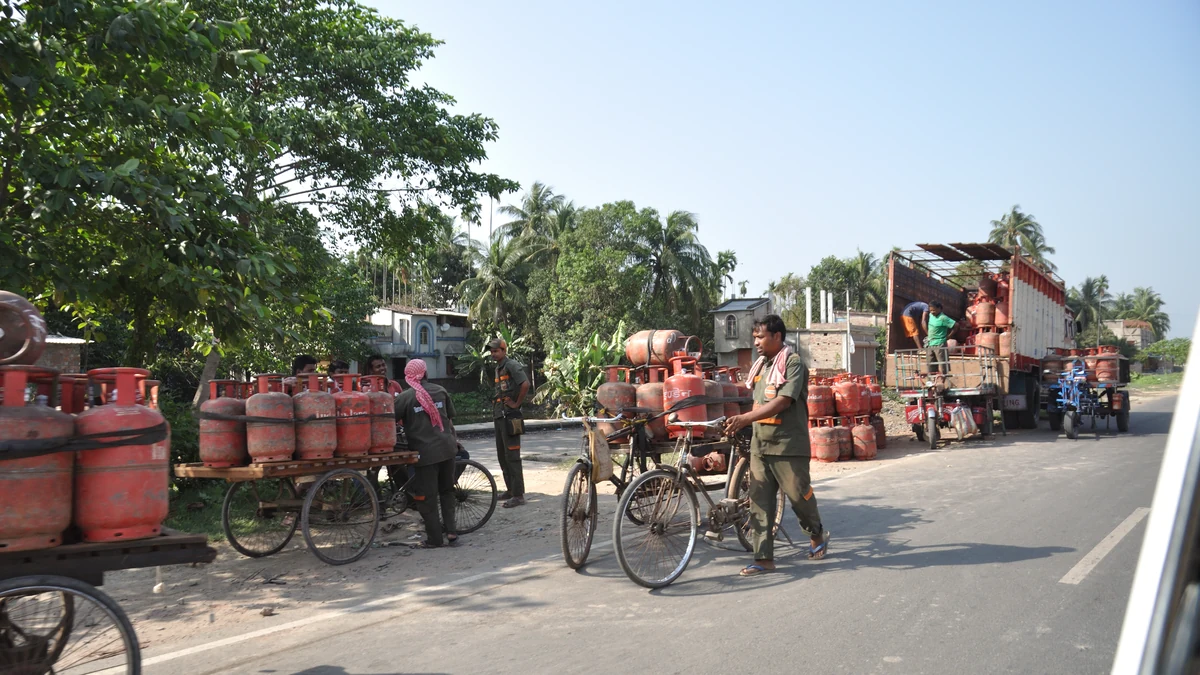
India has created a new crisis-time framework for liquefied petroleum gas production, setting a maximum daily target of 63,810 metric tons across state-run and private refiners as well as upstream producers. The measure is intended to give the government more domestic supply to call on when imported cooking gas is constrained, after the conflict involving the United States, Israel and Iran disrupted energy flows from the Middle East earlier this year.
The target is not the same as an instruction for every listed facility to produce at its maximum every day. It establishes production levels that can be activated when supply conditions require them. That distinction matters because India still depends heavily on imported LPG, and the domestic system has already been running above its pre-crisis production rate for months.
Reuters reported after reviewing the August 13 government order: Companies will also have to maintain adequate infrastructure to store and move the specified LPG volumes, either through their own facilities or with rail and road-tanker capacity. The government plans to update the targets every January and July as new production comes online or existing plants add output.
The new order creates a crisis-time production ceiling
Reliance Industries has been assigned the largest individual target under the framework, with its domestic-market-focused refinery required to be capable of producing as much as 18,000 tons of LPG a day. State-run upstream producers Oil and Natural Gas Corporation and Oil India, together with gas utility GAIL, are expected to provide roughly one-tenth of the nationwide target, according to Reuters.
The 63,810-ton figure is best read as emergency production potential rather than the country’s normal daily output. That makes the order an extension of measures New Delhi began using when the Middle East disruption first hit LPG supplies, but with a more formal facility-level structure and a recurring review schedule.
India had already pushed domestic LPG output sharply higher earlier in the crisis. In June, Petroleum and Natural Gas Minister Hardeep Singh Puri said production had risen from about 32,000 metric tons a day before the disruption to nearly 52,000 metric tons a day. The new maximum target is about 23% above that June level, showing that the government wants additional headroom if imports tighten again.
The earlier response also changed how feedstocks were used inside refineries. The government directed refiners to prioritize propane and butane streams for LPG instead of diverting them into petrochemical production. It also gave domestic cooking-gas users priority as officials tried to protect household supply. In an official June update, the Petroleum Ministry said the country had maintained supplies while raising refinery LPG production and encouraging greater use of piped natural gas where available.
The latest order makes those emergency tactics more systematic. Instead of relying only on broad instructions to maximize output, the government now has a set of company-level production limits and an infrastructure requirement that can be used when supply constraints emerge. It also creates a clearer basis for revising capacity as refinery configurations change.
Hormuz disruption exposed India’s import dependence
The policy is rooted in the scale of India’s reliance on overseas LPG. Reuters reported in July, citing government data, that India imported about 21.85 million metric tons of LPG in 2025 and that imports accounted for roughly 66% of consumption. About 90% of those imports came from the Middle East.
That concentration became a problem after the war disrupted traffic through the Strait of Hormuz, a key route for Gulf energy exports. The interruption produced what Reuters described as India’s worst LPG shortage earlier in 2026 and forced the government to redirect refinery feedstocks toward household cooking gas.
The impact was visible in trade and demand data. India’s LPG imports fell about 28% from a year earlier to roughly 7.5 million tons in the first six months of 2026, while consumption declined about 8% to around 14.7 million tons, according to provisional government data cited by Reuters. Lower availability, rather than a normal cyclical decline in demand, was a major part of that contraction.
New Delhi has been trying to reduce the concentration risk on more than one front. State refiners are preparing to increase purchases from the United States, with Reuters reporting in late July that India could source as much as one-quarter of its LPG imports from the U.S. in 2027. U.S. LPG shipments to India exceeded 1 million tons in June for the first time, according to the same report.
Domestic production targets do not remove the need for imports. Even a higher refinery contribution cannot quickly replace a market in which imported LPG has supplied most consumption. The new framework instead gives policymakers another buffer: more domestic output can be called on during a shipping disruption while import sources are diversified and alternative fuel networks expand.
Storage, transport and diversification are part of the response
The logistics requirement in the August order is as important as the production numbers. Producing more LPG does little to protect households if refiners cannot store it, load it into the distribution system or move it quickly to the regions that need it. By requiring adequate storage and transport arrangements, the government is tying emergency output capacity to the physical ability to deliver the fuel.
That approach fits a broader energy-security push that has accelerated since the Hormuz disruption. India and Japan said in July that they would deepen cooperation on strategic stockpiling, emergency response, third-country energy supplies and maritime transport. India has also encouraged faster adoption of piped natural gas, which can reduce pressure on cylinder-based LPG demand in areas where distribution networks already exist.
The policy also highlights a trade-off for refiners. Propane and butane can be valuable petrochemical feedstocks, so directing more of those streams into LPG can affect downstream production economics. The government used that lever during the shortage because cooking gas is an essential household fuel, but maintaining high LPG output for long periods can carry opportunity costs for other refinery and petrochemical operations. The new system is therefore designed around supply constraints rather than a permanent assumption that every facility should run at the maximum LPG setting.
For consumers, the immediate significance is not that 63,810 tons of LPG will suddenly appear in the market every day. The change is that the government has defined how much individual producers may be required to supply and what logistics they must have available if imports are interrupted again. That gives New Delhi a more explicit emergency mechanism after a year in which Middle East shipping risk moved from a theoretical concern to a direct constraint on cooking-gas supply.
The order calls for the production targets to be reviewed every January and July. Under that timetable, January 2027 is the next scheduled point at which the government can formally incorporate new refinery capacity or additional LPG output into the framework.
More News



Latest News
View all news- U.S. Commerce Department Finalizes South Korean Hot-Rolled Steel Subsidy Review
- Treasury Names Judy Shelton Counselor on Currency Policy, With China Focus
- U.S. Opens Proposed Gulf Offshore Oil and Gas Lease Sale 4 for Review
- Federal Reserve Reports Rising Household Financial Stress Despite Gains in Income and Wealth
- Canada Employment Falls in September as Unemployment Rises to 6.5%
